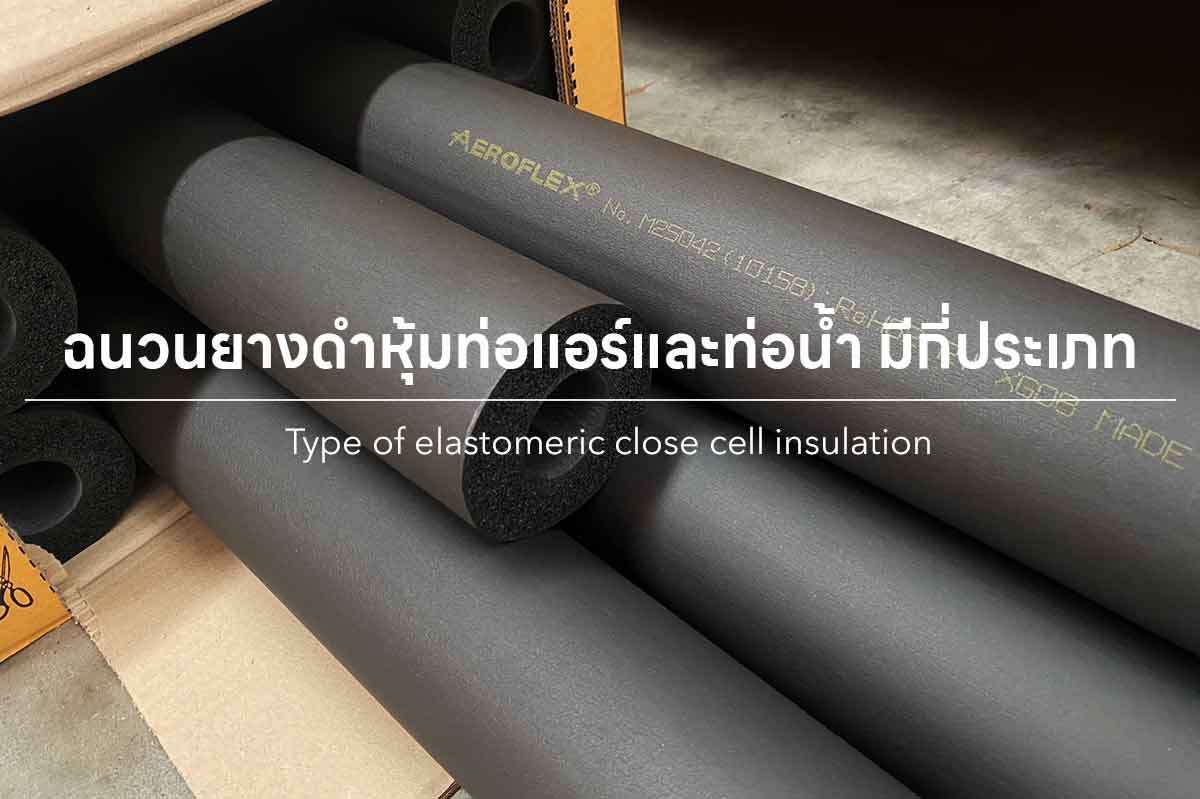
What are the types of black rubber insulation for air conditioning and chilled water pipes (Close cell insulation)?
Black rubber insulation is manufactured from synthetic polymer rubber and extruded into tube and sheet forms. It has low thermal conductivity and a closed-cell structure that prevents water penetration, making it ideal for cooling systems to maintain system temperature.
How many types of black rubber insulation are there?
We can divide commonly used black rubber insulation into 2 types:
- Classified by fire propagation characteristics
- Classified by rubber type
Classified by fire propagation characteristics
Fire propagation and flammability of construction materials is a critical consideration. For piping systems running throughout buildings, if materials attached to pipes are flammable and can spread fire, it can cause rapid fire spread throughout the building.
Therefore, materials used in piping and air duct systems must be non-flammable or non-fire-propagating, with self-extinguishing properties to prevent fire spread along pipes. Black rubber insulation is typically tested according to BS 476 Standard (British Standard 476 Fire Test)
Class 1: Black rubber insulation that passes BS 476 Part 7 is called Class 1
BS 476 Part 7 testing evaluates surface flame spread
- We measure the time it takes for flames to spread past reference lines
- We measure the spread distance after 1 minute 30 seconds
- We measure the total spread distance until test completion (10 minutes or less)
From the image below, at 1 minute 30 seconds, fire spread is classified into 4 levels
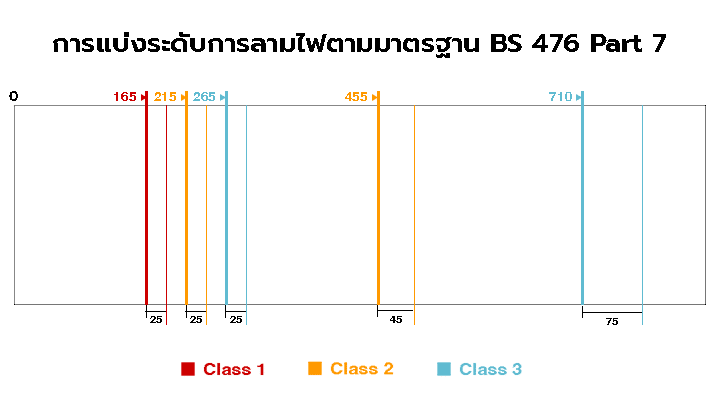
BS 476 part 7 standard testing for surface flame spread
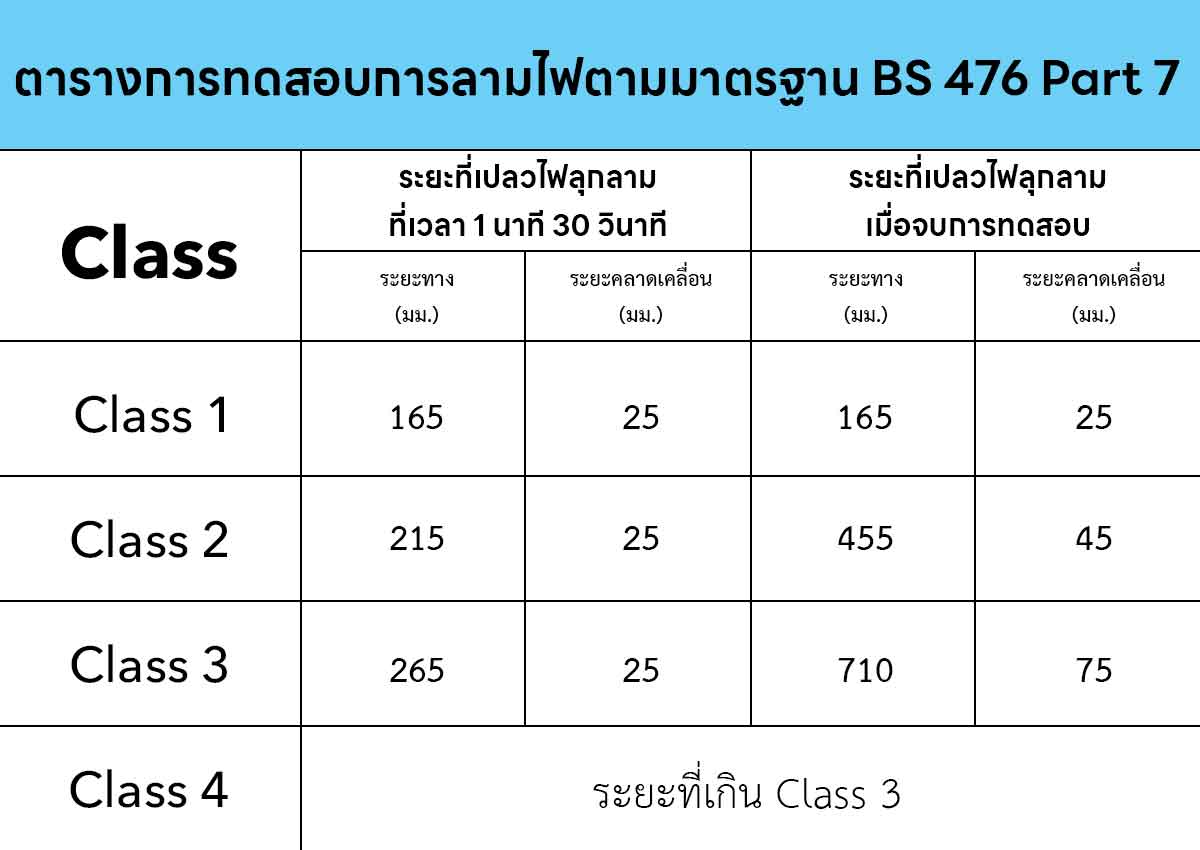
Surface flame spread test table according to BS 476 Part 7
Examples of close cell class 1 air conditioning pipe insulation
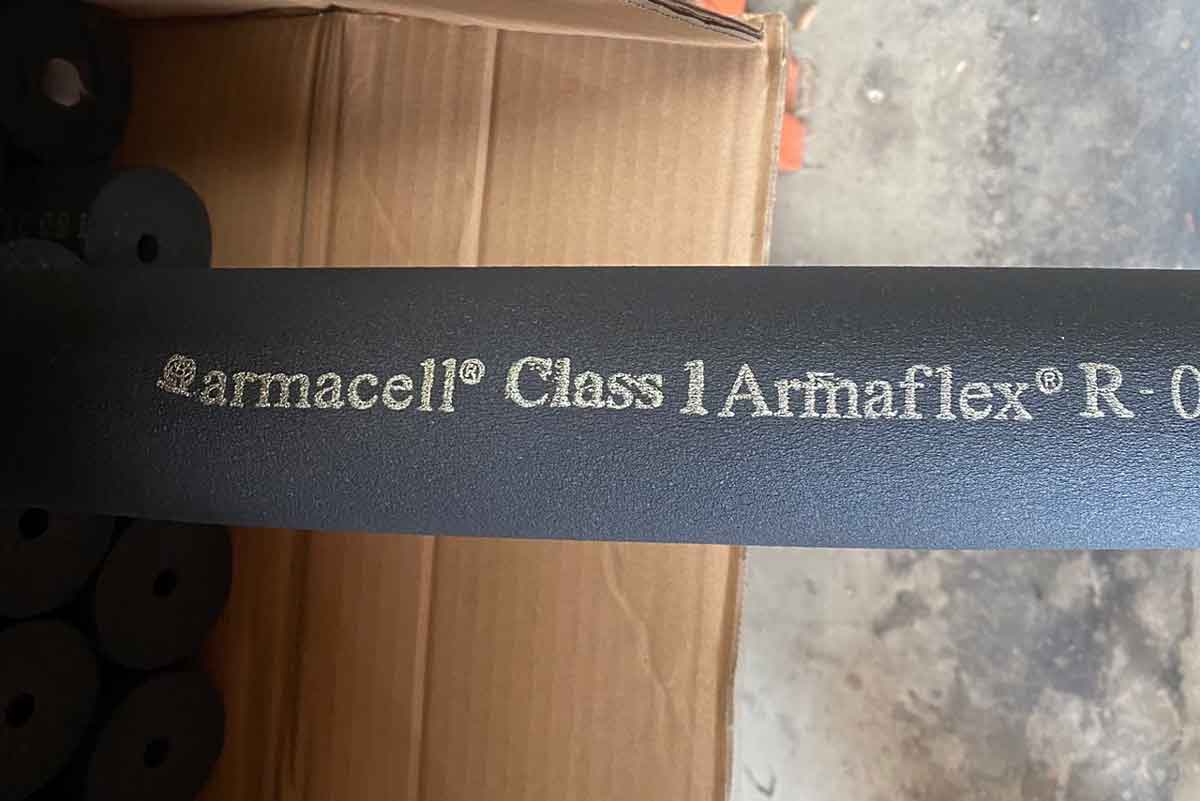
Standard Armaflex black rubber insulation has Class 1 fire protection
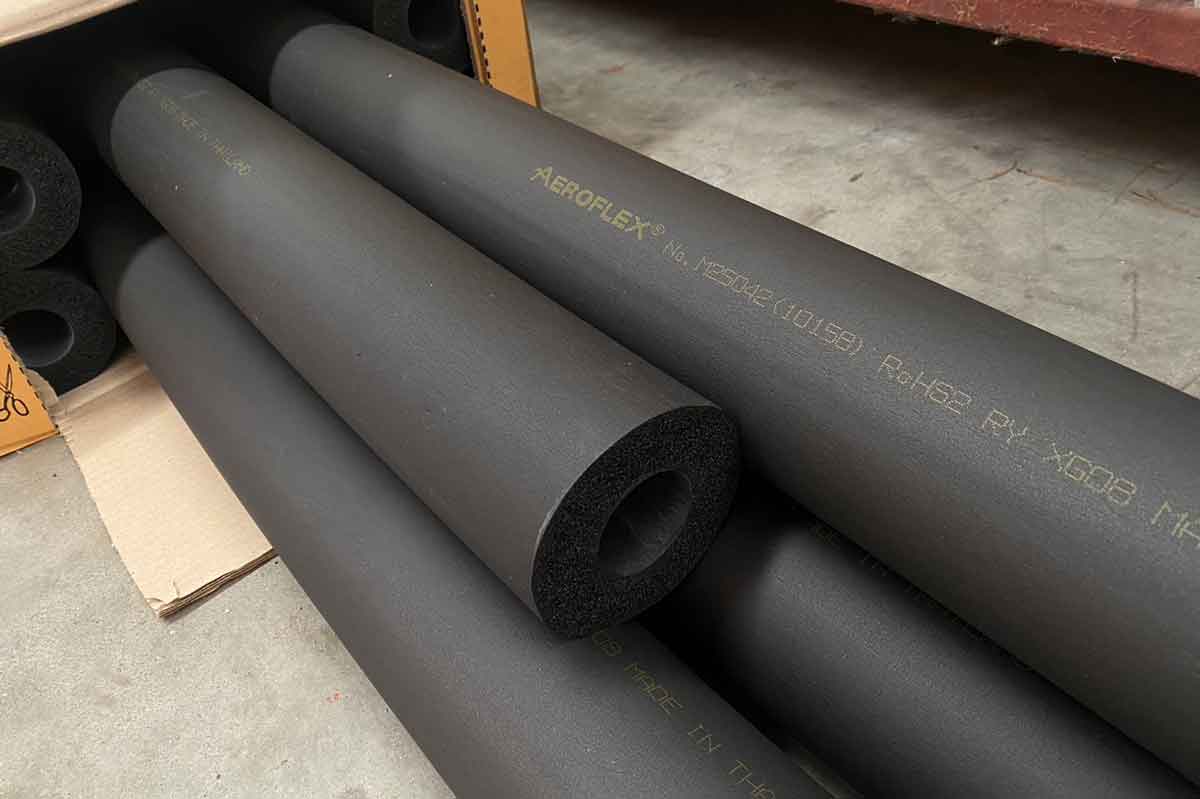
Standard Armaflex black rubber insulation has Class 1 fire protection
Class 1 certified black rubber insulation
- Armaflex Class 1 black rubber insulation – armacell
- aeroflex standard black rubber insulation – aeroflex
- maxflex fr black rubber insulation – maxflex
Class 0: Black rubber insulation that passes both BS 476 Part 6 and BS 476 Part 7 is called Class 0
We heat the material for 20 minutes while continuously measuring temperature to calculate the Fire Propagation index (I) and sub-indices i1, i2, i3
Materials certified as Class 0 must have an I value less than 12 and i1 less than 6
Class 0 certified black rubber insulation
- Armaflex Class 0 black rubber insulation – armacell
- aeroflex FO black rubber insulation – aeroflex
FM APPROVED: Black rubber insulation that passes FM 4924 standard is called FM APPROVED standard
The FM testing doesn’t use small samples like other standards, but tests actual installations on real pipe systems, burning the entire system for 10 minutes. For materials to pass FM 4924 standard
- Flames must not spread to pipe ends
- Temperature must not exceed 300°C
- Burned insulation that falls from the system must self-extinguish within 10 seconds of hitting the ground
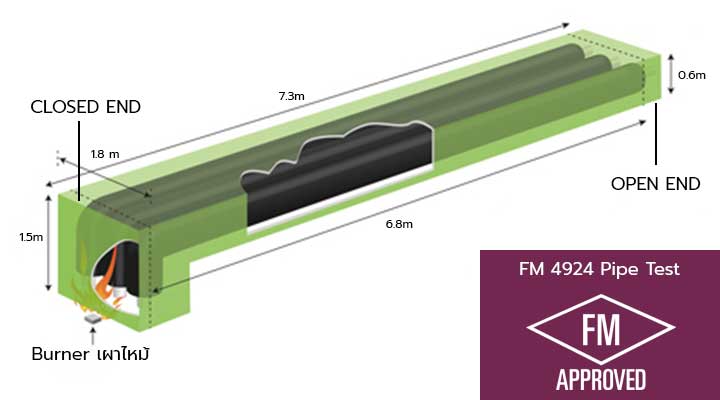
FM Approved standard testing - Source: Armacell Thailand
Examples of FM Approved air conditioning pipe insulation
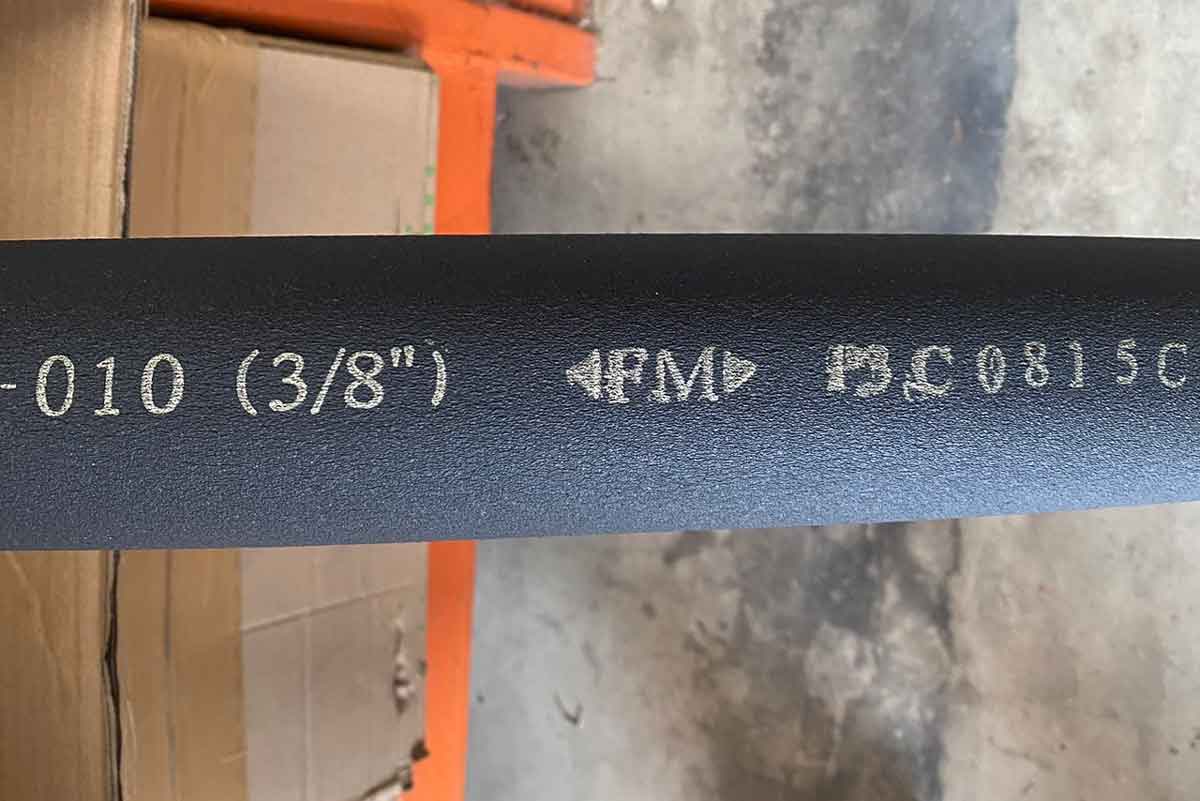
FM Approved certified black rubber insulation
- Armaflex Class 1 black rubber insulation – armacell
- aeroflex FO black rubber insulation – aeroflex
- Maxflex FR FM approved black rubber insulation – maxflex
Classification by rubber material type
Black rubber insulation is made from 2 types of base materials:
Both types are synthetic rubbers with similar thermal conductivity of 0.032 – 0.039 W/m.K and are suitable for air conditioning systems
Differences between NBR and EPDM insulation
While both materials are polymers with similar properties and can be used interchangeably, there are still distinct differences
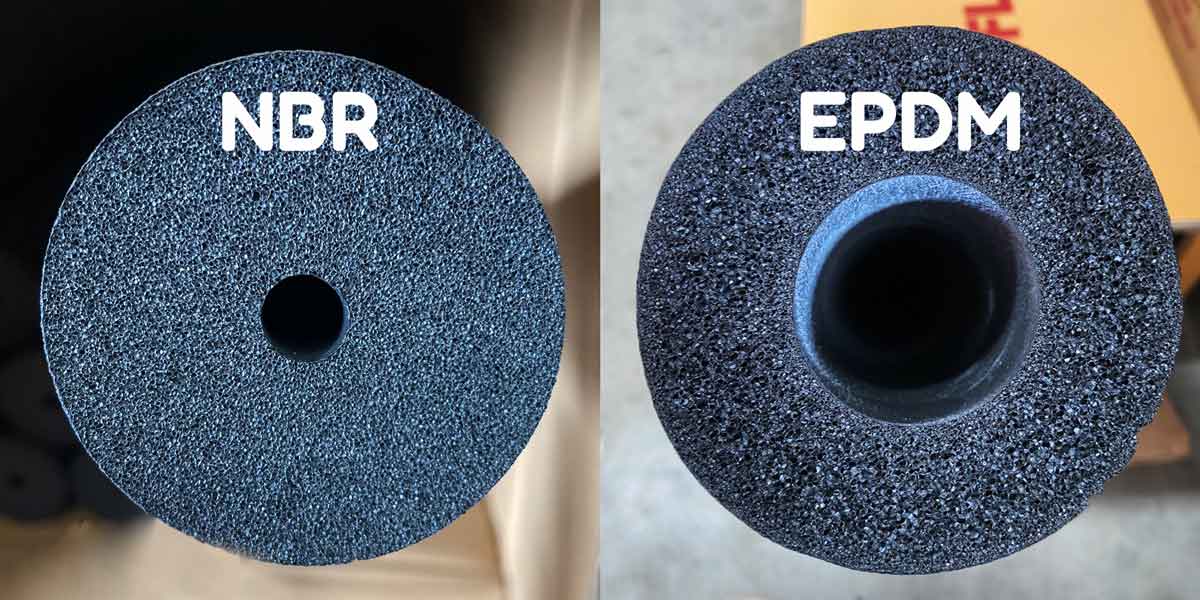
Comparison of NBR and EPDM black rubber insulation materials
Comparison table of NBR and EPDM insulation differences
|
Properties |
NBR type black rubber insulation |
EPDM type black rubber insulation |
|---|---|---|
|
Thermal Conductivity |
0.032 – 0.039 W/m.K |
0.032 – 0.039 W/m.K |
|
Service Temperature |
-57 – 105 °C |
-57 – 150 °C |
|
Cell Characteristic |
Uniform cell size providing consistent properties throughout |
Smaller cells at surface, larger cells in center, making EPDM surface more durable |
|
UV Resistance |
7 days UV resistance without jacketing |
28 days UV resistance without jacketing |
|
Water Vapor Diffusion Resistance Factor |
μ = 10,000 |
μ = 3,000 – 4,000 |
|
Flexibility |
Soft texture with smooth surface |
Firmer than NBR type |
* Comparison table based on ArmaFlex Class1 and HT/ArmaFlex material properties
Black rubber insulation by rubber type
- NBR black rubber insulation – Armaflex class 1
- EPDM black rubber insulation – Aeroflex , Maxflex , HT/Armaflex
How to prevent condensation when insulating
Condensation occurs when there is high water vapor in the air and temperature drops to the dew point. Three factors affect condensation:
- Ambient Temperature
- Relative Humidity in the air
- Dew Point
Given an air temperature of 32°C and 70% relative humidity (Point 1), the Psychrometric Chart shows the dew point at 25.8°C and 100% relative humidity (Point 2)
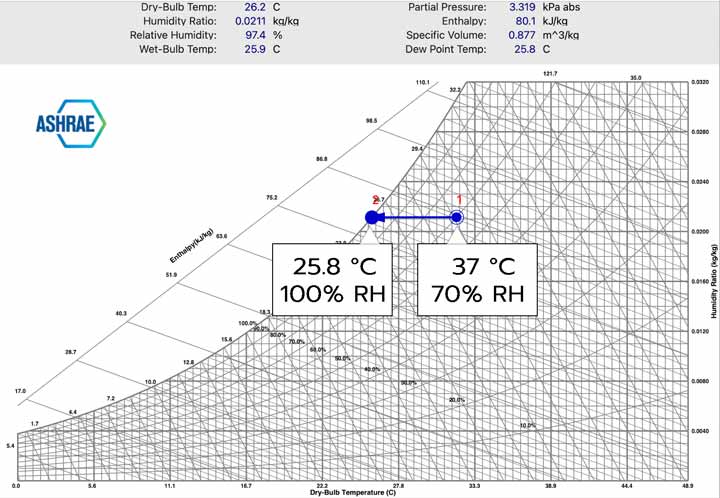
Psychrometric Chart graph
We can conclude that air will condense at 25.8°C, so we must insulate air ducts or chilled water pipes to maintain surface temperature above 25.8°C (normal chilled water temperature is 7-12°C and air temperature is 10-15°C)
We can easily find the dew point by plotting temperature and relative humidity on the Psychrometric Chart, drawing a horizontal line to 100% relative humidity, and drawing a vertical line down to find the condensation temperature
Applications of black rubber insulation in air conditioning systems
Chilled water pipe insulation
Black rubber insulation is ideal for chilled water pipes due to its low thermal conductivity (lower than fiber insulation) and low water permeability, reducing pipe corrosion risk. It comes in pre-formed tubes that fit steel or copper pipes
For outdoor pipes, jacketing is necessary as black rubber insulation isn’t UV-resistant and needs protection from damage. Indoor pipes don’t require jacketing, saving on aluminum sheet costs
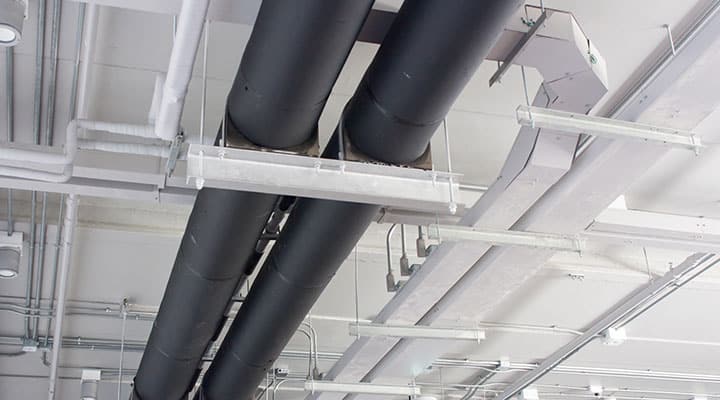
Chilled water pipe insulation with black rubber insulation
Chiller insulation
For chiller insulation, we use sheet rubber cut to size, minimizing joints. Complete coverage is essential to prevent energy loss
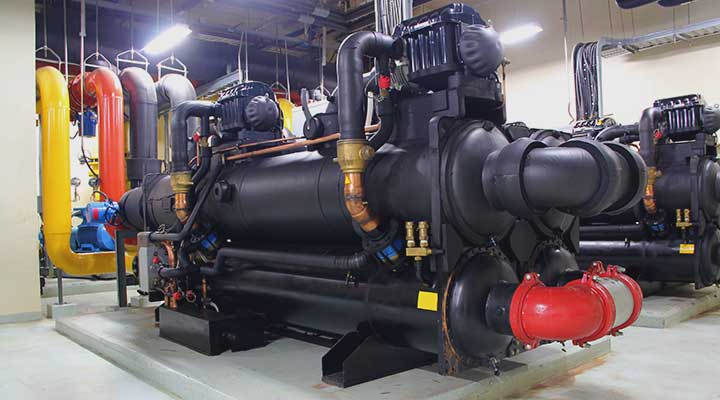
Chiller insulation with black rubber insulation
Air duct insulation
Clean rooms require temperature, pressure, and humidity control, and non-fibrous insulation, making black rubber insulation ideal for these applications
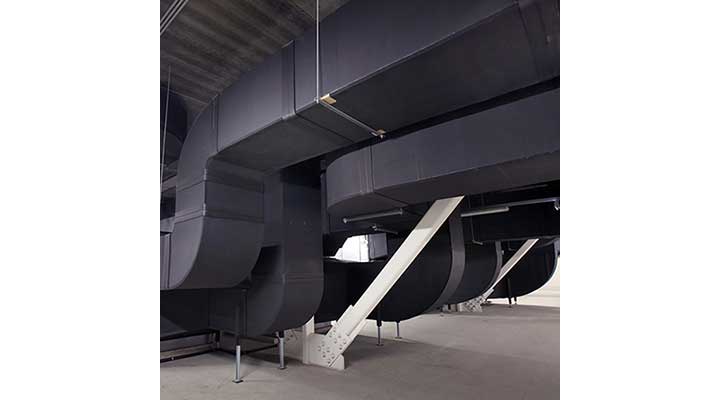
Air duct insulation with black rubber insulation


