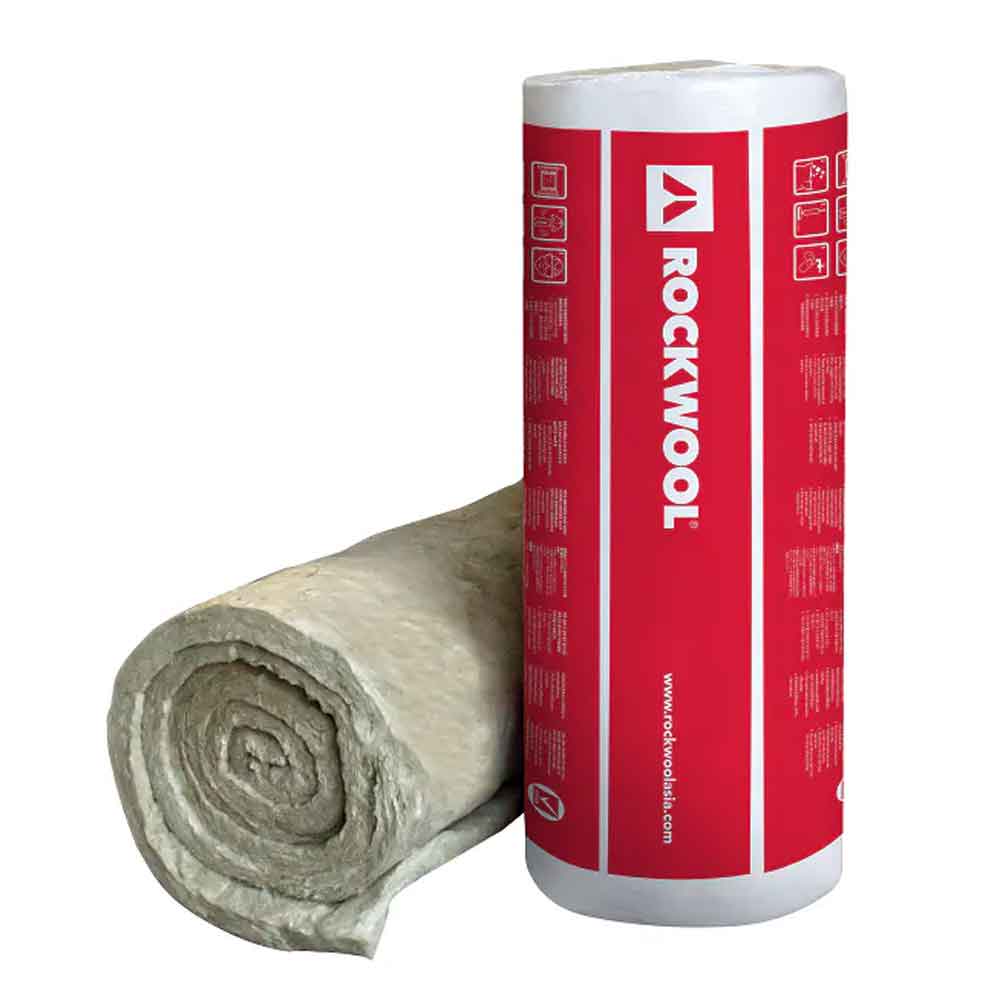
ROCKWOOL rock wool insulation for ventilation systems, roll type, ROCKDUCT model
Price 990.00 บาท – 5,295.00 บาทPrice range: 990.00 บาท through 5,295.00 บาท
Product Details
ROCKWOOL ROCKDUCT ProRox BL rock wool insulation has been developed to standard for use in air conditioning and ventilation systems to provide higher heat resistance properties. Faced with aluminum foil on one side, density from 40 kg/m³ – 80 kg/m³, thickness 25 and 50 mm.
Size 1.2 x 7.5 m.
ROCKDUCT ProRox BL
ROCKDUCT ProRox BL rock wool insulation has been developed to standard for use in air conditioning and ventilation systems to provide higher heat resistance properties. Faced with aluminum foil on one side, density from 40 kg/m³ – 80 kg/m³, thickness 25 and 50 mm.
Heat Conduction
Wire mesh roll thermal insulation can withstand temperatures up to 650 degrees Celsius, certified to ASTM C411 and ASTM C447 standards.
It has also been tested for thermal conductivity according to ASTM C117 standard, which is used to determine thermal conductivity within wire mesh rock wool blankets with the following results:
Thermal Conductivity Values of ProRox BL
|
Mean Temp (C) |
50 | 100 | 150 | 200 | 250 |
300 |
| Thermal Conductivity (W/m.K) | ||||||
| ProRox BL938-SA |
0.039 |
0.047 |
0.057 |
– |
– |
– |
| ProRox BL958-SA |
0.039 |
0.046 |
0.054 |
0.064 |
0.075 |
– |
| ProRox BL960-SA |
0.041 |
0.049 |
0.057 |
0.066 |
0.074 |
0.083 |
Fire Classification and Fire Reaction
With rock wool insulation properties having a melting point greater than 1,000 degrees Celsius, we tested for fire classification according to EN13501-1 standard, which classifies materials by fire reaction from A1 – F.
Material Classification Table by Fire Severity
|
Definition |
Classification according to European Standard EN 13501-1 |
||
| Non-Combustible materials |
A1 |
||
|
A2 – s1d0 |
A2 – s1d1 |
A2 – s1d2 |
|
|
A2 – s2d0 |
A2 – s2d1 |
A2 – s2d2 |
|
|
A2 – s3d0 |
A2 – s3d1 |
A2 – s3d2 |
|
| Combustible materials – very limited contribution to fire |
B – s1d0 |
B – s1d1 |
B – s1d2 |
|
B – s2d0 |
B – s2d1 |
B – s2d2 |
|
|
B – s3d0 |
B – s3d1 |
B – s3d2 |
|
| combustible materials – limited contribution to fire |
C – s1d0 |
C – s1d1 |
C – s1d2 |
|
C- s2d0 |
C – s2d1 |
C – s2d2 |
|
|
C – s3d0 |
C – s3d1 |
C – s3d2 |
|
| Combustible materials – medium contribution to fire |
D – s1d0 |
D – s1d1 |
D – s1d2 |
|
D – s2d0 |
D – s2d1 |
D – s2d2 |
|
|
D – s3d0 |
D – s3d1 |
D- s3d2 |
|
| Combustible materials – highly contribution to fire |
E |
E – d2 |
|
| Combustible materials – easily flammable |
F |
||
“s” Smoke emission level: ranges from 1 (low smoke emission – no smoke) to 3 (high smoke emission)
“d” Flaming Droplets: ranges from 0 (no flaming droplets) to 1 (high flaming droplets)
Table showing levels of smoke generation and flaming droplets
|
Additional class |
Level Definition |
||
| Smoke emission during combustible |
S |
1 |
Quantity/speed emission of absent or weak |
|
2 |
Quantity/speed emission of average intensity |
||
|
3 |
Quantity/speed emission of high intensity |
||
| Production of flaming droplets/particles during combustible |
D |
0 |
No dripping |
|
1 |
Slow dripping |
||
|
2 |
High dripping |
||
From the material classification table, we can see that ProRox BL rock wool insulation is A1 type material which is non-combustible, does not produce smoke and has no flaming droplets, ensuring it can be used confidently for fire protection.
Chloride Testing
In hot water pipe insulation work, a common problem is rust that corrodes pipe surfaces and interiors. We cannot see this until we remove the jacket and thermal insulation covering, but by the time we discover it, corrosion damage has already occurred requiring costly pipe replacement.
Rust is caused by moisture from water vapor, oxygen, and catalysts such as chloride and fluoride, forming brown rust stains on pipe surfaces.
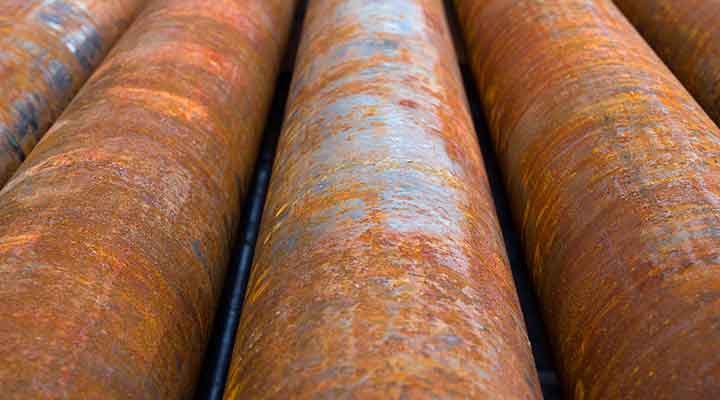
Rust occurring on pipe surfaces due to moisture
We can prevent rust formation in several ways including cleaning pipe surfaces before applying coating and maintaining jackets to prevent damage by not stepping on them.
ProRox series rock wool insulation reduces chloride water usage in the manufacturing process, decreasing chloride content in the insulation. We tested our rock wool insulation to ASTM C871 standard, which tests for chloride, fluoride, silicate and sodium ion content within thermal insulation to determine potential harm to pipe materials. Test results showed only 10 ppm chloride content in the insulation, which is very low for practical use and has virtually no effect on rust formation.
Moisture and Water Vapor
Moisture and water vapor accumulation in insulation is another cause of rust on pipe surfaces. Water vapor and moisture can come from two sources: inside pipes (pipe leaks) or outside jackets. Using ROCKWOOL rock wool insulation with open-cell structure allows water vapor and water droplets to evaporate more easily than closed-cell insulation.
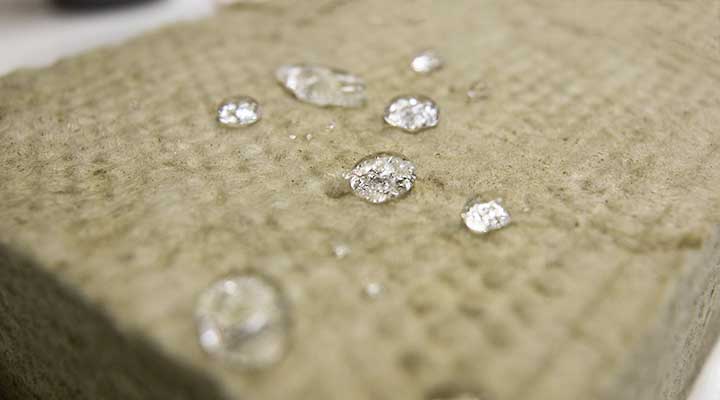
Water droplets will not penetrate rock wool insulation and will evaporate naturally
Additionally, ROCKWOOL rock wool insulation has silicone water repellent added during manufacturing, making every fiber of ROCKWOOL rock wool insulation non-water absorbent. If water droplets fall on the insulation, they will form beads or if water is poured on the insulation sheet, it will flow on the surface like automotive glass film.
We also tested rock wool insulation according to ASTM C1104/C1104M standard to determine water absorption of rock wool insulation. Test results showed rock wool insulation absorbs only 1% of its weight in water.
Rock Wool Insulation Causes Cancer
Only Thailand is concerned about “rock wool” causing “cancer.” This is a misunderstanding from translation confusion between rock wool insulation (ROCKWOOL) and asbestos mineral with these two terms causing confusion. Let us explain:
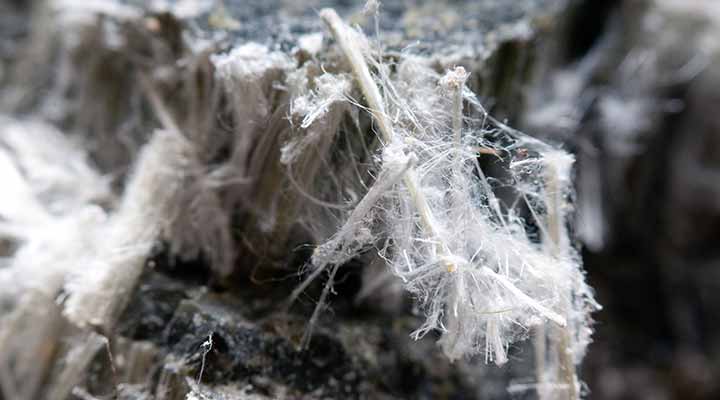
Image of asbestos mineral
Asbestos mineral is a group of naturally occurring minerals with white fiber characteristics smaller than 0.1 microns, made from silicate mineral raw materials. It can disperse in air and fibers can break down continuously with sharp characteristics and is carcinogenic.
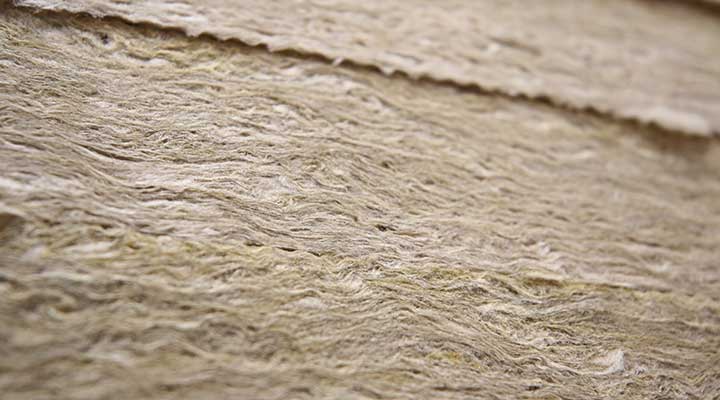
Image of ROCKWOOL rock wool insulation
ROCKWOOL rock wool insulation is produced through controlled manufacturing processes using standard machinery that melts basalt and dolomite rock to spin into 4-6 micron fibers. Fibers can break with rounded ends too large to enter lungs and do not cause cancer.
Comparison table between ROCKWOOL rock wool insulation and asbestos mineral
|
Differences |
ROCKWOOL rock wool insulation |
Asbestos mineral |
|
Raw materials |
Basalt rock, dolomite |
Silicate mineral group |
|
Origin |
Standard machinery |
Silicate mineral group deposits |
|
Fiber characteristics |
4 – 6 micron size, rounded fiber ends |
Smaller than 1 micron, sharp fiber ends |
|
Health effects |
Does not cause cancer in humans |
Causes cancer in humans |
| Classification by International Agency for Research on Cancer |
Group 3 – does not cause cancer in humans |
Group 1 – carcinogenic to humans |
We can find information about various cancer-causing substances from the International Agency for Research on Cancer (IARC). The international cancer research institute divides products into 3 groups:
Carcinogenic substance classification table
|
Group 1 |
Carcinogenic to humans |
|
Group 2A |
Probably carcinogenic to humans |
|
Group 2B |
Possibly carcinogenic to humans |
|
Group 3 |
Not carcinogenic to humans |


