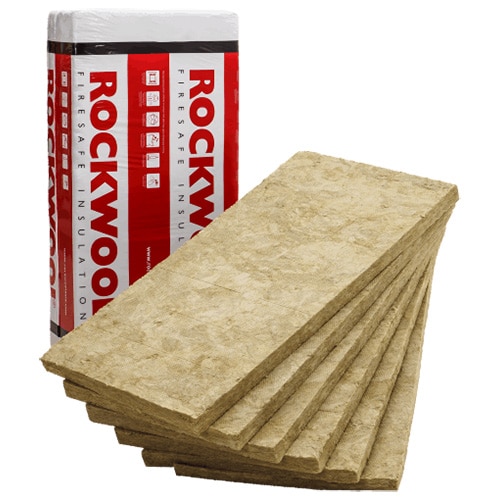
ROCKWOOL mineral wool insulation for Fire Partition, ThermalRock S model
Price 2,246.40 บาท – 3,369.60 บาทPrice range: 2,246.40 บาท through 3,369.60 บาท
Product Details
ROCKWOOL ThermalRock S mineral wool insulation is a high-density mineral wool insulation (120 kg/m3 – 150 kg/m3) that does not collapse during fire, making it suitable for Fire Partition work to provide fire resistance to walls.
Size: 0.6 meters wide, 1.2 meters long
ThermalRock
ThermalRock S mineral wool insulation is a high-density rigid board (120 – 150 kg/m3) used for building partition walls or Fire Partition to prevent fire spread between buildings
To reduce losses from fire, fire escape walls or corridors and building partition walls or Fire Partitions must have fire resistance capability
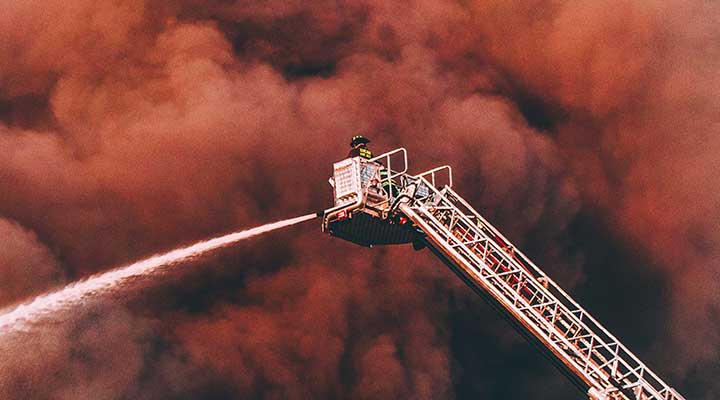
During a fire, 80% of deaths are caused by smoke. Having a fire partition wall reduces losses
Thermal Conductivity
Before we explain what thermal conductivity is, we’d like to briefly explain the concept of heat transfer first
If we imagine we have a metal cup with hot water inside, and we touch that metal cup, we’ll feel that it’s hot. But if it’s a ceramic cup (pottery, coffee mug), we might feel it’s warm, but certainly not as hot as the metal cup
Now let’s return to thermal conductivity or K-Value. The metal cup feels cold because it has “high thermal conductivity”, allowing heat from the hot water to easily transfer through the metal to our hand. Conversely, the ceramic cup has “low thermal conductivity”, making it harder for heat from the hot water inside to reach our hand. Or as we say, the ceramic cup is a good thermal insulator because it transfers less heat
Therefore, for thermal insulation, a lower thermal conductivity value is better
Thermal conductivity testing for insulation can be conducted. For ROCKWOOL’s ThermalRock S mineral wool insulation, it is tested according to ASTM C518 standard, and the test results are shown in this table
Table of thermal conductivity values for ThermalRock S mineral wool insulation
|
Product |
ThermalRock S120 |
ThermalRock S140 |
ThermalRock S150 |
| Thermal Conductivity (W/m.K) |
0.034 |
0.034 |
0.034 |
Sound absorption value
For wall systems and ceiling work, the main goal may be only sound insulation or heat insulation. But mineral wool insulation with an open cell structure can provide both heat insulation and significant protection against external noise
The sound absorption value or NRC (Noise Reduction Coefficient) tells us how much sound is absorbed when it hits this material. For example, NRC = 0.8 means if sound hits this material, 80% will be absorbed and only 20% will be reflected
So when there’s external noise like car horns during heavy traffic at night, when the sound hits our wall with ThermalRock S insulation installed, the insulation will absorb the sound inside and not release it, effectively blocking the sound from passing through. Thus, the loud noise will be significantly reduced
Non-combustible material EN13501-1
In fire resistance or fire protection work, the first important point is that the material must be “non-combustible” and must not cause the fire to spread further. ThermalRock S mineral wool insulation has been tested according to EN13501-1 standard to classify materials from A – F based on fire severity
Table classifying materials by fire severity
|
Definition |
Classification according to European Standard EN 13501-1 | ||
| Non-Combustible materials |
A1 |
||
|
A2 – s1d0 |
A2 – s1d1 |
A2 – s1d2 |
|
|
A2 – s2d0 |
A2 – s2d1 |
A2 – s2d2 |
|
|
A2 – s3d0 |
A2 – s3d1 |
A2 – s3d2 |
|
| Combustible materials – very limited contribution to fire |
B – s1d0 |
B – s1d1 |
B – s1d2 |
|
B – s2d0 |
B – s2d1 |
B – s2d2 |
|
|
B – s3d0 |
B – s3d1 |
B – s3d2 |
|
| Combustible materials – limited contribution to fire |
C – s1d0 |
C – s1d1 |
C – s1d2 |
|
C- s2d0 |
C – s2d1 |
C – s2d2 |
|
|
C – s3d0 |
C – s3d1 |
C – s3d2 |
|
| Combustible materials – medium contribution to fire |
D – s1d0 |
D – s1d1 |
D – s1d2 |
|
D – s2d0 |
D – s2d1 |
D – s2d2 |
|
|
D – s3d0 |
D – s3d1 |
D- s3d2 |
|
| Combustible materials – highly contribution to fire |
E |
E – d2 |
|
| Combustible materials – easily flammable |
F |
||
“s” Smoke emission level: ranges from 1 (low-no smoke) to 3 (high smoke emission)
“d” Flaming droplets: ranges from 0 (no droplets) to 1 (many droplets)
Table showing levels of smoke production and flaming droplets
|
Additional class |
Level Definition |
||
| Smoke emission during combustion |
S |
1 |
Quantity/speed emission of absent or weak |
|
2 |
Quantity/speed emission of average intensity |
||
|
3 |
Quantity/speed emission of high intensity |
||
| Production of flaming droplets/particles during combustion |
D |
0 |
No dripping |
|
1 |
Slow dripping |
||
|
2 |
High dripping |
||
From the material classification table, we can see that ThermalRock S mineral wool insulation is an A1 class material, which is non-combustible, does not produce smoke, and does not produce flaming droplets. Therefore, it can be confidently used as a material for fire protection
Moisture absorption/Water absorption
In wall systems, moisture is a significant problem. Damp walls can cause paint to blister, mold to grow on ceilings and walls, and water stains on walls, reducing the building’s lifespan
This issue has led insulation manufacturers to develop their products further by making mineral wool insulation less water-absorbent. This means the insulation won’t retain water. When water drops onto ROCKWOOL mineral wool insulation, it forms droplets and doesn’t penetrate the insulation, instead remaining as water droplets on the surface
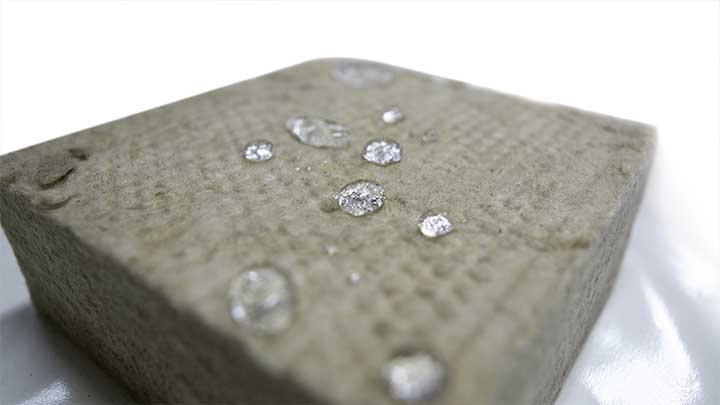
Water droplets will not penetrate the mineral wool insulation and will evaporate on their own
This method allows the insulation to dry quickly when air passes through, causing the water droplets to evaporate completely. ROCKWOOL mineral wool insulation has also passed moisture absorption tests according to ASTM C1104 and ASTM C1104M standards, with a water vapor absorption value of only 0.04%, which is practically no water vapor absorption at all
Mineral wool insulation and cancer risk
Only in Thailand is there concern about “mineral wool” causing “cancer”. This is a misunderstanding due to translation issues. Mineral wool insulation (ROCKWOOL) and asbestos are confused due to similar terminology. We will explain the difference.
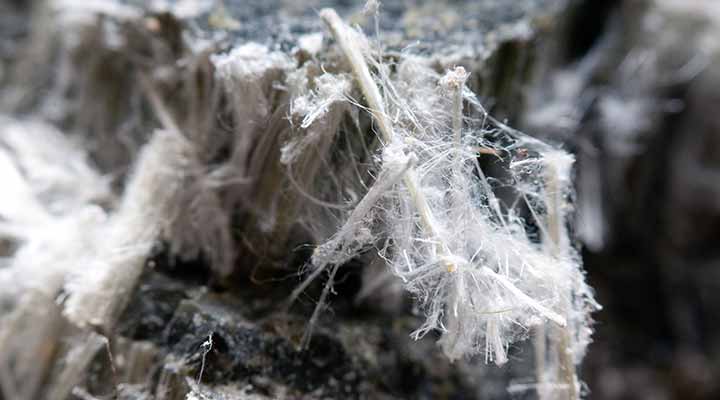
Image of asbestos
Asbestos is a naturally occurring group of minerals with white fibers smaller than 0.1 micron, derived from silicate minerals. It can become airborne and break into smaller, sharp fibers. It is a known carcinogen.
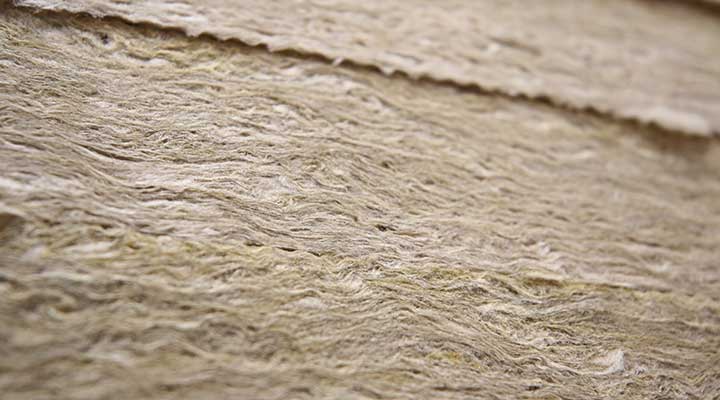
Image of ROCKWOOL insulation
ROCKWOOL mineral wool insulation is produced through a controlled manufacturing process that melts basalt and dolomite rocks to spin fibers 4-6 microns in size. These fibers can break but have large, rounded ends too big to enter the lungs. It does not cause cancer.
Table of differences between ROCKWOOL mineral wool insulation and asbestos
|
Difference |
|
|
|
Raw material |
Basalt rock, dolomite |
Silicate mineral group |
|
Source |
Standardized machinery |
Accumulation of silicate minerals |
|
Fiber characteristics |
4-6 microns, rounded fiber ends |
Smaller than 1 micron, sharp fiber ends |
|
Health impact |
Does not cause cancer in humans |
Causes cancer in humans |
|
Classification by International Agency for Research on Cancer |
Group 3: Not classifiable as to its carcinogenicity to humans |
Group 1: Carcinogenic to humans |
We can find information about various carcinogenic substances from the International Agency for Research on Cancer (IARC). The IARC divides products into 3 groups
Table classifying carcinogenic substances
|
Group 1 |
Carcinogenic to humans |
|
Group 2A |
Probably carcinogenic to humans |
|
Group 2B |
Possibly carcinogenic to humans |
|
Group 3 |
Not classifiable as to its carcinogenicity to humans |


