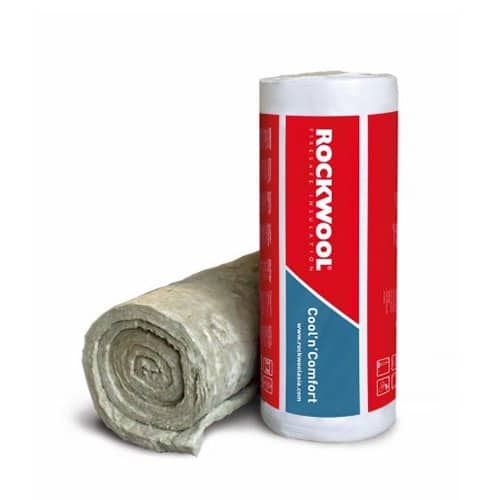
ROCKWOOL insulation for roofing, roll type, Cool ‘n’ Comfort RL model
Price 996.00 บาท – 3,725.00 บาทPrice range: 996.00 บาท through 3,725.00 บาท
Product Details
In roofing systems, rockwool roof insulation Cool ‘n’ Comfort RL model comes in long rolls
. We can easily install the insulation by simply rolling it out, significantly reducing installation time compared to laying it across rafters.
Cool ‘n’ Comfort RL
Cool ‘n’ Comfort insulation is a ROCKWOOL mineral wool insulation designed for roof heat insulation systems. It’s designed in roll form for easy rolling on roofs, and also comes in pre-cut sheets to fit roof batten sizes, making installation as simple as placing the insulation on the roof channel.
Mineral wool insulation is highly suitable for roof heat insulation with a low thermal conductivity of only 0.033 W/m.K. Its sound absorption properties with an NRC value of 1.00 prevent noise from rain hitting the roof from disturbing the building interior.
A main issue with heat insulation in roofing systems is roof leaks causing water to drip onto the insulation material. The insulation can absorb water and potentially become a breeding ground for pathogens. However, ROCKWOOL mineral wool insulation incorporates water-repellent silicone adhesive in every fiber during the production process. This causes water droplets to bead up on the surface and evaporate naturally, rather than being absorbed.
Thermal Conductivity
The heat of a metal sheet roof during the day can reach up to 70°C. The heat transferred from the roof to the building increases accordingly, causing air conditioners to work harder. Installing insulation with low thermal conductivity can significantly reduce electricity costs from air conditioning.
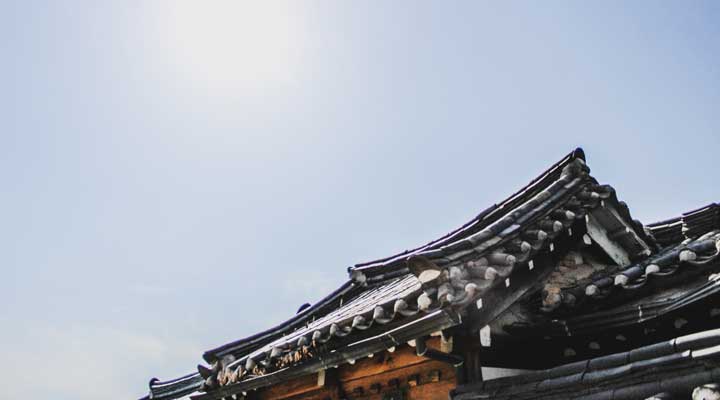
The roofing system is the part that receives the most heat
The thermal conductivity of normal heat insulation is between 0.032 – 0.045 W/m.K, which is considered very low. This thermal conductivity value is tested by ASTM using the ASTM C518 standard, which tests heat flow through smooth-surfaced test materials using a Heat Flow Meter. The Cool ‘n’ Comfort mineral wool insulation has achieved a thermal conductivity of only 0.033 W/m.K.
Sound absorption
Is sound insulation necessary for roofing systems? This is a common question. Let’s use a simple example: If we’re in a warehouse and it’s raining on the metal sheet roof, we can barely hear each other when talking to coworkers or customers.
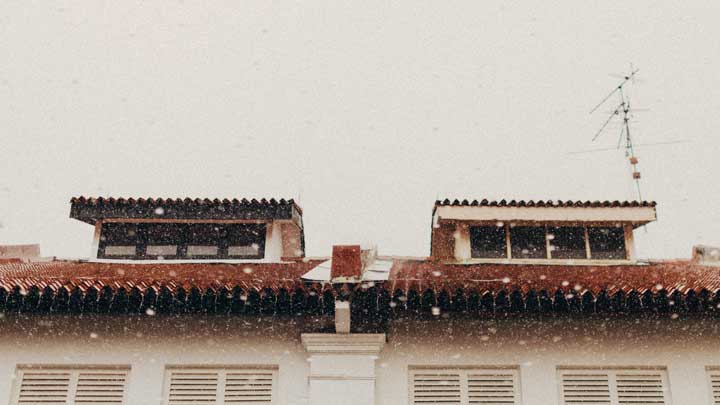
When rain hits the roof, it creates a very loud noise
Therefore, sound absorption in roofing systems isn’t essential but greatly improves comfort. Mineral wool insulation has an open cell structure, which absorbs sound waves upon impact. This follows the principle of sound absorption design: “When sound hits, make it unable to find a way out.”
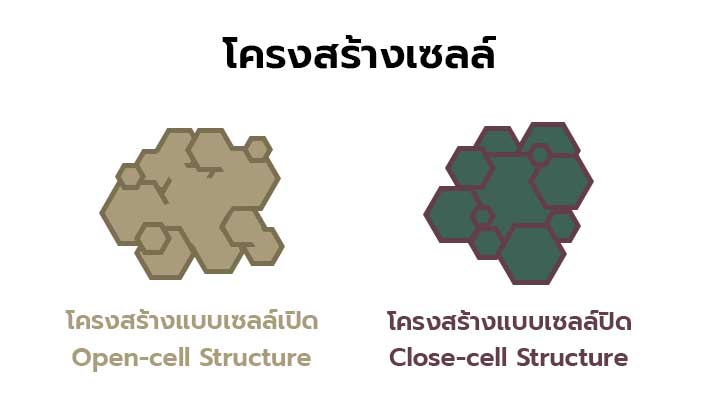
Open and closed cell structures of insulation
How do we know if this heat insulation has good sound insulation? We use an engineering value called NRC (Noise Reduction Coefficient) or sound absorption value, ranging from 0 to 1.0. If NRC = 0.8, it means the material absorbs 80% of sound, with the remaining 20% reflected. Our mineral wool insulation has a minimum NRC of 0.9 and a maximum of 1.0, meaning no sound can escape the material.
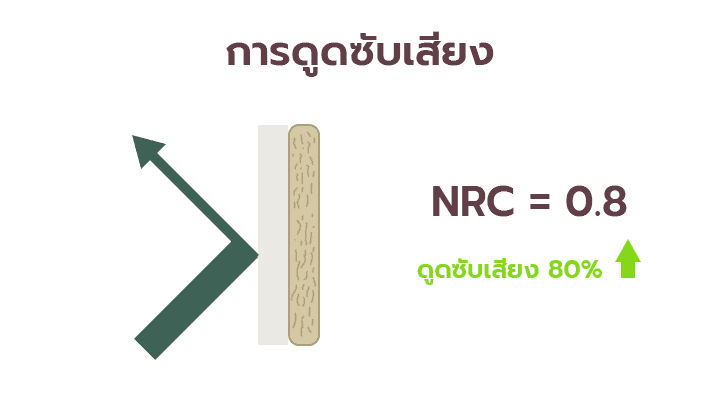
The sound absorption of insulation is measured by the NRC value
Moisture resistance
A major problem in roofing systems is rain and moisture. In case of rain and roof leaks, water droplets will flow down. If we install a ceiling, we’ll see water stains. If we install insulation, we worry it might absorb water like a sponge, making it heavier and potentially causing the roof structure to sag, or leading to mold and fungus growth that can cause various diseases.
However, Cool ‘n’ Comfort heat insulation is made from melted volcanic rock produced into fibers, which isn’t food for living organisms like mold or rats. In the production process, ROCKWOOL adds silicone to the rock fiber production, coating every rock fiber with water-repellent silicone.
This means that when water drops onto Cool ‘n’ Comfort mineral wool insulation, the droplets will bead up and evaporate over time. We’ve tested the water absorption and moisture absorption of the silicone-coated mineral wool fibers to provide users with more confidence.
Water absorption is tested according to EN 1609.97 standard, which involves partially immersing the test material for 24 hours. The test results show how much water the insulation absorbs. From these tests, we found that the water absorption of Cool ‘n’ Comfort mineral wool insulation is 0.5 – 1.0 kg/m³.
For moisture vapor absorption, it’s tested according to ASTM C1104/C1104M, which is the standard for testing unfaced mineral wool insulation. From these tests, we found the moisture absorption to be less than 0.04% by volume.
Fire resistance
The melting point of mineral wool insulation is over 1,000°C and it’s classified as a non-combustible material at A1 level, categorized according to EN 13501-1/ BS EN 1182 standards.
Environmental standards
Environmental standards are becoming a global megatrend. More efficient energy use, valuable resource utilization, and environmentally friendly material disposal are key. Various materials must adapt to this global trend.
Commonly used green labels
A widely accepted environmental standard is the Singapore Green Building Council (SGBC) standard, with criteria set by 100 experts. These criteria are developed from ISO 14020 Type 1, which is an international standard for environmental labeling.

ROCKWOOL has received a green label from SGBC
The criteria are based on product Life-Cycle Assessment (LCA) to predict long-term environmental impacts. This construction product certification is recognized by the construction industry as a standard for green building products, encouraging manufacturers to develop and sell more environmentally friendly products.
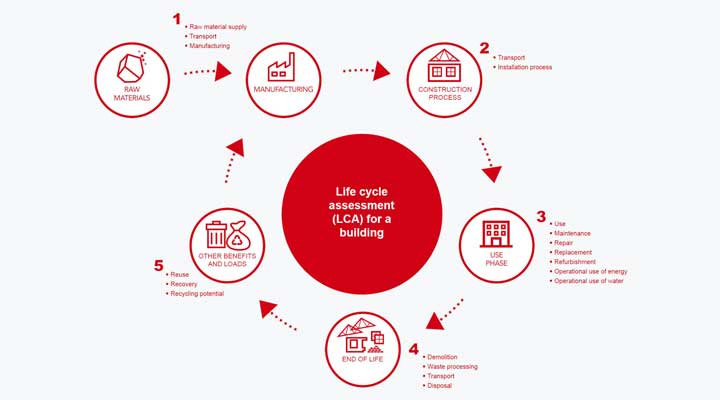
LCA of ROCKWOOL mineral wool insulation products
As part of the initiative to assess environmental impact, Cool ‘n’ Comfort mineral wool insulation has participated in this policy and received certification as a Singapore Green Building Product Certified product for use in energy-efficient building projects worldwide.
Mineral wool insulation causing cancer
Only in Thailand is there concern about “mineral wool” causing “cancer”. This is a misunderstanding due to translation issues. Mineral wool insulation (ROCKWOOL) and asbestos are confused due to similar terminology. We will explain the difference.
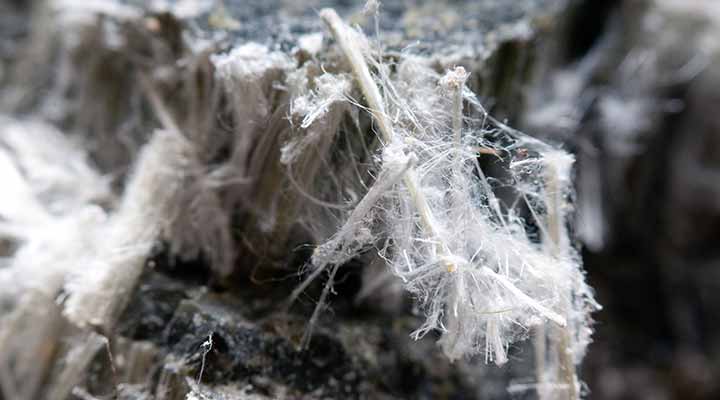
Image of asbestos
Asbestos is a naturally occurring group of minerals with white fibers smaller than 0.1 micron, derived from silicate minerals. It can become airborne and break into smaller, sharp fibers. It is a known carcinogen.
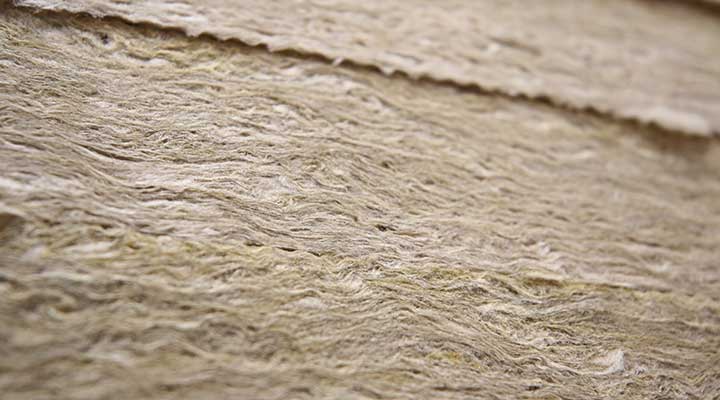
Image of ROCKWOOL insulation
ROCKWOOL mineral wool insulation is produced through a controlled manufacturing process that melts basalt and dolomite rocks to spin fibers 4-6 microns in size. These fibers can break but have large, rounded ends too big to enter the lungs. It does not cause cancer.
Table of differences between ROCKWOOL mineral wool insulation and asbestos
|
Difference |
ROCKWOOL mineral wool insulation |
Asbestos |
| Raw material |
Basalt rock, dolomite |
Silicate mineral group |
| Source |
Standardized machinery |
Accumulation of silicate minerals |
| Fiber characteristics |
4-6 microns, rounded fiber ends |
Smaller than 1 micron, sharp fiber ends |
| Health impact |
Does not cause cancer in humans |
Causes cancer in humans |
| Classification by International Agency for Research on Cancer |
Group 3: Not classifiable as to its carcinogenicity to humans |
Group 1: Carcinogenic to humans |
We can find information about carcinogenic substances from the International Agency for Research on Cancer (IARC). IARC classifies products into 3 groups:
Table classifying carcinogenic substances
| Group 1 |
Carcinogenic to humans |
| Group 2A |
Probably carcinogenic to humans |
| Group 2B |
Possibly carcinogenic to humans |
| Group 3 |
Not classifiable as to its carcinogenicity to humans |
Installation
Installation in roofing systems can be done in various ways, but the two most popular roofing systems for insulation are:
1.) Single skin roof system
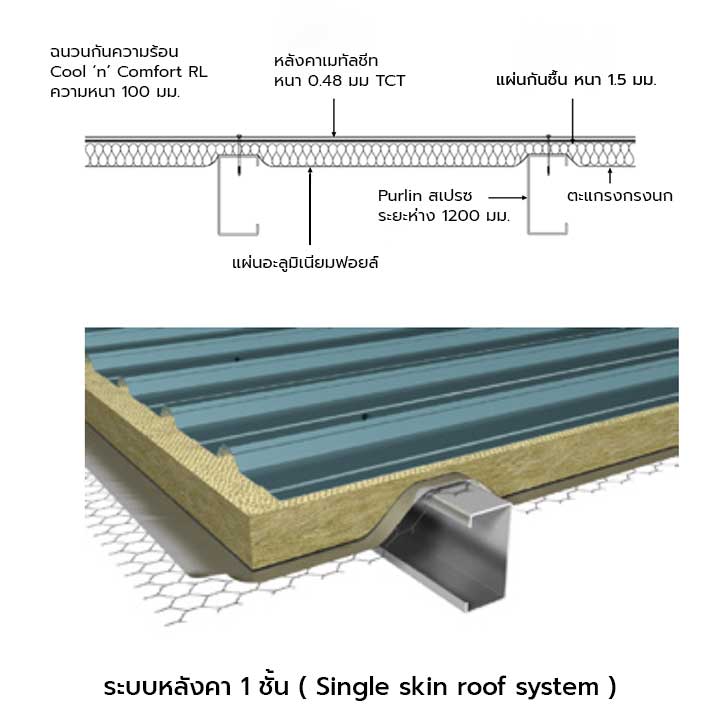
Installation of insulation in a single skin roof system consists of metal roof sheets, moisture barrier, Cool ‘n’ Comfort heat insulation, and wire mesh.
2.) Double skin roof system
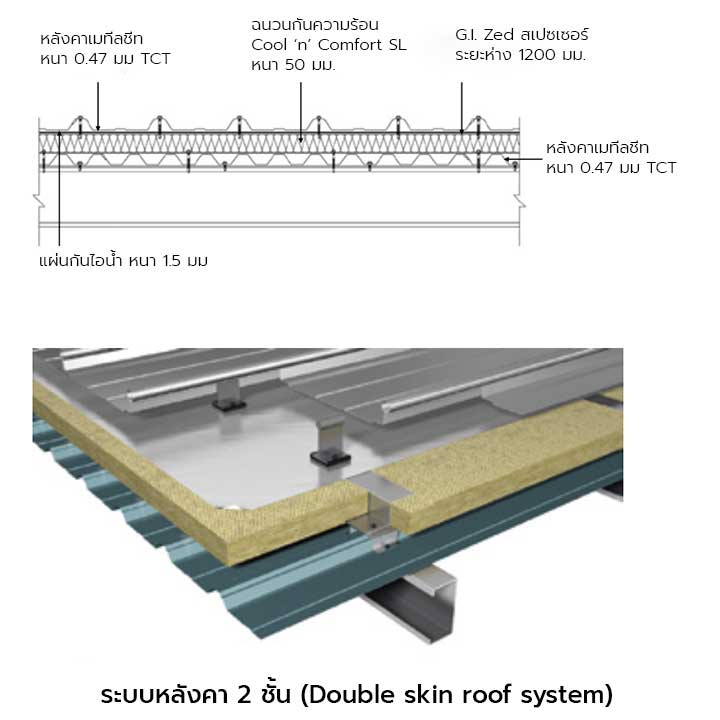
Installation of insulation in a double skin roof system consists of metal roof sheets, moisture barrier, Cool ‘n’ Comfort heat insulation, and another layer of metal roof sheets.


