How to Insulate Hot Pipes with ROCKWOOL Mineral Wool
Piping systems serve as the central connection between various equipment in chemical and petroleum industries. For example, power plants contain numerous equipment including columns, pressure vessels, boilers, turbines, and others.
The piping system transfers raw materials from one piece of equipment to another. The contents may be chemicals or steam that must maintain their original conditions (temperature, viscosity, pressure) for further use.
It is crucial to maintain the original conditions of materials as they move through pipes between equipment. Designers must ensure that the insulated piping system minimizes heat loss and maximizes energy conservation.
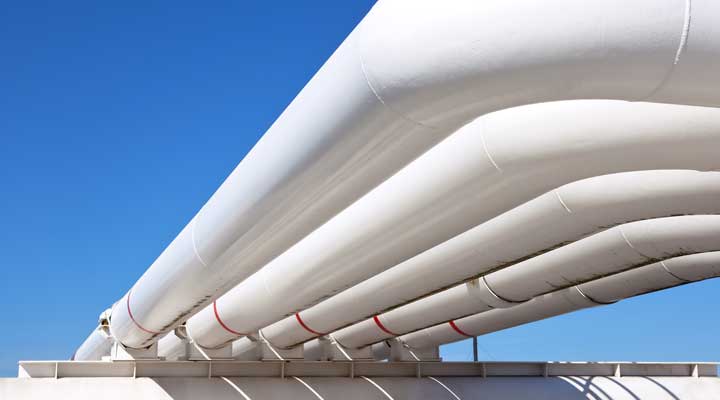
Hot Pipe Systems
Requirements for Hot Pipe Insulation
Goals of Hot Pipe Insulation
-
- Reduce heat loss (reduce energy costs)
- Reduce CO2 emissions
- Mineral wool insulation can maintain system temperature
- Reduce pipe system noise
- Prevent condensation
- Protect against potentially dangerous heat contact with humans
- Prevent and inhibit fire
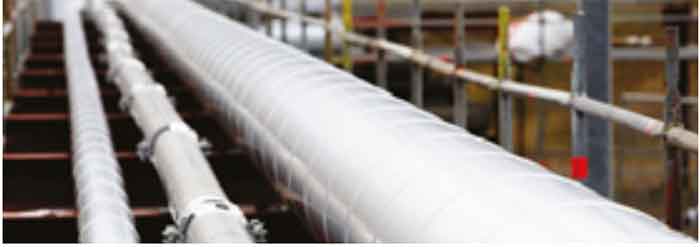
Standards for Hot Pipe Insulation
Installation and usage should consider these standards and regulations:
-
-
- DIN 4140: Thermal insulation for power plants and equipment
- AGI Q101: Thermal insulation for power plant equipment
- CINI-Manual: Thermal insulation for industrial applications
- BS 5970: Code of practice for thermal insulation of hot water pipes, air conditioning systems, and other industrial equipment
-
Thermal Insulation Systems for Hot Pipes
Hot pipe insulation requires metal cladding after insulation to protect both pipe and insulation from weather conditions and external forces (such as impact, collision, or maintenance foot traffic).
Spacer installation is necessary when insulating pipes with wire mesh mineral wool because this type of insulation cannot withstand external compression forces and the weight of surface metal cladding (if the cladding directly compresses the insulation, the mineral wool will collapse, reducing insulation thickness and increasing energy loss).
Therefore, installing spacers directs external compression weight directly to the pipe, avoiding any impact on the insulation system.
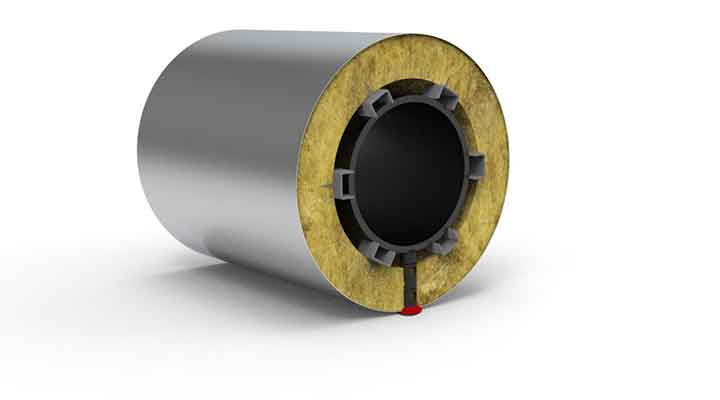
Spacers for mineral wool insulation installation - Source: Integrity-products
Mineral Wool Pipe Insulation Pre-formed Pipe Sections (ProRox Pipe Section)
ROCKWOOL has developed ProRox PS WR-Tech pre-formed pipe sections that reduce chloride content to below 10 ppm to prevent steel pipe corrosion and corrosion under insulation.
Pre-formed pipe sections are available from small 1/2″ NPS (23mm) to large 36″ NPS (915mm) sizes, with thicknesses from 25-100 mm, giving designers multiple options. The clear advantage is easy and quick installation, as they simply slip onto steel pipes and don’t require spacers like wire mesh types.
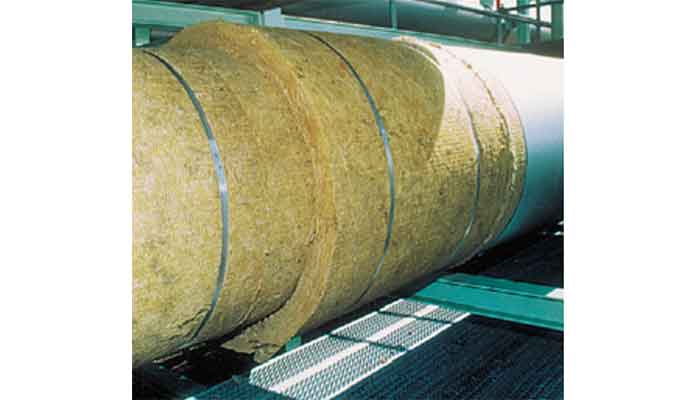
Pre-formed pipe sections have high densities of 120 kg/m³ and 150 kg/m³, making them compression-resistant. Wire mesh types are softer with densities of only 80/100/128 kg/m³.
Mineral Wool Pipe Insulation Wire Mesh Type (ProRox Wire Mat)
Wire mesh mineral wool insulation like ProRox WM is made from volcanic rock fibers, bonded with a binder, and features ROCKWOOL’s exclusive WR-Tech innovation that reduces chloride content below 10 ppm to prevent under-insulation corrosion.
Standard products use galvanized wire mesh, but special products with stainless steel mesh are also available. Wire mesh mineral wool insulation is used for large pipes 14″ NPS (DN 350) or fittings that are difficult to insulate with pre-formed sections, such as T-joints, elbows, or various flanges.
Wire mesh mineral wool insulation is used because it can be easily cut and shaped – simply cut the insulation with a knife and the wire with pliers for immediate use.
However, wire mesh insulation is not compression-resistant and must be used with spacers or pipe supports to maintain the insulation system’s effectiveness.
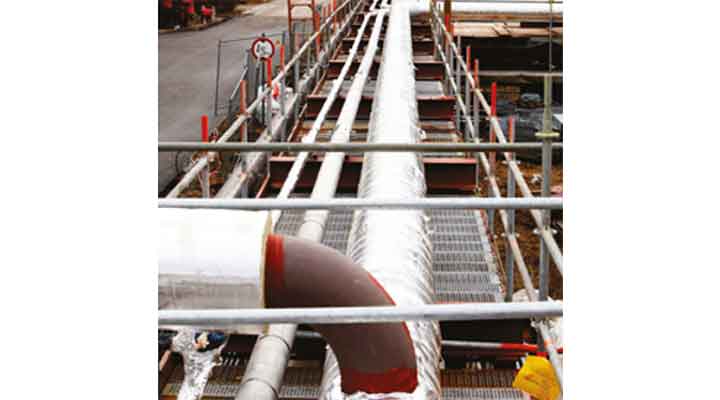
Pipe system with completed mineral wool insulation and cladding installation - Source: ROCKWOOL PROCESS MANUAL
Comparison Between Pre-formed and Wire Mesh Insulation Systems
The main benefit of pre-formed pipe sections is that they don’t require pipe support installation, allowing faster work and better heat retention. Wire mesh types require spacer installation, taking longer and creating heat points at spacers that increase heat loss.
Advantages of Pre-formed Pipe Sections
- No need to install spacers or pipe supports
- Faster installation due to no spacer requirement
- Jacket can be installed directly against mineral wool insulation
- Spacer installation increases energy loss
- Heat points develop at spacer installation areas
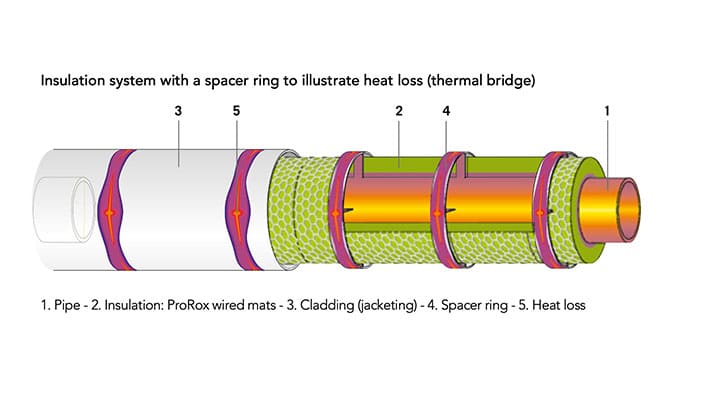
Insulation system with a spacer ring and diagram showing heat loss. Source - ROCKWOOL PROCESS MANUAL
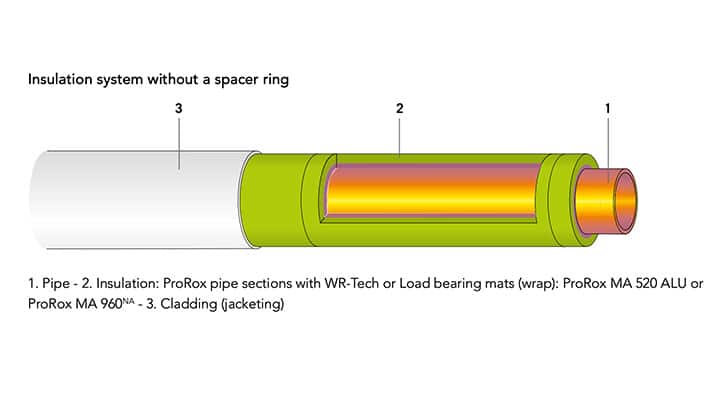
Insulation system without a spacer ring. Source - ROCKWOOL PROCESS MANUAL
Comparing Thickness of Pre-formed and Wire Mesh Mineral Wool Insulation
When comparing both insulation systems with equal heat loss, use the table below to compare insulation thicknesses under these conditions:
- Average temperature: 250°C
- Ambient temperature: 10°C
- Wind speed: 5 meters/second
- Jacket: Aluzinc
- Heat loss rate: 150 watts/meter
- Spacer installation required for wire mesh insulation system
| Pipe Size DN | inches | mm | ProRox PS960 | ProRox WM950 |
|---|---|---|---|---|
| 50 | 2 | 60 | 30 | N/A |
| 80 | 3 | 89 | 30 | N/A |
| 100 | 4 | 115 | 40 | N/A |
| 150 | 6 | 169 | 60 | N/A |
| 200 | 8 | 220 | 80 | 110 (50+60) |
| 250 | 10 | 275 | 90 | 140 (70+70) |
| 300 | 12 | 324 | 100 | 160 (80+80) |
| 350 | 14 | 356 | 110 | 180 (90+90) |
Comparing Thickness of Pre-formed and Wire Mesh Mineral Wool Insulation
Typically, pre-formed mineral wool insulation is more suitable for straight pipes as it doesn’t require spacer installation, allowing faster work. For flanges or elbows, wire mesh types are necessary as they can be easily cut to shape. Here’s a table for recommended insulation selection:
| Application | Temperature (°C) | ProRox PS960 | ProRox WM950 | ProRox WM960 |
|---|---|---|---|---|
| Straight Pipes | < 300°C | +++++ | ++ | + |
| 300 – 600°C | +++ | ++ | + | |
| > 600°C | +++ | |||
| Short Pipes Elbows Valves Flanges |
< 300°C | + | +++ | ++ |
| 300 – 600°C | +++ | ++ | ||
| 600 – 650°C | +++ | |||
| Building Hot Pipes for Building Services |
D < 356 mm | +++++ | ||
| D > 356 mm | ++++ |
Installing Hot Pipe Insulation with ROCKWOOL ProRox PS Pre-formed Sections
Designing Insulation Thickness for Contact Protection
The table below helps design insulation thickness to prevent hazards from pipe surface contact, with these example conditions:
- Ambient temperature: 25°C
- Wind speed: 0 meters/second
- Jacket: Galvanized sheet
- Maximum surface temperature: 60°C
- Insulation used: ProRox PS960
| Pipe Size DN | inches | mm | < 200°C | 250°C | 300°C | 350°C | 400°C | 450°C |
500°C |
|---|---|---|---|---|---|---|---|---|---|
| 25 | 1 | 34 | 20 | 30 | 40 | 60 | 70 | 80 | 100 |
| 50 | 2 | 60 | 30 | 40 | 50 | 70 | 80 | 100 | 110 |
| 80 | 3 | 89 | 30 | 40 | 50 | 80 | 90 | 100 | 130 |
| 100 | 4 | 115 | 30 | 40 | 60 | 80 | 100 | 120 | 140 |
| 150 | 6 | 169 | 30 | 50 | 60 | 90 | 110 | 130 | 150 |
| 200 | 8 | 219 | 40 | 50 | 60 | 90 | 120 | 140 | 160 |
| 250 | 10 | 275 | 40 | 50 | 70 | 100 | 120 | 150 | 170 |
| 300 | 12 | 324 | 40 | 50 | 70 | 100 | 130 | 150 | 180 |
Installation
ROCKWOOL ProRox PS960 mineral wool comes as hollow tubes with inner diameters matching steel pipe sizes and layered thicknesses, fitting perfectly when slipped onto steel pipes.
- For horizontal pipes, we rotate the insulation split beneath the pipe to prevent rainwater from dripping through the split to the steel pipe.
- For vertical pipes, we offset the insulation gaps by about 30 degrees to prevent water droplets from flowing through splits to the steel pipe.
- After installing insulation, we secure it with galvanized wire or metal straps.
- Pipe insulation thicker than 120 mm (or for temperatures above 300°C) requires 2 or 3 layers of insulation. The splits must be staggered to prevent water penetration to the inner pipe surface.
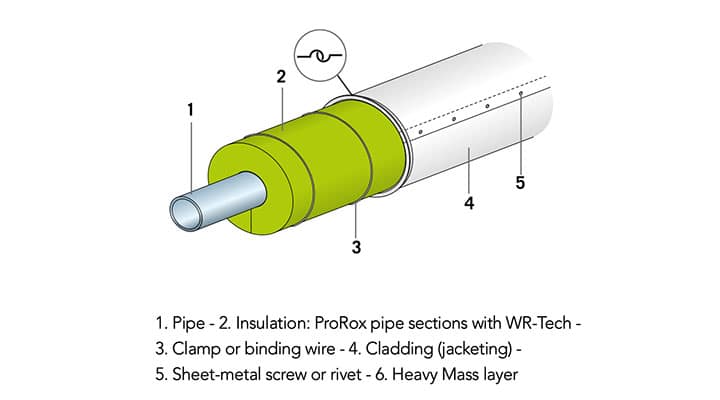
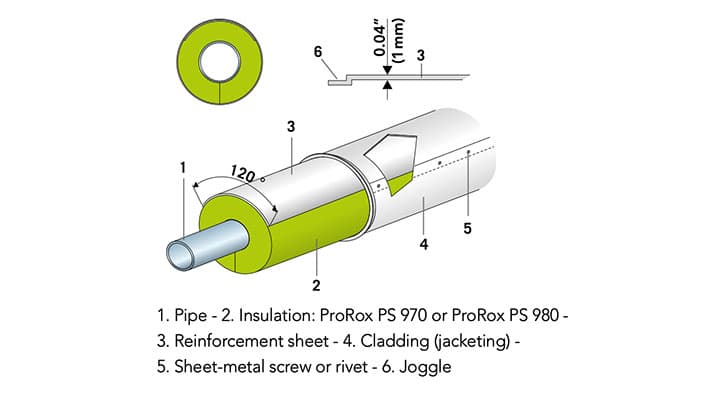
Characteristics of pipe insulation system using prefabricated pipe sections. Source - ROCKWOOL PROCESS MANUAL
Pipe Supports and Spacers
Typically, pre-formed pipe section systems don’t need spacers and pipe supports. However, for pipes with significant vibration and/or temperatures above 300°C, spacer installation may be necessary.
For vertical pipes taller than 4 meters, pipe supports lock insulation to the pipe. We install the first support ring at the pipe’s lowest point, with subsequent rings spaced no more than 4 meters apart.
Insulating Hot Pipes with Wire Mesh Mineral Wool
Wire mesh mineral wool insulation suits large pipes or fittings because it’s easier to cut and shape for fitting joints. Wire mesh mineral wool has lower compression resistance than pre-formed sections and should be installed with spacers.
Designing Insulation Thickness for Contact Protection
The table below helps design insulation thickness to prevent hazards from pipe surface contact, with these conditions:
- Ambient temperature: 25°C
- Wind speed: 0 meters/second
- Jacket: Galvanized sheet
- Maximum surface temperature: 60°C
- Insulation used: ProRox WM950
| Pipe Size DN | inches | mm | < 100°C | 200°C | 300°C | 400°C | 500°C | 600°C |
|---|---|---|---|---|---|---|---|---|
| 200 | 8 | 219 | 30 | 40 | 80 | 110 | 160 | 180 |
| 250 | 10 | 274 | 30 | 50 | 80 | 120 | 170 | 190 |
| 300 | 12 | 324 | 30 | 50 | 80 | 130 | 170 | 190 |
| 400 | 16 | 406 | 30 | 50 | 90 | 130 | 170 | 190 |
| 500 | 20 | 508 | 30 | 50 | 90 | 130 | 180 | 200 |
Installation
- Cut mineral wool insulation to length that wraps around pipe completely
- Pull wire mesh of mineral wool tight and secure with 0.5 mm metal wire
- Stainless steel pipes and pipes above 400°C use wire stitching to prevent wire tearing and rust
- For insulation thicker than 120 mm or temperatures above 300°C, multiple insulation layers are needed. Split joints must not align to prevent water penetration to inner pipe surface.
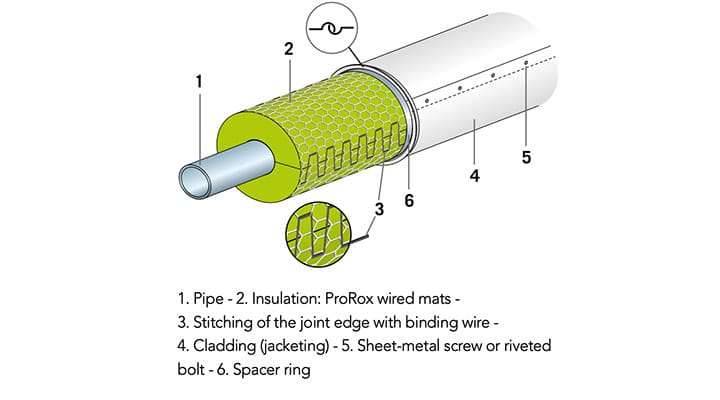
Wire stitching to secure wire mesh blanket insulation. Source - ROCKWOOL PROCESS MANUAL
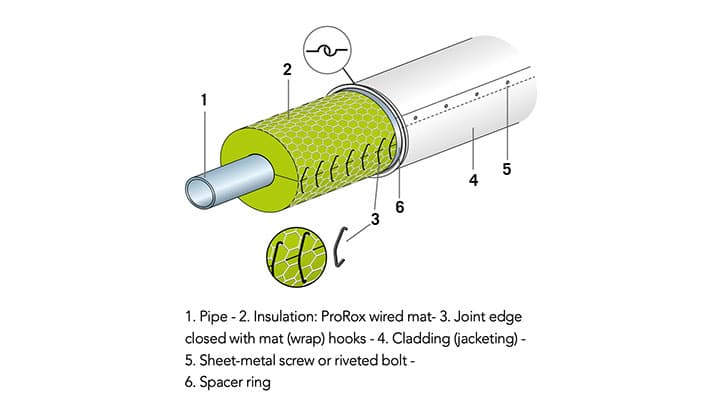
Tightly binding with 0.5 mm wire. Source - ROCKWOOL PROCESS MANUAL
Pipe Supports and Spacers
Wire mesh type insulation is not compression-resistant, so cladding cannot be installed directly on the insulation. Spacers or pipe supports must be installed before cladding.
For vertical pipes taller than 4 meters, pipe supports lock insulation to the pipe. We install the first support ring at the pipe’s lowest point, with subsequent rings spaced no more than 4 meters apart.
Support Equipment for Pipe Insulation Systems
A. Spacers
Spacers are installed to support cladding weight installed after insulation. Spacers are necessary with wire mesh mineral wool but not with pre-formed pipe sections.
The pipe structure includes an outer metal ring against the cladding, followed by metal or ceramic spacers installed on the pipe, such as Omega Clamps commonly used for vibration reduction.
- Metal spacers require at least 3 pieces with spacing not exceeding 16 inches (400 mm) when measured against the outer metal ring.
- Ceramic spacers require at least 4 pieces with spacing not exceeding 10 inches (250 mm) when measured against the outer metal ring.
The number of spacers depends on operating temperature and external forces. Spacer spacing can be referenced from CINI 1.3.23.
For pipe bend spacer installation, such as elbows, install at bend start and end. If spacer spacing exceeds 27 inches (700 mm) when measured at the outer bend line, additional spacers must be installed.
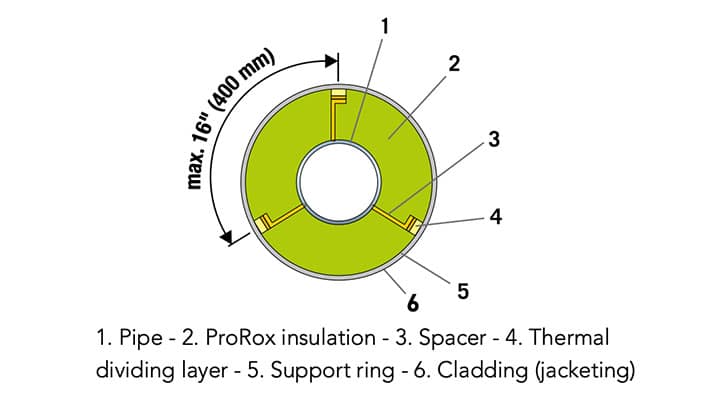
Spacing for installing spacers around pipes. Source - ROCKWOOL PROCESS
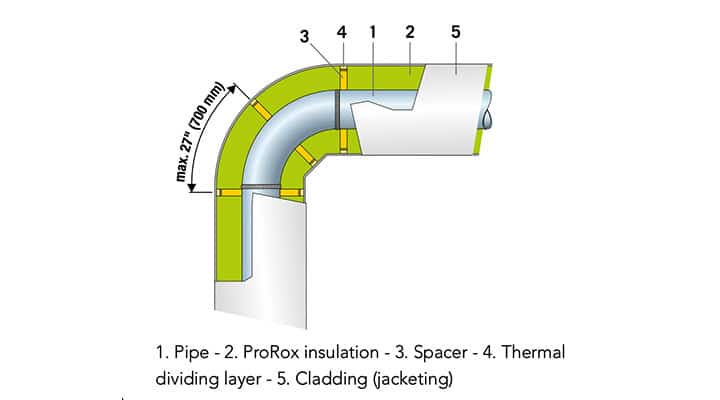
Spacing for installing spacers on pipe elbows. Source - ROCKWOOL PROCESS
B. Pipe Supports
We install pipe supports for vertical pipes because they carry significant weight from pipe, insulation, and cladding, and experience more vibration than horizontal pipes. Support selection depends on pipe size and temperature, using screws, welding, or double clamps for high-temperature pipes. Supports must be made from high-temperature resistant metal.
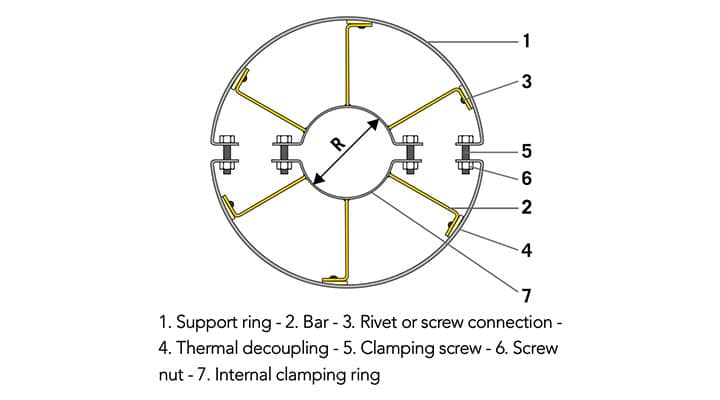
Method for installing vertical pipe support. Source - ROCKWOOL PROCESS
Table Showing Insulation Weight per Pipe Length
| Pipe Size DN | inches | mm | 30 mm | 40 mm | 50 mm | 60 mm | 80 mm | 100 mm | 120 mm | 140 mm |
|---|---|---|---|---|---|---|---|---|---|---|
| 15 | 0.5 | 22 | 4 | 5 | 6 | 8 | 11 | 15 | 19 | 24 |
| 25 | 1 | 34 | 4 | 5 | 7 | 8 | 12 | 15 | 20 | 25 |
| 50 | 2 | 60 | 5 | 7 | 8 | 10 | 13 | 17 | 22 | 27 |
| 65 | 2.5 | 76 | 6 | 7 | 9 | 10 | 14 | 18 | 23 | 28 |
| 80 | 3 | 89 | 7 | 8 | 10 | 11 | 15 | 19 | 24 | 29 |
| 100 | 4 | 115 | 8 | 9 | 11 | 12 | 16 | 21 | 26 | 31 |
| 200 | 8 | 219 | 12 | 14 | 16 | 18 | 23 | 28 | 33 | 39 |
| 300 | 12 | 324 | 17 | 19 | 21 | 24 | 29 | 35 | 41 | 47 |
| 500 | 20 | 508 | 25 | 28 | 31 | 34 | 40 | 47 | 54 | 62 |
| 700 | 28 | 711 |
|
37 | 41 | 44 | 52 | 60 | 69 | 78 |
Metal Cladding
Cladding protects thermal insulation from weather and other environmental pollutants. Material selection depends on factors like pipe vibration, maintenance foot traffic, weather, and ambient temperature.
We select cladding materials as follows:
- Galvanized sheets for indoor use due to good strength and fire resistance
- Aluminum sheets for outdoor use due to good weather resistance and lower cost than stainless steel
For corrosive areas, aluminum sheets, stainless steel sheets, or reinforced plastic sheets are used for cladding, with stainless steel recommended in potentially flammable environments.
| Cladding Material | Fire Risk Areas | Corrosion | < 60°C |
> 60°C |
|---|---|---|---|---|
|
Aluminum Sheet |
– | – | / | |
|
Aluzinc Sheet |
– | – | / | |
|
Galvanized Sheet |
/ | – | / | |
|
Stainless Steel Sheet |
/ | / | / | |
|
Aluminum-Coated Steel Sheet |
/ | / | / | |
|
Plastic-Coated Steel Sheet |
– | – | / | |
|
Reinforced Plastic Sheet |
– | / |
< 90°C |
| Cladding Material | Fire Risk Areas | Corrosion | < 60°C |
> 60°C |
|---|---|---|---|---|
|
Aluminum Sheet |
– | – | / | |
|
Aluzinc Sheet |
– | – | / | |
|
Galvanized Sheet |
/ | – | / | |
|
Stainless Steel Sheet |
/ | / | / | |
|
Aluminum-Coated Steel Sheet |
/ | / | / | |
|
Plastic-Coated Steel Sheet |
– | – | / | |
|
Reinforced Plastic Sheet |
– | / |
< 90°C |
Table Showing Cladding Sheet Thickness According to CINI
| Pipe Diameter | Aluminum Sheet (CINI 3.1.01) |
Aluminum-Coated Steel Sheet (CINI 3.1.02) |
Aluzinc Sheet (CINI 3.1.02) |
Galvanized Steel Sheet (CINI 3.1.04) |
Stainless Steel Sheet |
|---|---|---|---|---|---|
| < 140 mm | 0.6 mm | 0.56 mm | 0.5 mm | 0.5 mm | 0.5 mm |
| 130 – 300 mm | 0.8 mm | 0.8 mm | 0.8 mm | 0.8 mm | 0.8 mm |
| > 300 mm | 1.0 mm | 0.8 mm | 0.8 mm | 0.8 mm | 0.8 mm |
Basic Guidelines
- Secure longitudinal joints with self-drilling screws or rivets every 1 meter
- Do not use aluminum screws
Impact of Cladding on Surface Temperature
Increased insulation thickness, insulation thermal conductivity, and environment – surface temperature depends on cladding heat emission
For general thermal insulation applications, the more reflective the surface, the higher the surface temperature. Below is a comparison of surface temperatures for different cladding materials:
- Pipe diameter: 4″ NPS (114 mm)
- Internal temperature: 500°C
- Location: Indoor
- Wind speed: 0.5 meters/second
- Mineral wool: ProRox WM950
- Cladding materials:
-
- Aluminum sheet
- Galvanized steel sheet
- Stainless steel sheet
- Plastic-coated color sheet
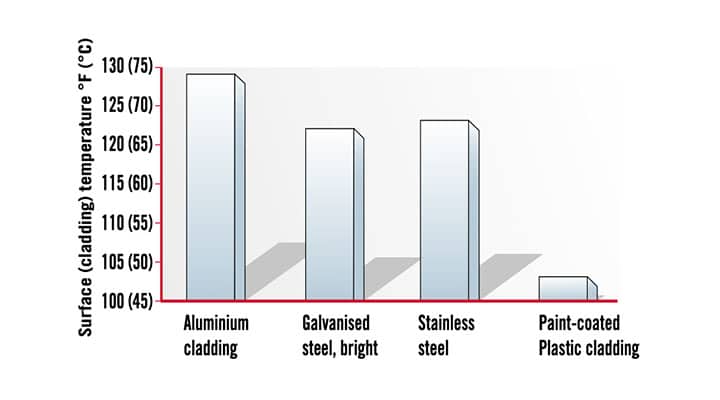
Graph comparing surface temperatures of jacket sheets. Source - ROCKWOOL PROCESS
Pipe Hangers and Pipe Supports
There are various types of pipe hangers and supports, illustrated below:
-
- Direct-mount pipe hangers
- Direct-mount pipe supports
- Indirect-mount pipe supports (typically used in cold insulation)
Direct-mount pipe hangers
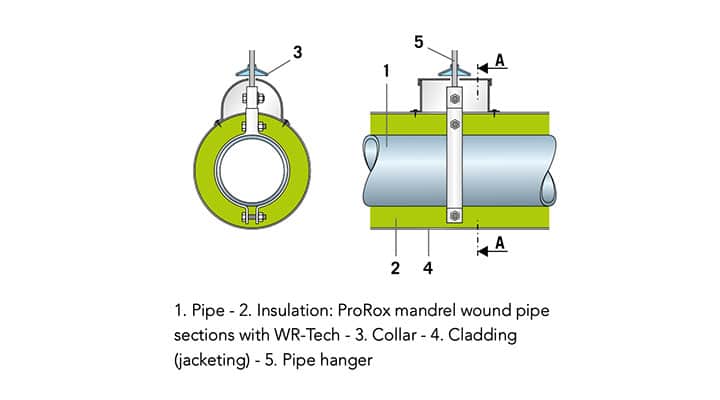
Image of insulating pipe hanger equipment. Source - ROCKWOOL PROCESS
Direct-mount pipe hangers
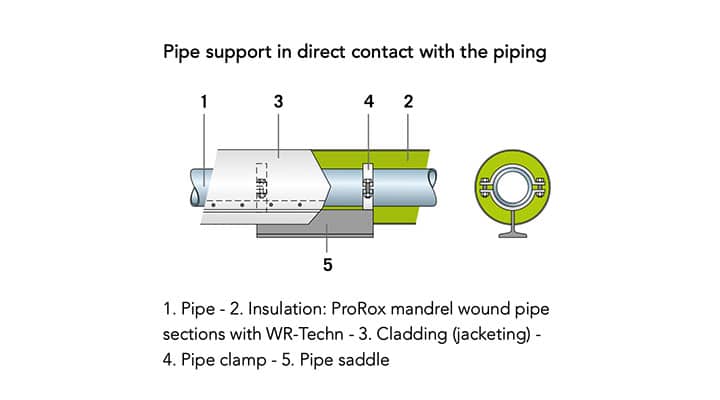
Image of insulating pipe support equipment not directly attached to the pipe. Source - ROCKWOOL PROCESS
Direct-mount pipe hangers
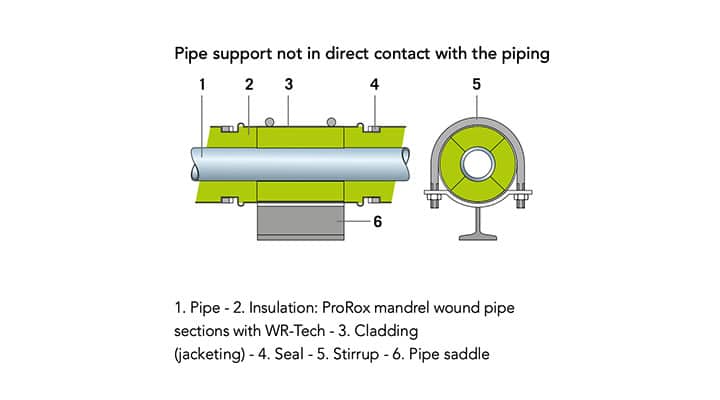
Image of insulating pipe support equipment directly attached to the pipe. Source - ROCKWOOL PROCESS
Insulating Valves and Flanges with Mineral Wool
Heat loss occurs at uninsulated joints or flanges. We can roughly estimate that a valve loses heat equivalent to 1 meter of uninsulated straight pipe.
Without insulation at valves or flanges, internal material temperature drops, reducing system efficiency. Valves and flanges should be insulated with at least the same thickness as pipe insulation.
Guidelines for Thermal Insulation of Joints and Flanges
Joint or flange insulation should overlap straight pipe insulation by about 50 mm
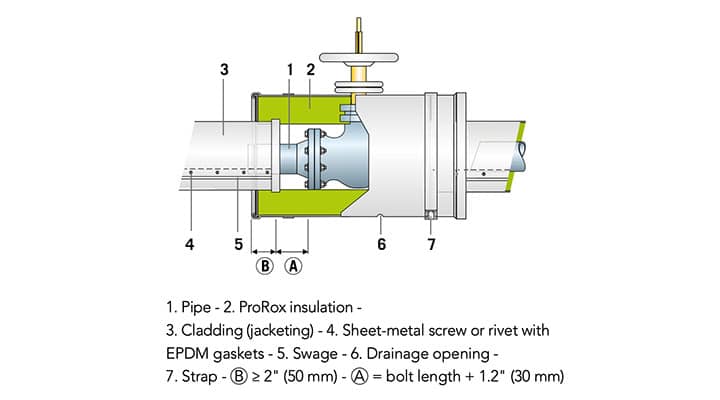
Insulating gate valves with mineral wool. Source - ROCKWOOL PROCESS
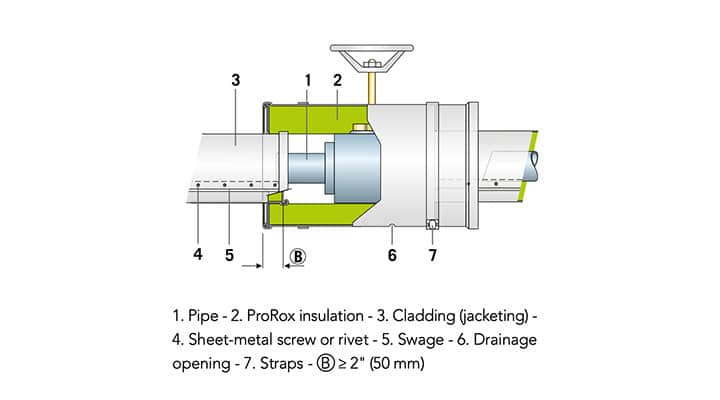
Insulating butterfly valves with mineral wool. Source - ROCKWOOL PROCESS
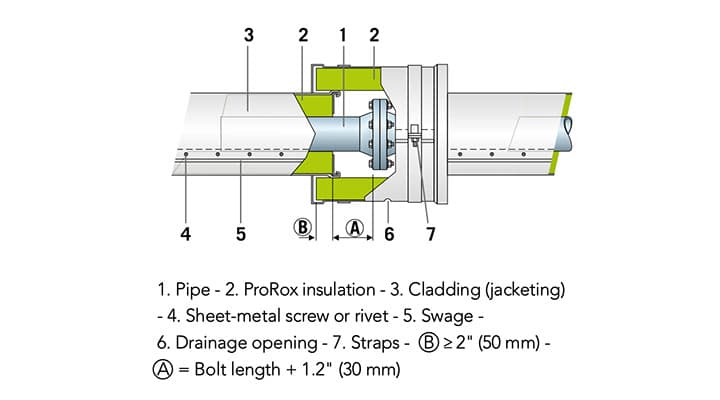
Insulating joints with mineral wool. Source - ROCKWOOL PROCESS
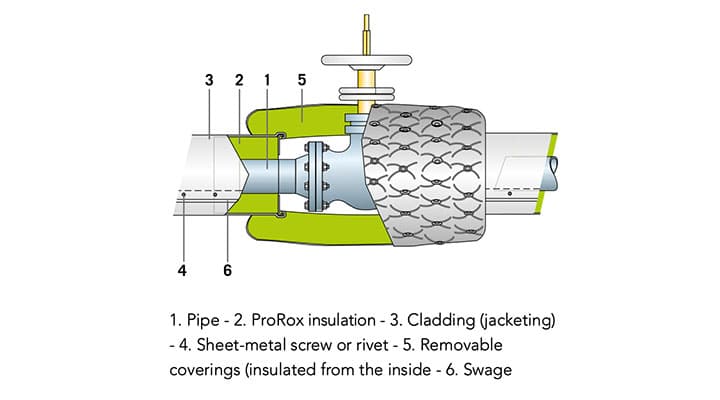
Insulating gate valves with mineral wool. Source - ROCKWOOL PROCESS
How to Insulate Elbows and T-Pieces
Elbow or T-piece cladding is easily damaged from pipe vibration or expansion, and must resist moisture and vapor when installed outdoors.
Insulating Elbows with ROCKWOOL ProRox PS Pre-formed Pipe Sections
We cut pre-formed pipe section insulation to match elbow curves
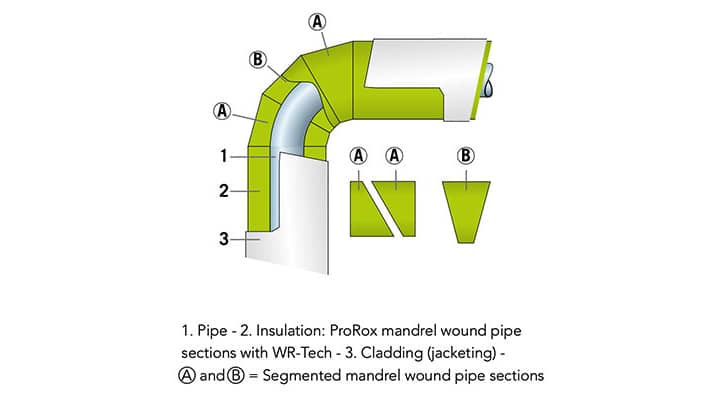
Insulating elbows with prefabricated ROCKWOOL pipe sections. Source - ROCKWOOL PROCESS
Insulating Elbows with ROCKWOOL ProRox WM Wire Mesh
We cut wire mesh mineral wool into a fish-shaped elbow pattern for perfect fit against the elbow, then secure wire mesh with wire or ties. Install spacers at start and end points of elbow.
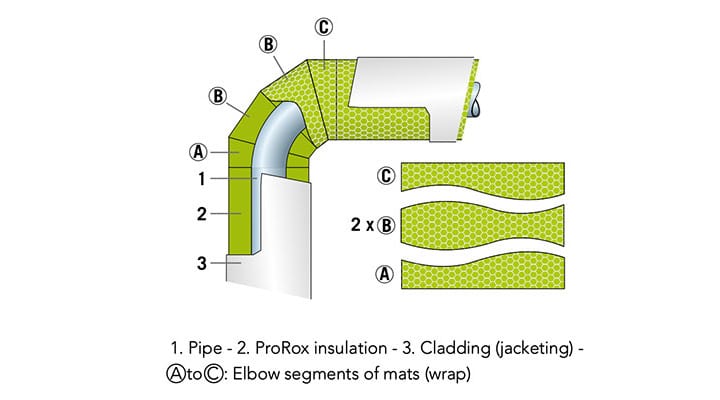
Insulating elbows with ROCKWOOL wire mesh blanket Source - ROCKWOOL PROCESS
Cladding Installation at Elbows
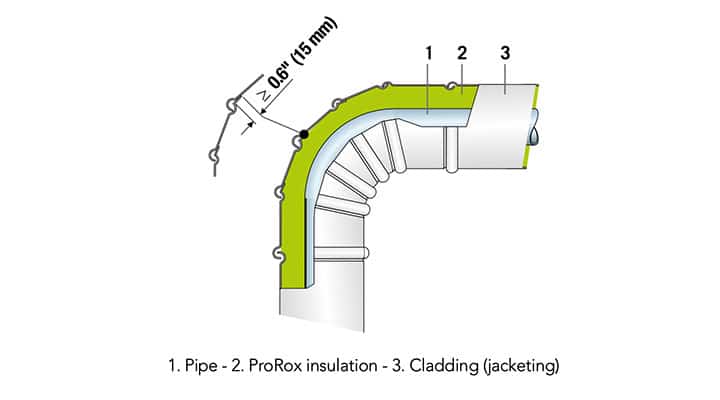
Installing elbow jacket. Source - ROCKWOOL PROCESS
Cladding Installation at T-Pieces
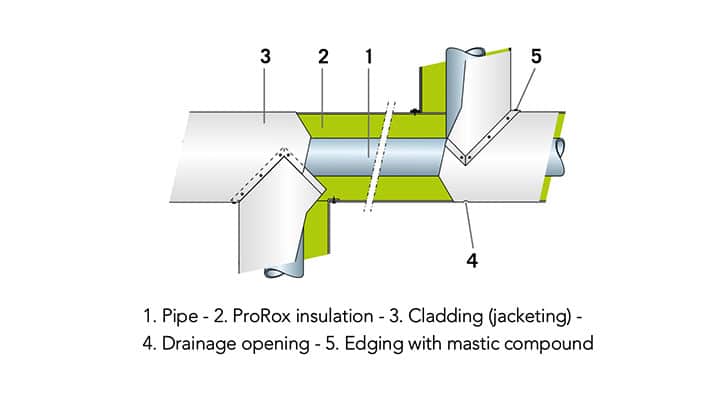
Insulating and jacketing 3-way joints with mineral wool. Source - ROCKWOOL PROCESS
Insulating Reducers
Insulating Horizontal Reducers with Mineral Wool
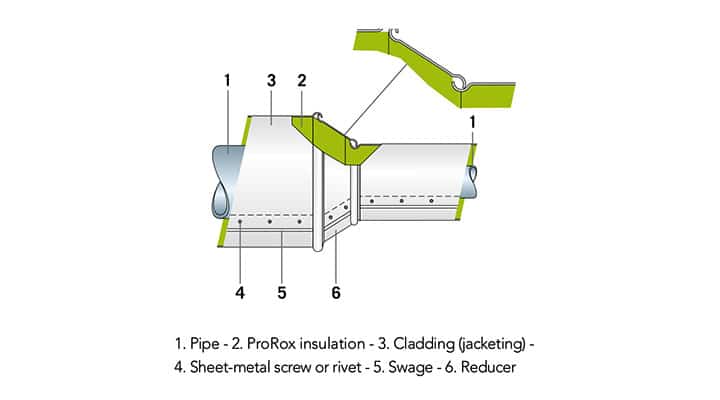
Insulating horizontal pipe reducers with mineral wool. Source - ROCKWOOL PROCESS
Insulating Vertical Reducers with Mineral Wool
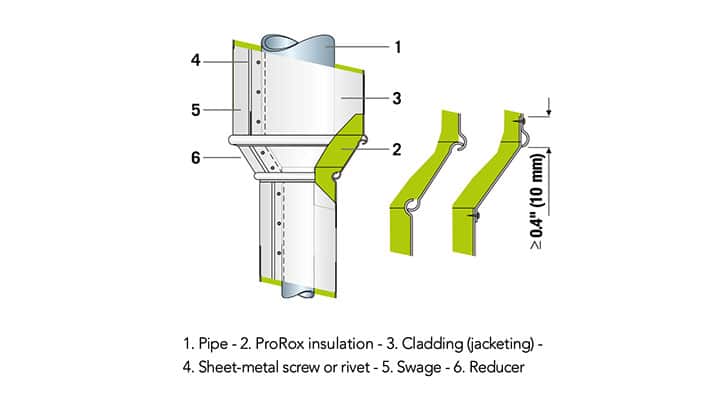
Insulating vertical pipe reducers with mineral wool. Source - ROCKWOOL PROCESS
Expansion Joints
In insulation systems, pipe and cladding expansion can differ significantly. Uneven expansion results from different materials, thermal insulation, and temperatures causing different expansion coefficients.
We use Al as the symbol for longitudinal expansion
Δl = l * Δt * α
l = pipe length
Δt = temperature difference between hot and cold pipe (or cladding)
α = longitudinal expansion coefficient
|
Material |
Longitudinal Expansion Coefficient (α) |
|---|---|
|
Aluminum |
23.8 |
|
Bronze |
200 |
|
Cast Iron |
10.4 |
|
Copper |
16.5 |
|
Stainless Steel |
16 |
|
Iron |
11 |
Insulating Vertical Expansion Joints with Mineral Wool
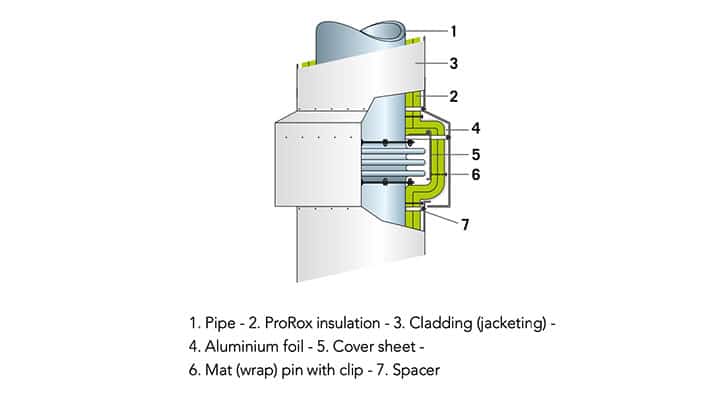
Insulating vertical expansion joints with mineral wool. Source - ROCKWOOL PROCESS
Insulating Horizontal Expansion Joints with Mineral Wool
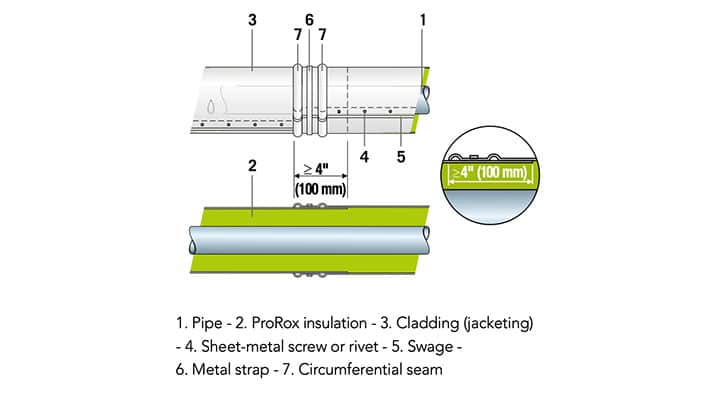
Insulating horizontal expansion joints with mineral wool. Source - ROCKWOOL PROCESS
Foot Traffic on Insulated Pipes
Avoid walking on insulated pipes as this can damage insulation, such as creating gaps in cladding joints that allow moisture to reach pipes and cause rust.
In limited space where maintenance requires pipe walking, use ProRox PS970 pre-formed pipe sections that resist both cladding weight and foot traffic compression. For wire mesh insulated pipes, cladding must be installed on pipe support brackets to handle walking weight and cladding weight.