
Fires occur frequently worldwide and are events that cause loss of property and human lives. Thailand has fire control laws but may be considered “not strict” because many buildings still do not comply with the standards set by law.
In Thailand, we have standards from the Department of Public Works called Fire Protection Standards and related laws including the Building Control Act B.E. 2543, but the internationally used standard is NFPA (National Fire Protection Association).
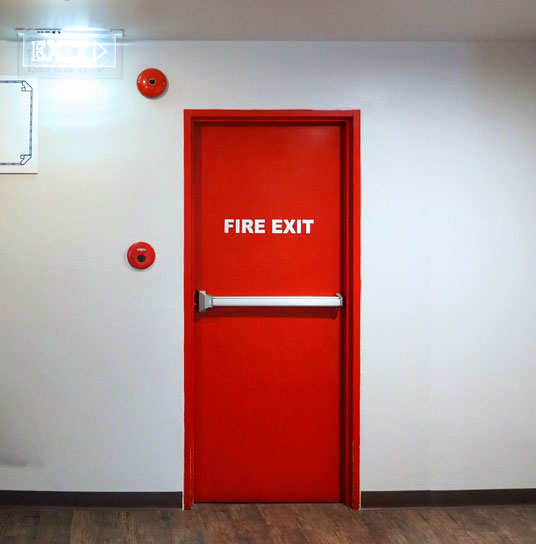
What is Fire Protection Work?
Fire protection work involves multiple disciplines but shares a common goal: to protect life, property, business operations, and the environment. In the Building Control Act No. 3 B.E. 2543
It is required that high-rise buildings and assembly buildings must have engineering inspectors or architectural inspectors conduct inspections of fire alarm systems, fire prevention and suppression systems, and report the inspection results to local authorities.
Fire protection principles consist of
- Building fire-resistant structures
- Creating fire and smoke compartments
- Providing convenient and safe fire escape routes
- Controlling materials within buildings
- Good safety management
- Fire alarm systems
- Fire suppression and smoke control systems that meet standards and are in good working condition
Building Area Compartmentalization
The reason we compartmentalize building areas is to control fire within designated boundaries and prevent it from spreading to other areas, limiting damage to a single area. This gives people time to evacuate safely and allows firefighters time to enter and extinguish the fire.
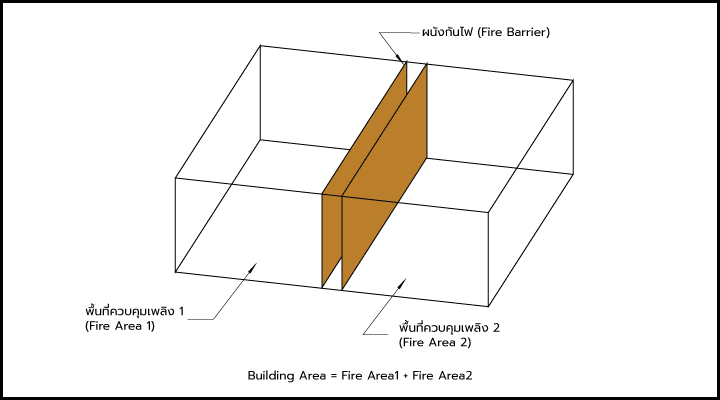
From this building plan, we can see that if a fire occurs in Zone A, it will not spread to Zone B because there is area separation between Zone A and B with a partition wall. The partition wall between zones must be a 2-hour fire-resistant wall, and if there are openings in the partition wall such as doors or pipes penetrating the wall, the opening materials must have a fire resistance rating equal to the partition wall (2-hour fire-resistant wall, therefore doors must also be 2-hour fire-resistant).
Examples of Fire Resistance Ratings for Non-Load Bearing Walls
| Wall Type | Fire Resistance Rating (minutes) |
|---|---|
| Half-brick masonry wall with 1.5-2 cm plaster on both sides | 60 |
| Full-brick masonry wall with 1.5-2 cm plaster on both sides | 120 |
| 14 cm thick concrete block wall with 1.5-2 cm plaster on both sides | 120 |
| 19 cm thick concrete block wall with 1.5-2 cm plaster on both sides | 180 |
Opening Protection
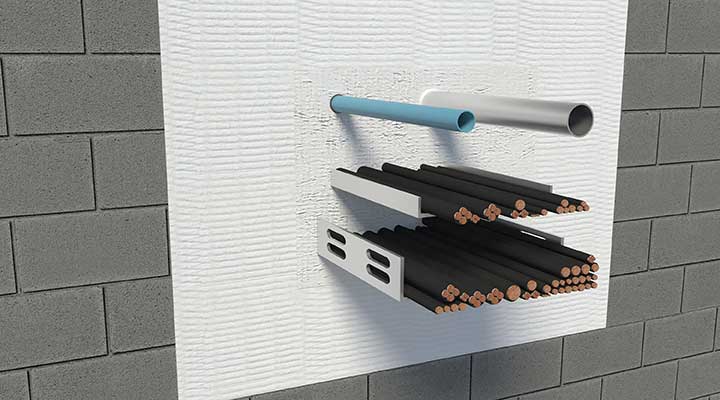
We have reasons to protect openings that penetrate fire walls to prevent smoke or flames from spreading through those openings. In case of fire, we have properly compartmentalized zones so fire cannot spread to other zones, but we forget to protect pipe holes through walls, allowing smoke to pass through these openings and obstruct visibility while we are escaping. Opening protection is done to ensure the integrity of walls that we have used for building compartmentalization.
Building Material Control
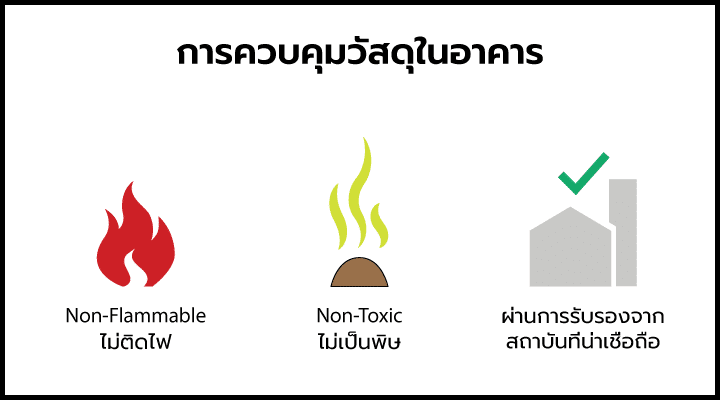
Materials attached to buildings remain with the building for long periods such as floors, walls, ceilings, curtains, decorative equipment, etc.
– Materials used should not be flammable (Not Flammable)
– Materials used should not contain toxic substances when ignited or producing smoke (Non Toxic)
– Materials should have standards tested by credible institutions
Means of Egress
Escape routes are pathways that lead us to safe areas or to ground level. They must be unobstructed, sufficient in number, and must be safe areas (free from smoke or fire) because escape routes are something we can choose which way to escape safely. Should we wait for sprinklers to activate and spray water to extinguish the fire?
If something malfunctions with the sprinkler system (which should not happen), we still have safe escape routes, building zone compartmentalization to prevent fire spread, fire-resistant buildings that can be trusted, and building material control certified by credible institutions. We can therefore be confident to some extent that we can preserve life. These are called Passive Fire Protection.
Active Fire Protection systems require command or fire detection capabilities first, such as
- Fire Alarm System
- Fireman Lift
- Communication System
- Emergency Electric System
- Lighting System
- Sprinkler System


