

Calculating ROCKWOOL Stone Wool Insulation Thickness with RockAssist Program
In hot pipe lagging or hot tank insulation applications, we use ROCKWOOL stone wool insulation to wrap equipment to conserve energy and protect workers in the area from hazards.
What is RockAssist
RockAssist is a program that helps calculate the required thickness of stone wool insulation for wrapping various heating equipment. It provides data options for both flat surfaces and various pipe sizes (Pipe Section).
How to Use RockAssist
RockAssist is a ROCKWOOL program used to calculate insulation systems to solve heat problems in factories for both hot pipe systems and hot tanks. You can register for use at this link >>>> https://www.rockassist-asia.com
Registering for RockAssist Asia

Registering for ROCKWOOL's RockAssist Asia
When you arrive at the RockAssist website, first you need to register for use.
- Click the Register button to sign up.
- After registration is complete, you will receive a confirmation email to enable usage.
- Enter your email and password, then log in to access the system.
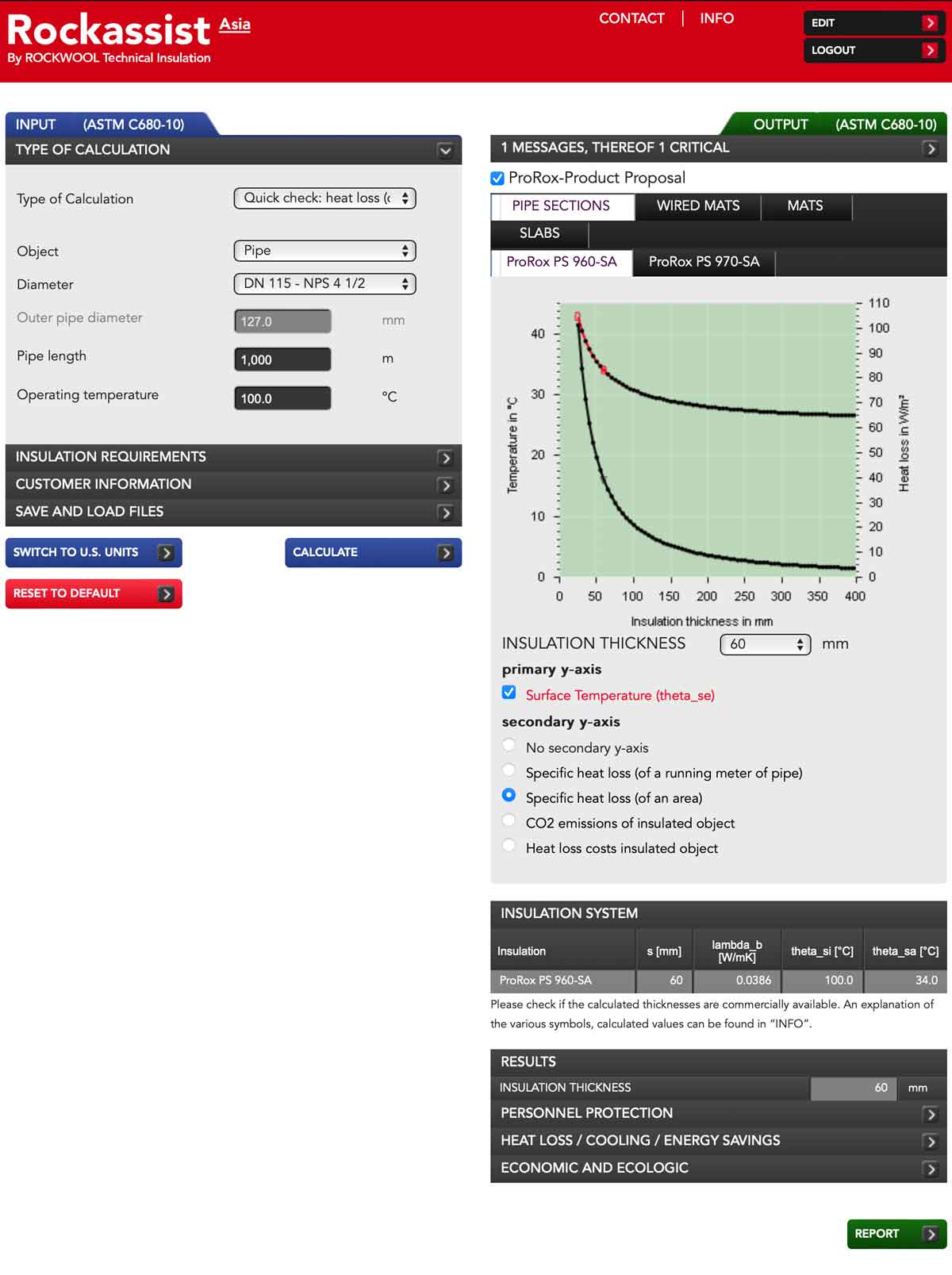
The RockAssist window is divided into 2 sides: input and output
After successfully logging in, you will see the screen divided into 2 sections:
- Input (data that we enter for calculation purposes)
- Output (calculation results displayed in graphs and tables)
TYPE OF CALCULATION
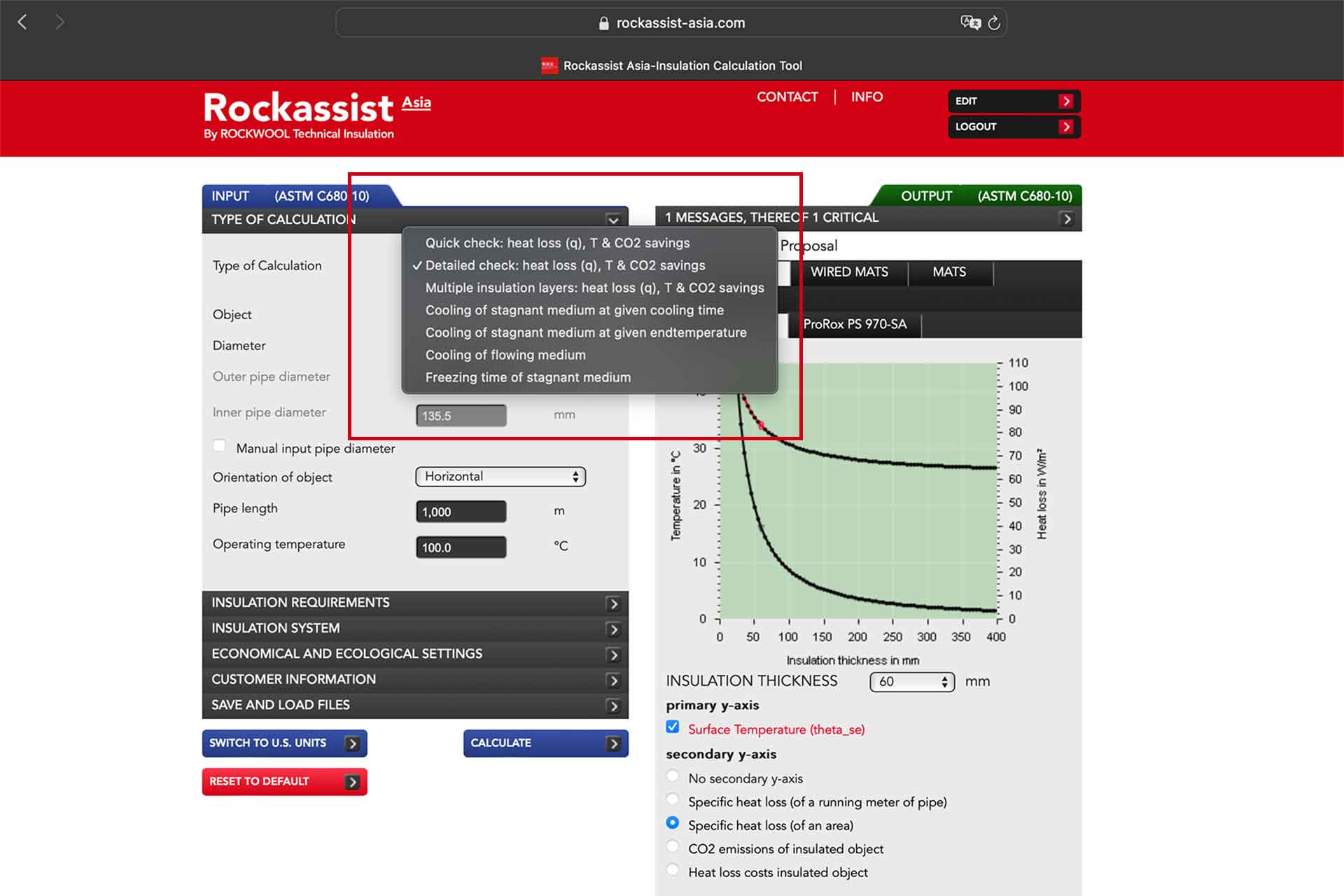
RockAssist calculation has 7 formats in total
Let’s look at the first window in the Input section called TYPE OF CALCULATION. In the TYPE OF CALCULATION section, this is the calculation format for what type of results we need.
1.) Quick check: heat loss(q), T & CO2 savings
- Quick thermal insulation thickness calculation with fewer parameters
2.) Detail check: heat loss(q), T & CO2 savings
- Detailed thermal insulation thickness calculation with many parameters
3.) Multiple Insulation layers: heat loss(q), T & CO2 savings
- Calculation for insulation thickness with multiple overlapping material layers
4.) Cooling of stagnant medium at given cooling time
- Calculation for insulation thickness used to maintain internal system temperature for a specified time period
5.) Cooling of stagnant medium at given end temperature
- Calculation for insulation thickness used to prevent temperature from dropping below specified limits
6.) Cooling of flowing medium
- Calculation for insulation thickness and fluid temperature after insulation wrapping
7.) Freezing time of stagnant medium
- Calculation for insulation thickness to prevent fluid freezing
Object
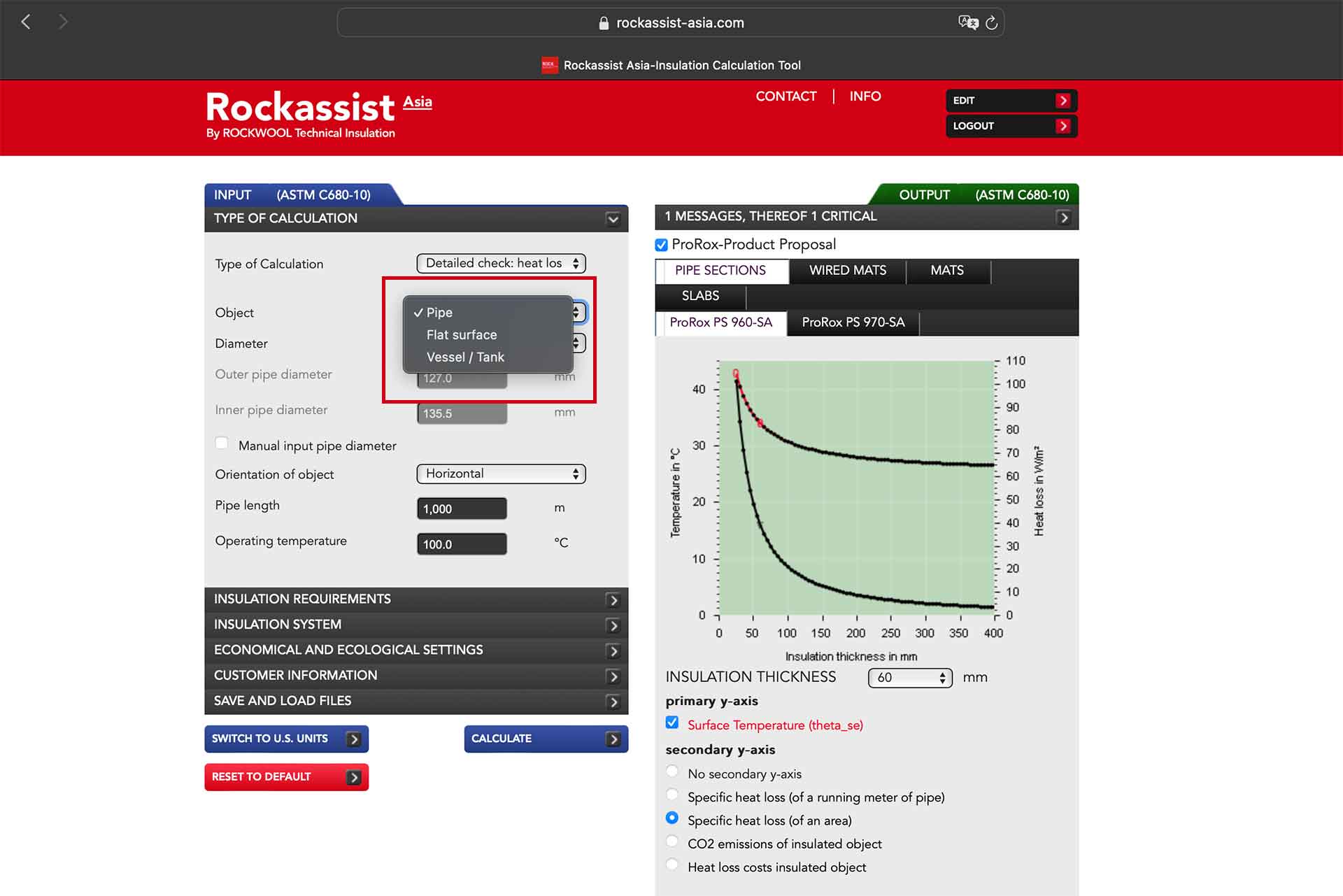
Objects in the RockAssist window have 3 types
Object refers to the vessel used to contain fluids, with 3 types available:
- Pipe
- Flat Surface
- Tank / Vessel
Pipe
If we select Pipe as the Object, the screen will show 4 parameters:
- Pipe Diameter – pipe size in millimeters and inches
- Orientation of object – Horizontal and Vertical
- Pipe length – length in meters
- Operating Temperature – fluid temperature in ºC
Flat surface
If we select Flat Surface as the Object, the screen will show 4 parameters:
- Length of flat area – length in meters
- Width of flat area – width in meters
- Orientation of object – Horizontal and Vertical
- Operating Temperature – fluid temperature in ºC
Tank / Vessel
If we select Tank / Vessel as the Object, the screen will show 4 parameters:
- Tank Diameter – diameter in meters
- Length – length in meters
- Orientation of object – Horizontal and Vertical
- Operating Temperature – fluid temperature in ºC
Calculation Example
TYPE OF CALCULATION
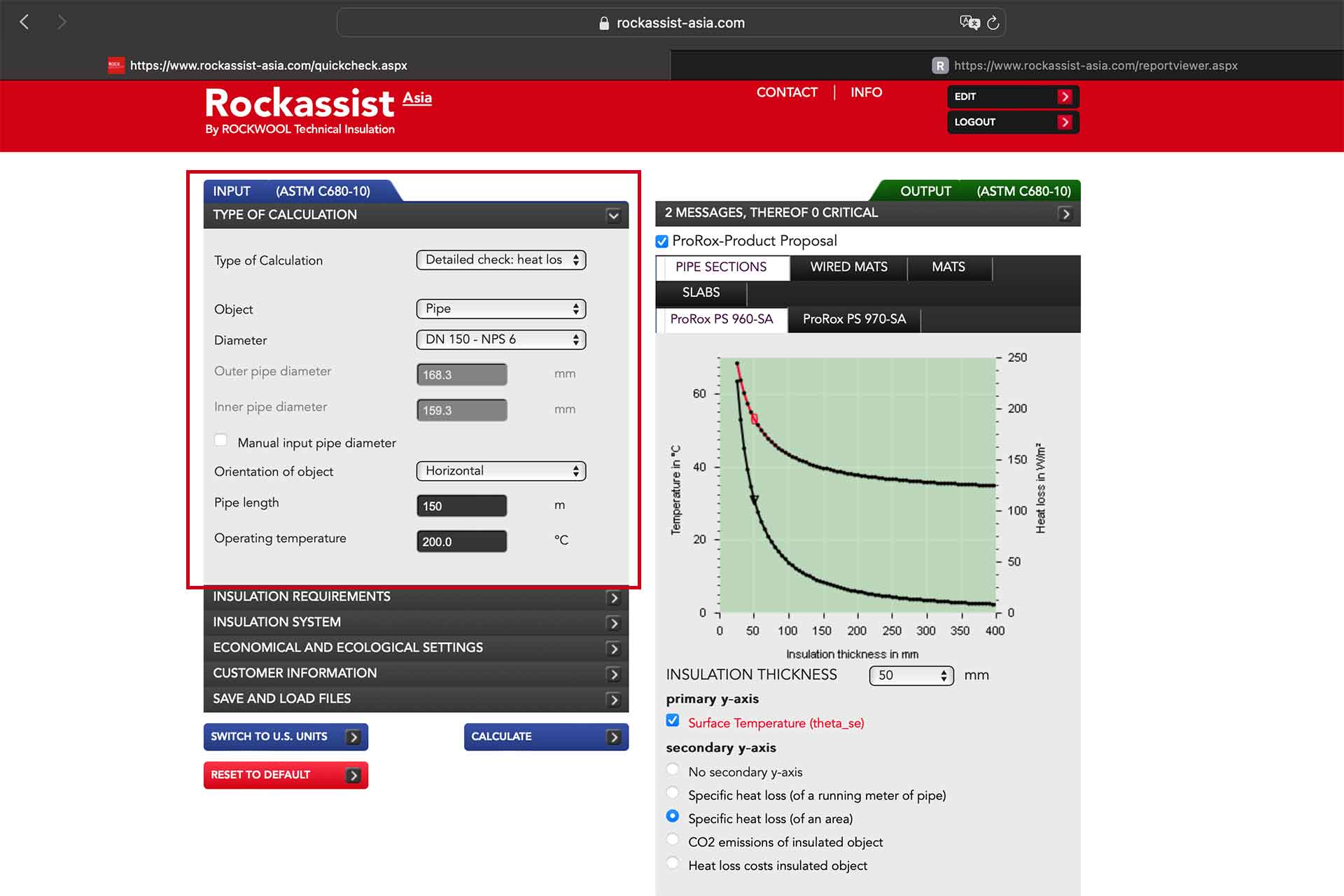
Example calculation for steam pipe insulation thickness
Let’s look at an example of how to calculate insulation thickness for steam pipe lagging.
We will calculate the stone wool insulation thickness for a 6-inch steam pipe at 200ºC temperature, 150 meters long. We will set the TYPE OF CALCULATION section as follows:
Enter values in TYPE OF CALCULATION
INSULATION REQUIREMENTS
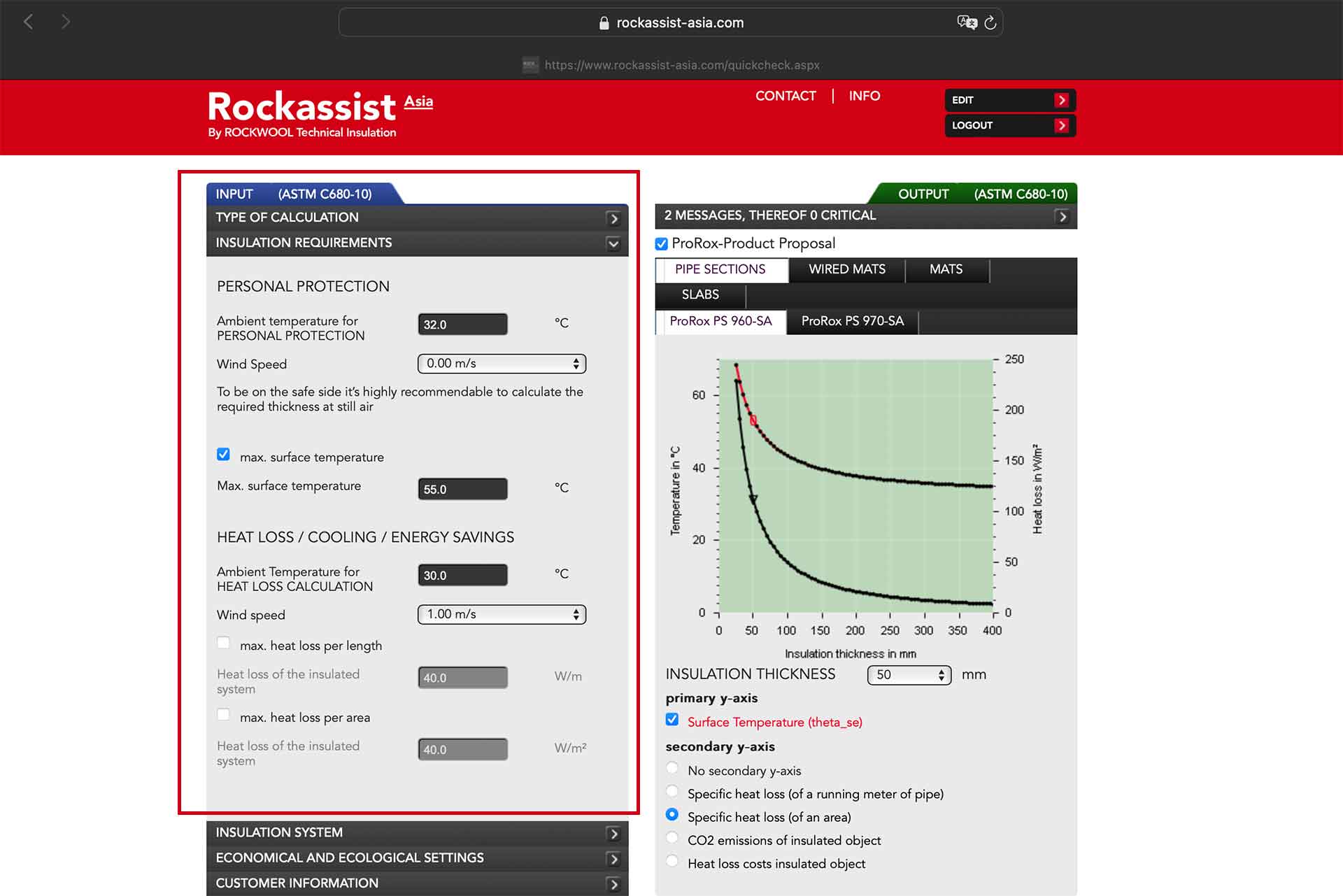
INSULATION REQUIREMENT window in RockAssist
Next is the INSULATION REQUIREMENT section, which is very important for determining stone wool insulation thickness.
Personal Protection
This value is used to protect people from contact, consisting of 3 parts:
- Ambient Temperature is the environmental temperature around the steam pipe in areas where people can make contact, such as factory temperature
- Wind Speed is the wind velocity in areas where people can make contact. For locations without wind, enter 0
- Max surface Temperature is the maximum temperature at the insulation jacket surface, typically set at 55 ºC
HEAT LOSS / COOLING / ENERGY SAVING
Calculating stone wool insulation thickness to reduce thermal energy loss
- Ambient Temperature is the environmental temperature around the steam pipe for calculating heat loss
- Wind Speed is the wind velocity for calculating heat loss
- Max heat loss per length is the maximum thermal energy loss per meter
- Max heat loss per area is the maximum thermal energy loss per area
Enter values in INSULATION REQUIREMENTS
We don’t need to fill in the remaining sections
INSULATION SYSTEM
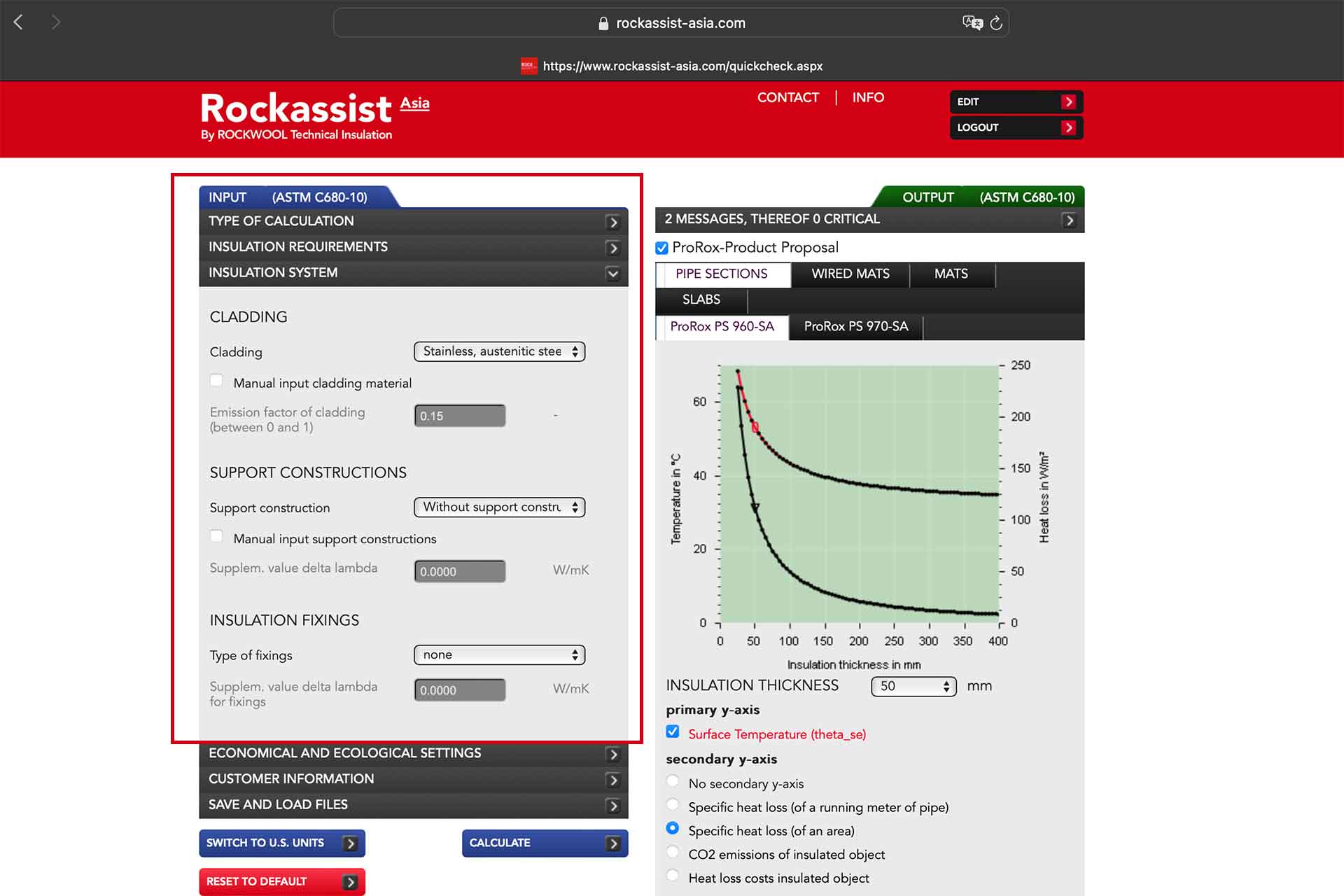
INSULATION SYSTEM window in RockAssist
This section specifies the insulation system structure, consisting of 3 parts:
- Type of Cladding
- Type and format of Support
- Type of flange joint surface
Enter values in INSULATION SYSTEM
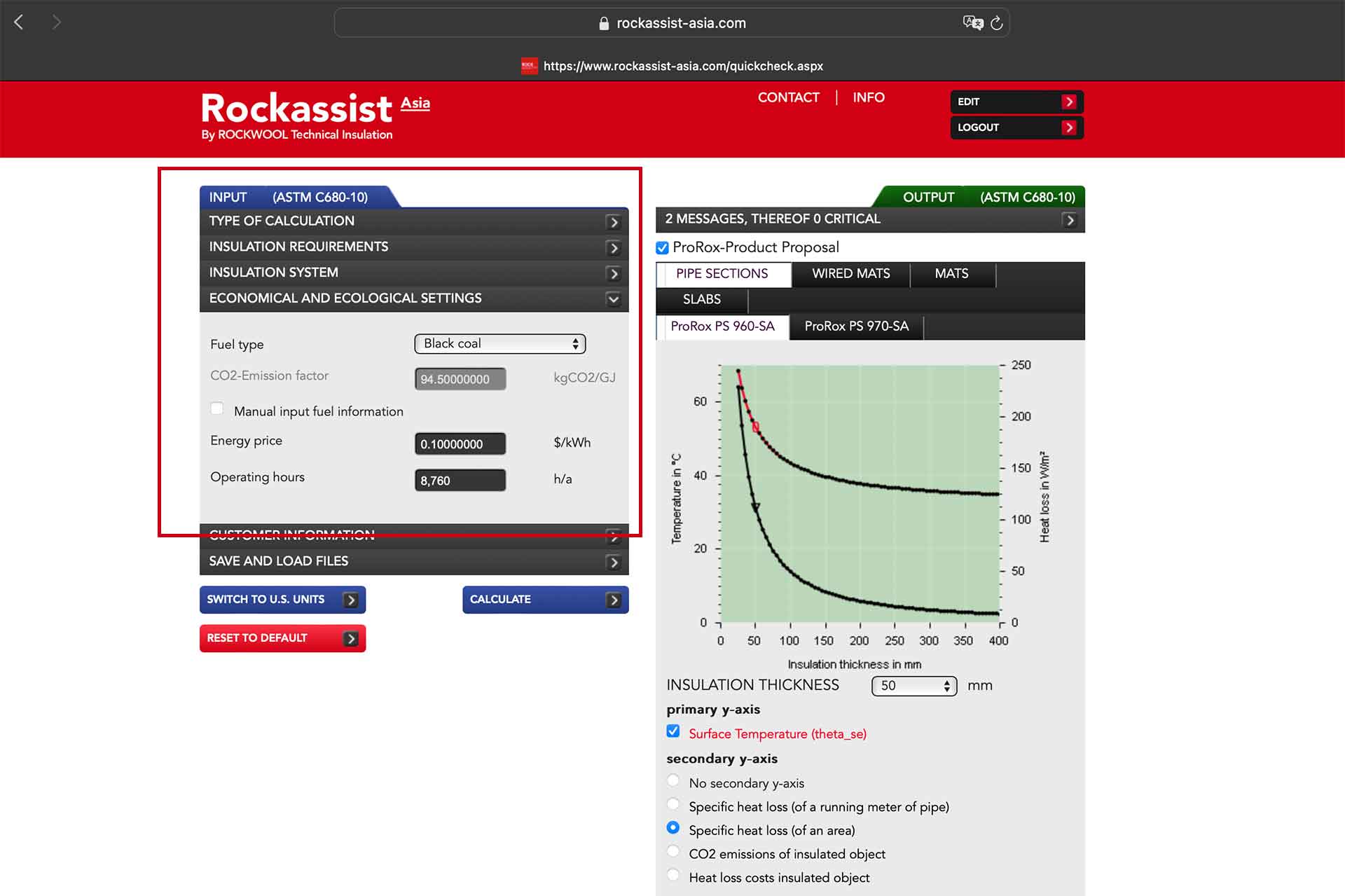
ECONOMICAL AND ECOLOGICAL SETTINGS
INSULATION SYSTEM window in RockAssist
This section specifies the insulation system structure, consisting of 3 parts:
- Type of Cladding
- Type and format of Support
- Type of flange joint surface
Enter values in INSULATION SYSTEM
Calculation Results OUTPUT
After entering all INPUT values, we get results in the OUTPUT section on the right
After entering all the required data, we click the Calculate button to get results in the green Output section on the right
- The insulation thickness for the 6-inch steam pipe at 200ºC, 150 meters long will be 50 mm thick
- The stainless steel jacket surface temperature will be 53.1ºC
If we click the green Report button below, it will open the report. See the next page
RockAssist Report
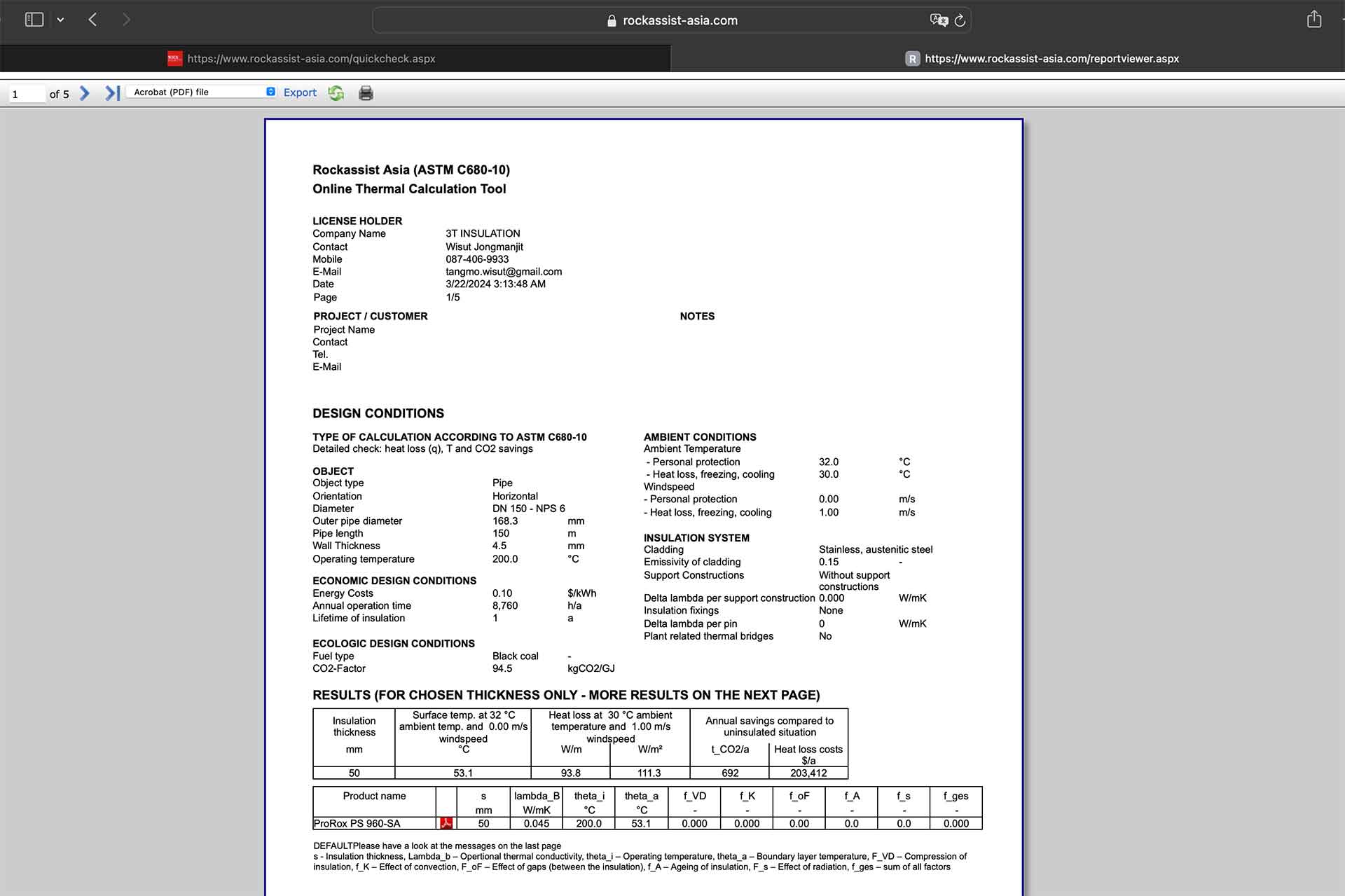
RockAssist Report Window
After opening the Report, on the first page we will see details of the data we entered from the TYPE OF CALCULATION section through the ECONOMICAL AND ECOLOGICAL SETTINGS section, along with the stone wool insulation thickness results
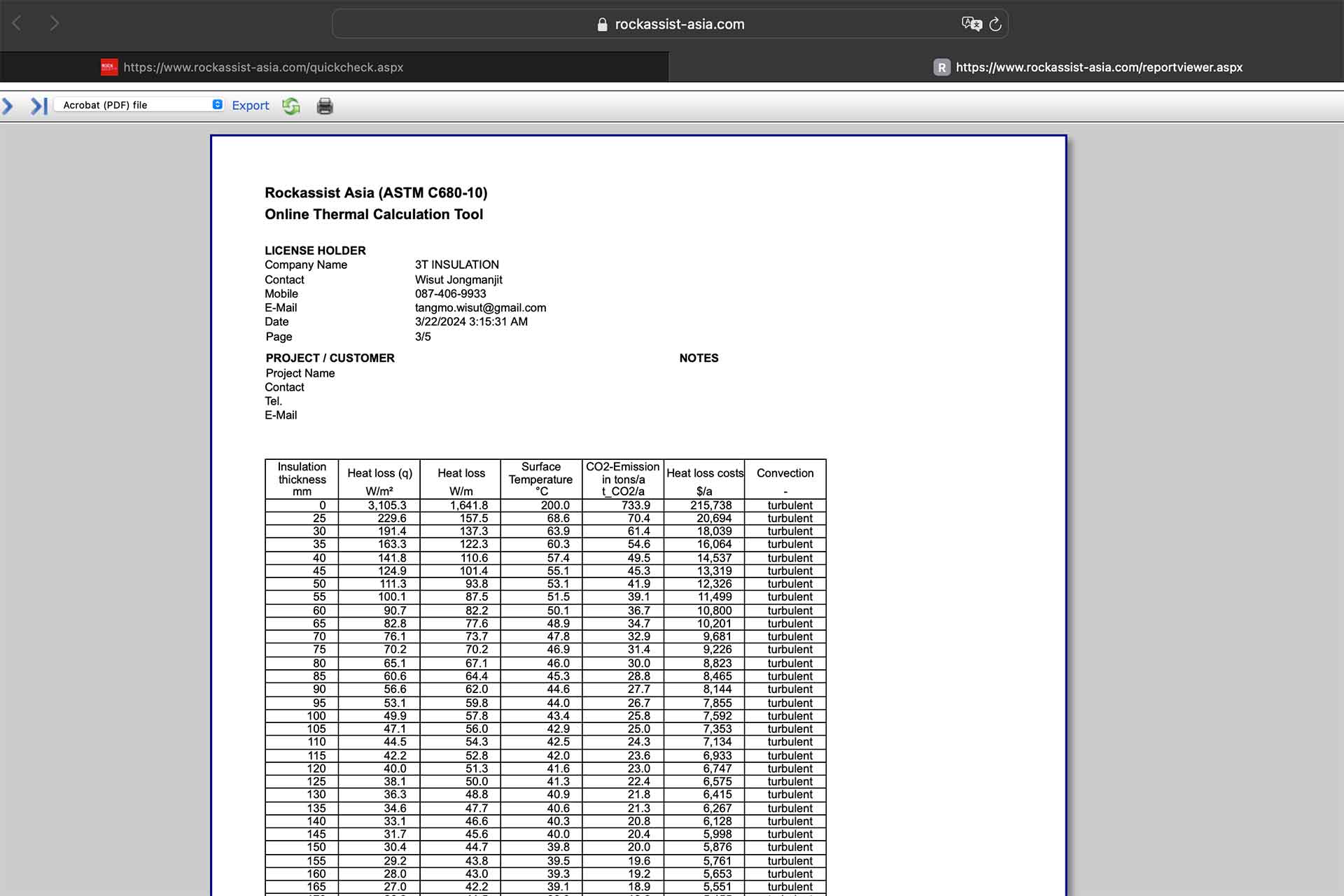
Page 3 shows thickness and jacket surface temperature
On page 3 of the report, it shows the jacket surface temperature at various stone wool insulation thicknesses. If we want to increase or decrease insulation thickness, we can refer to page 3 of the report


