

Plumbing System Design
Key Considerations in Plumbing System Design
- Water Quality and Quantity
Water supplied to buildings must be of suitable quality for consumption and use, with sufficient quantity for operational needs.
- Pipe Materials
Plumbing pipe materials are standardized for water distribution. Building plumbing typically uses Galvanized Steel Pipe, Black Steel Pipe, Copper Pipe, Cast Iron Pipe, or Plastic Pipe (PE, PVC).
- Building Plumbing System
As a principle, pipes should be installed in straight lines to achieve the shortest distance (for cost efficiency).
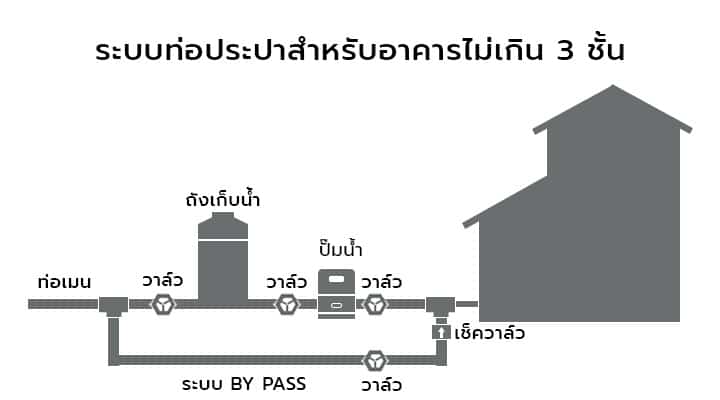
Plumbing System for Buildings up to 3 Floors
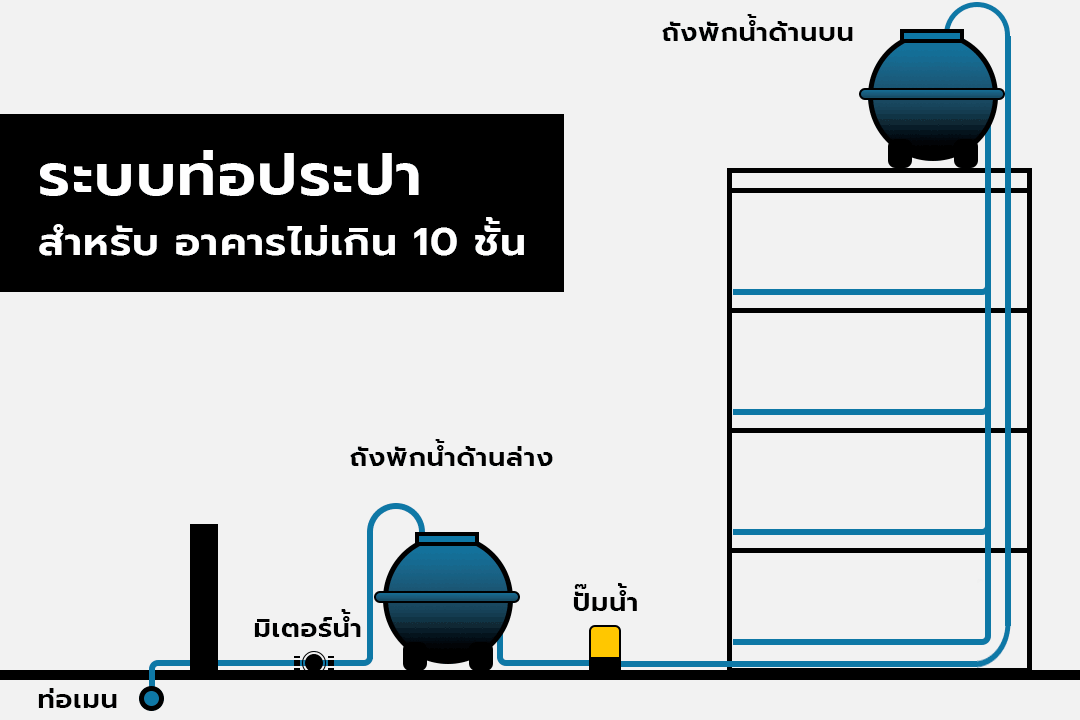
Plumbing System for Buildings up to 10 Floors
Types of Building Water Distribution Systems
Building water distribution systems can be divided into 2 types based on design:
- Upfeed System
The upfeed system distributes water upward through the building height, suitable for buildings up to 10 floors and less than 10,000 square meters.
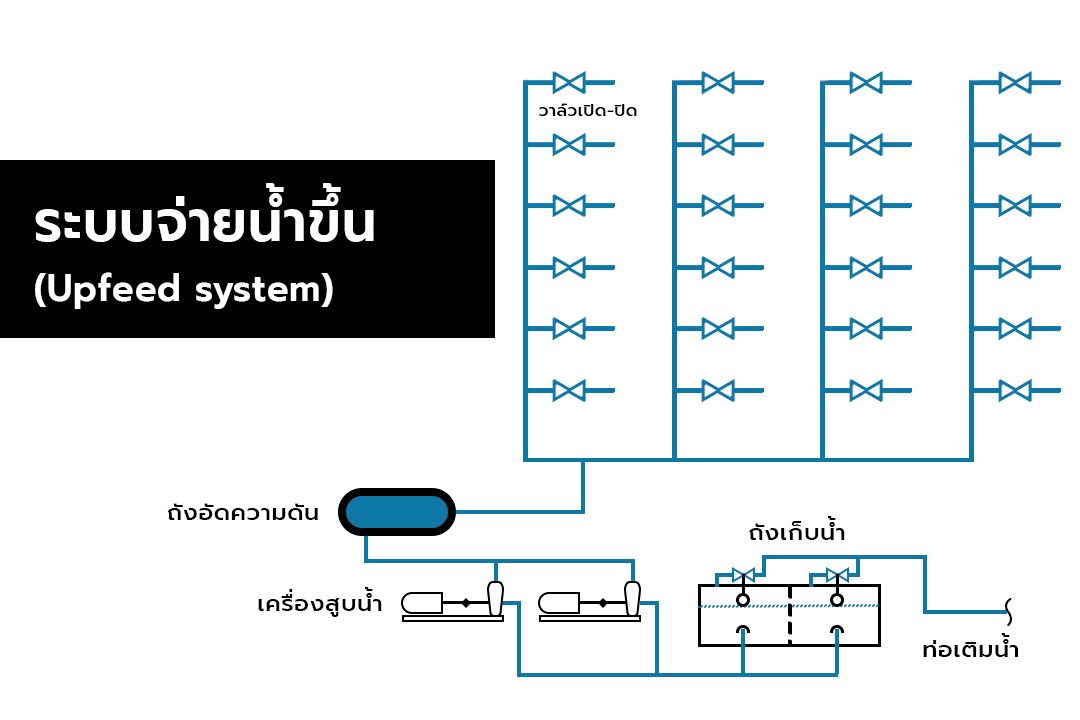
Upfeed System
- Downfeed System
The downfeed system distributes water downward from the top floor, suitable for tall buildings and large buildings.
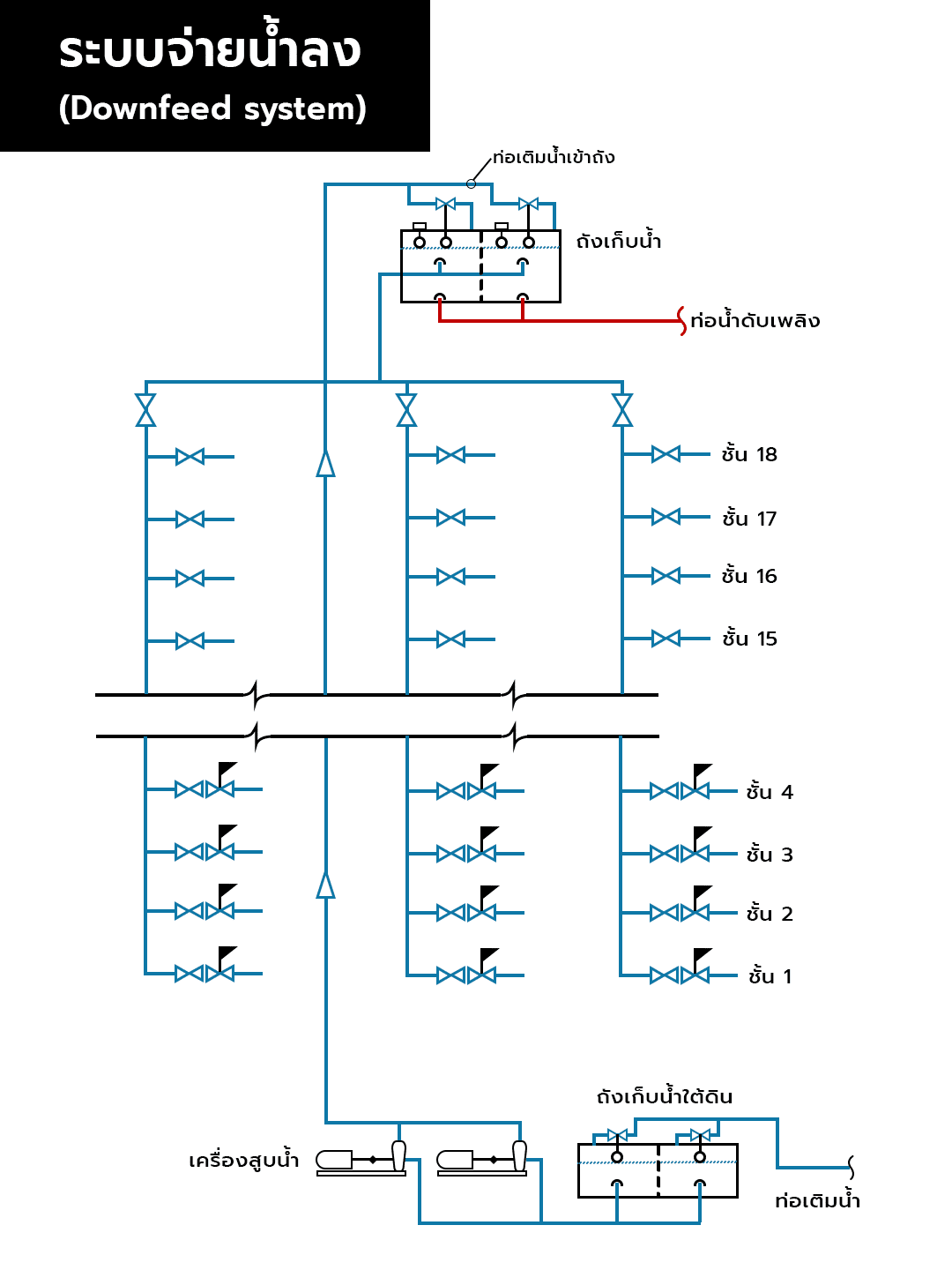
Downfeed System
Water distribution in high-rise buildings can be divided into multiple zones for easier maintenance and pressure management.
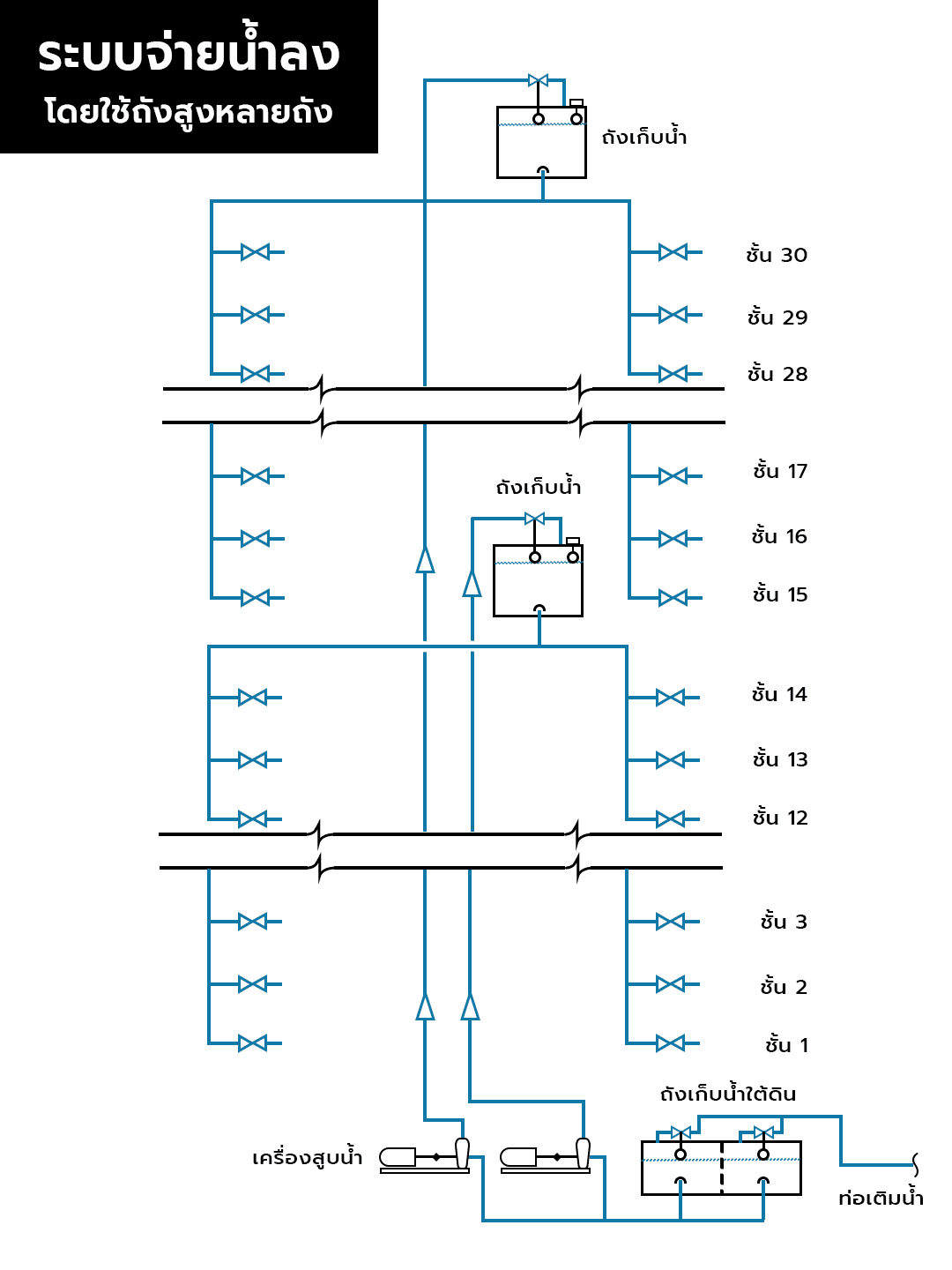
Downfeed System with Multiple High Tanks
In downfeed systems with rooftop water tanks, plumbing fixtures and water-using equipment on upper floors may have insufficient water pressure and volume. Therefore, the upper floor water system is separated and a “pressure tank” is added to increase pressure and water volume for adequate usage.
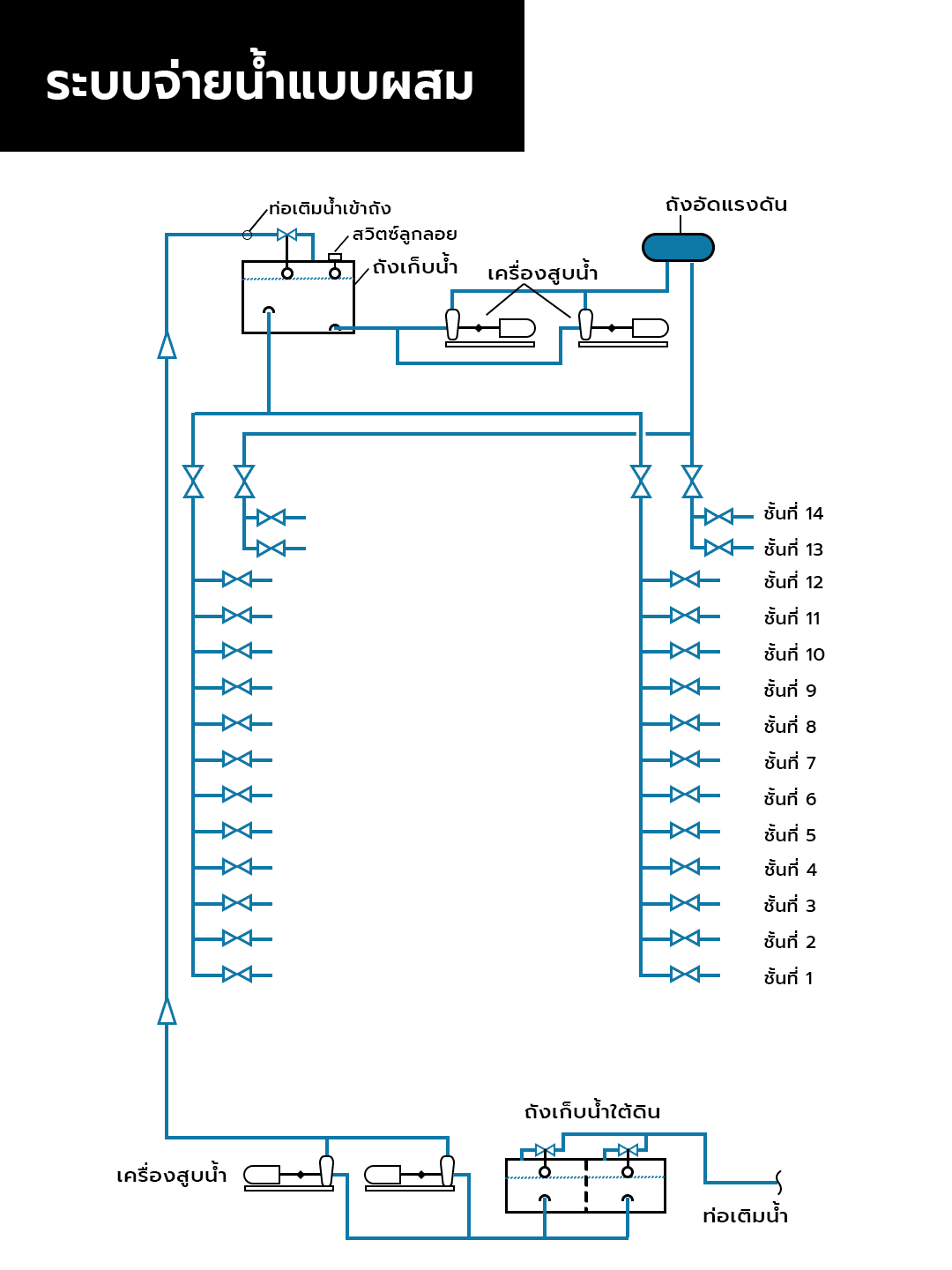
Combined System
Water Hammer
Water hammer occurs when flowing water is suddenly blocked (by closing valves or faucets). When water cannot continue flowing, it creates impact and backflow, causing pipe vibration, noise, and accelerated pipe damage.
Water hammer pressure can be calculated using the formula:
P = 14.8V
Where:
P = Pressure increase from water hammer (unit: bar)
V = Water velocity (unit: meters/second)
We can see that internal pipe pressure increases 4-8 times normal operating pressure.
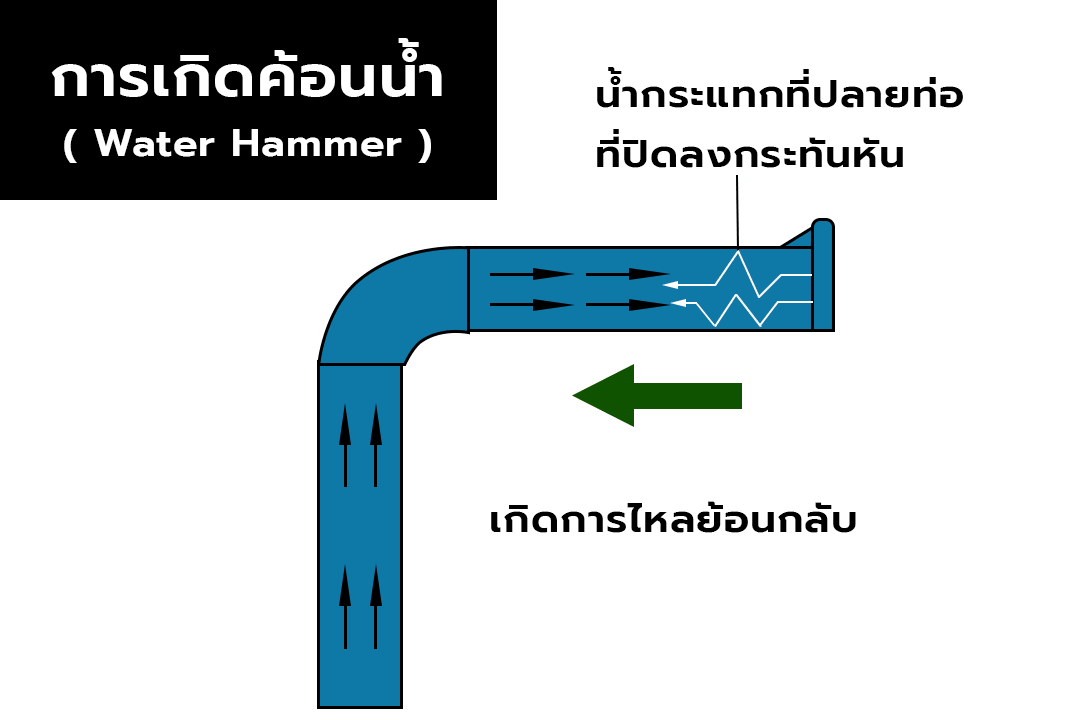
Water Hammer
Water Hammer Prevention
We can prevent water hammer by installing devices that “absorb pressure wave energy” (water hammer arrestor) in the pipe system. The simplest device is called an Air Chamber, which is a water pipe extended beyond the fixture connection.
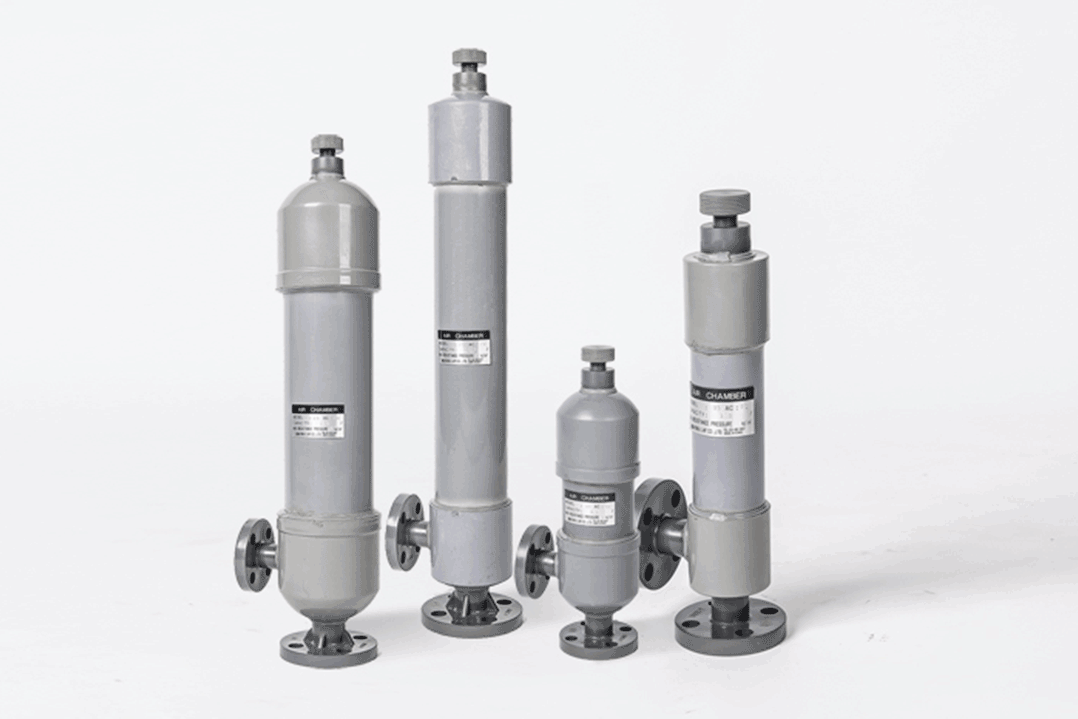
Air Chamber (from dongilmt.com)
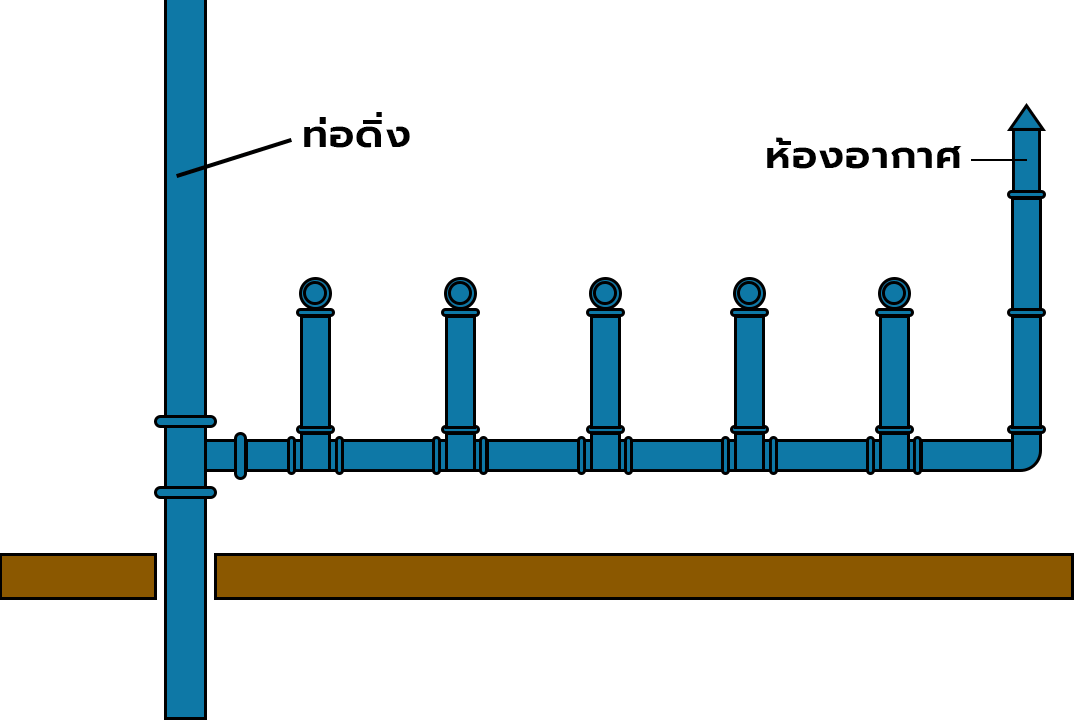
Using Air Chambers for Multiple Fixtures
Flow Rate and Pressure Requirements for Plumbing Fixtures
Each type of plumbing fixture requires specific pressure and flow rates as recommended by manufacturers. Minimum pressure and flow rates for common fixtures can be found in the table below.
Table showing pressure and flow rates for common plumbing fixtures
|
Plumbing Fixtures |
Pressure |
Flow Rate |
|---|---|---|
| Ordinary basin faucet |
0.55 (8) |
0.19 (3) |
| Self-closing basin faucet |
0.84 (12) |
0.16 (2.5) |
| Sink faucet (15 mm.) |
0.35 (5) |
0.28 (4.5) |
| Bathtub faucet |
0.35 (5) |
0.38 (6) |
| Laundry tub cock |
0.35 (5) |
0.32 (5) |
| Shower |
0.84 (12) |
0.32 (5) |
| Ball cock for closet |
1.00 (15) |
0.19 (3) |
| Flush valve for closet | 0.7-1.4 (10-20) |
0.9 – 2.5 (15 – 40) |
| Flush valve for urinal |
1.00 (15) |
0.95 (15) |
Due to varying pipe pressure, installing flow control devices for fixtures provides these benefits:
- Can limit necessary flow rates for each type of fixture
- Enables more precise pipe design
- Saves energy in the water system
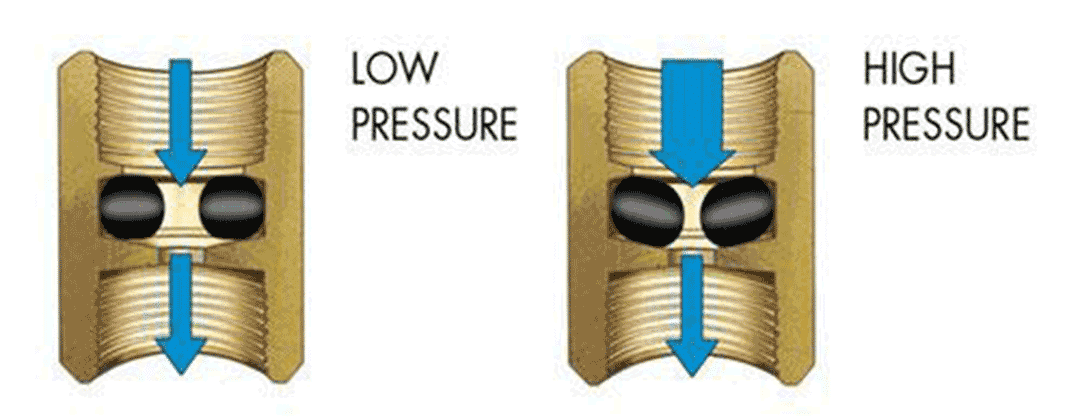
Flexible Orifice (image from bertfelt.com)
Daily Water Demand
Different types of buildings have varying daily water demands, typically ranging from 75-300 liters (20-80 gallons). Daily water demand for buildings can be found in the table below.
| Building Type | Water Demand Liters/Person/Day |
|---|---|
| Residential Buildings/Apartments |
100 – 300 |
| Office Buildings |
40 – 70 |
| Hospitals |
600 – 1200 |
| Schools |
50 – 80 |
| Hotels |
200 – 400 |
| Dormitories |
200 – 300 |
| Laundries |
20 – 40 |
| Airports |
15 – 25 |
Pipe Sizes for Plumbing Fixtures
Plumbing pipe sizes for different fixtures are specified to ensure adequate water supply and appropriate pressure, as shown in the table below.
Table showing minimum pipe sizes for each type of fixture
|
Type of Fixture |
Pipe Size mm. (inches) |
|---|---|
| Bathtub |
15 (1/2) |
| Drinking fountain |
10 (3/8) |
| Dishwasher |
15 (1/2) |
| Lavatory |
15 (1/2) |
| Shower |
15 (1/2) |
| Urinal with angle valve |
15 (1/2) |
| Urinal with flush valve |
20 (3/4) |
| Water closet with flush tank |
15 (1/2) |
| Water closet with flush valve |
25 (1) |
| Hose bib |
15 (1/2) |
| Service sink |
20 (3/4) |
Maximum Water Demand Estimation
In pipe system design, we must consider:
-
- Having sufficient water for fixtures in use
- Number of fixtures used simultaneously
Fixture water demand is measured in fixture units (FU). We can find water demand by totaling FU values for that pipe, then determining flow rate from Hunter’s curve.
We can calculate water flow rate as follows:
1. Total the FU values for that pipe using the table below
Table showing FU values for fixtures
|
Fixtures |
Valve Type |
Building Type |
Cold Water |
Hot Water |
|---|---|---|---|---|
| Water Closet |
Flush Valve |
Public |
10 |
– |
| Water Closet |
Flush Tank |
Public |
5 |
– |
| Urinal |
Flush Valve |
Public |
10 |
– |
| Urinal |
Flush Valve |
Public |
5 |
– |
| Urinal |
Flush Tank |
Public |
3 |
– |
| Lavatory |
Regular Valve |
Public |
1.5 |
1.5 |
| Bathtub |
Regular Valve |
Public |
3 |
3 |
| Shower |
Regular Valve |
Public |
3 |
3 |
| Service Sink |
Regular Valve |
Office |
2.25 |
2.25 |
| Kitchen Sink |
Regular Valve |
Hotel, Restaurant |
3 |
3 |
| Drinking Fountain |
Regular Valve |
Office |
0.25 |
– |
| Water Closet |
Flush Valve |
Private |
6 |
– |
| Water Closet |
Flush Tank |
Private |
3 |
– |
| Lavatory |
Regular Valve |
Private |
0.75 |
0.75 |
| Lavatory |
Regular Valve |
Private |
1.5 |
1.5 |
| Kitchen Sink |
Regular Valve |
Private |
1.5 |
1.5 |
2. Find water flow rate from Hunter’s curve
Hunter’s Curve Maximum Water Demand Table
|
For systems with flush tanks |
For systems without flush tanks |
For systems without flush tanks |
|---|---|---|
| 6 | 5 | |
| 8 | 6.5 | |
| 10 | 8 | 27 |
| 12 | 9.2 | 28.6 |
| 14 | 10.4 | 30.2 |
| 16 | 11.6 | 31.8 |
| 18 | 12.8 | 33.4 |
| 20 | 14 | 35 |
| 25 | 17 | 38 |
| 30 | 20 | 41 |
| 35 | 22.5 | 43.8 |
| 40 | 24.8 | 46.5 |
| 45 | 27 | 49 |
| 50 | 29 | 51.5 |
| 60 | 32 | 55 |
| 70 | 35 | 58.5 |
| 80 | 38 | 62 |
| 90 | 41 | 64.5 |
| 100 | 43.5 | 67.5 |
| 120 | 48 | 72.5 |
| 140 | 52.5 | 77.5 |
| 160 | 57 | 82.5 |
| 180 | 61 | 87 |
| 200 | 65 | 91.5 |
| 225 | 70 | 97 |
| 250 | 75 | 101 |
| 275 | 80 | 105.5 |
| 300 | 85 | 110 |
| 400 | 105 | 126 |
| 500 | 125 | 142 |
| 750 | 150 | 178 |
| 1000 | 208 | 208 |
| 1250 | 240 | 240 |
| 1500 | 267 | 267 |
| 1750 | 294 | 294 |
| 2000 | 328 | 328 |
| 2250 | 348 | 348 |
| 2500 | 375 | 375 |
| 2750 | 402 | 402 |
| 3000 | 432 | 432 |
| 4000 | 525 | 525 |
| 5000 | 593 | 593 |
| 6000 | 643 | 643 |
| 7000 | 685 | 685 |
| 8000 | 718 | 718 |
| 9000 | 745 | 745 |
| 10000 | 769 | 769 |
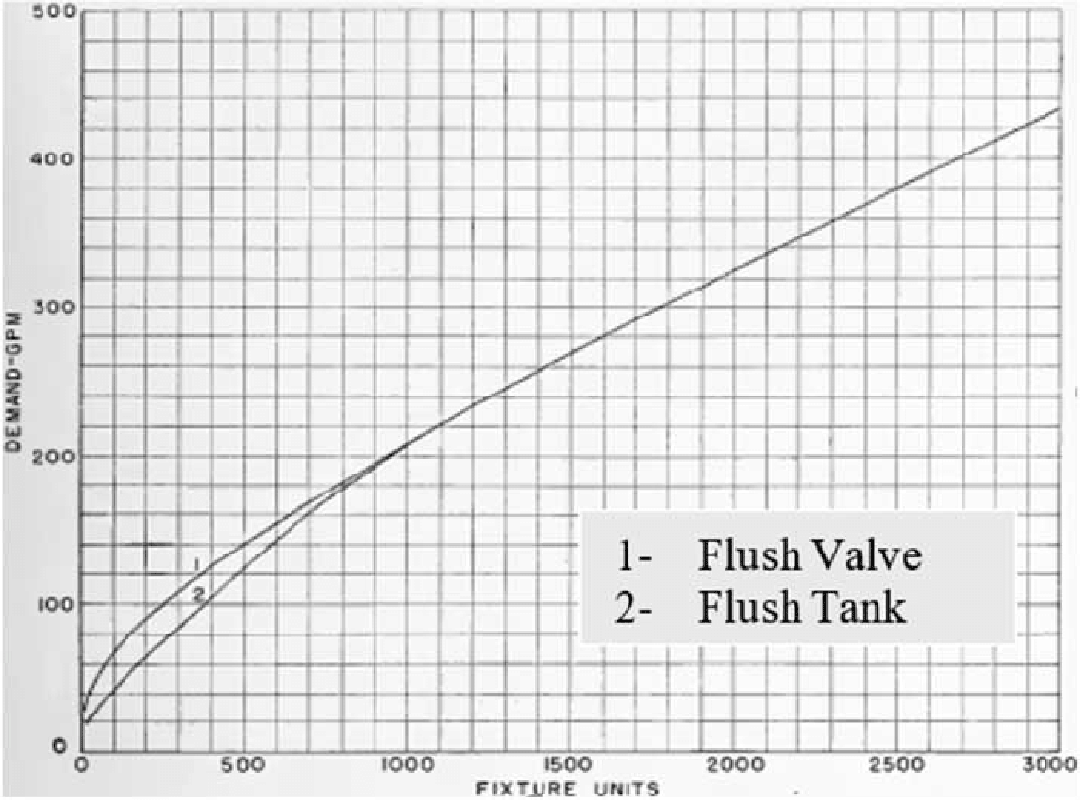
Hunter's Curve
3. Adjust maximum water demand rate using Water Factor
Multiply Water Factor by flow rate from Hunter’s Curve
Water Factor Table for Hospitals
|
FU |
Water Factor |
|---|---|
|
Less than 400 |
1 |
|
401 – 600 |
0.9 |
|
601 – 1,200 |
0.77 |
|
1,201 – 1,500 |
0.74 |
|
1,501 – 2,000 |
0.7 |
|
2,001 – 2,500 |
0.69 |
|
2,501 – 3,000 |
0.68 |
|
3,001 – 4,000 |
0.65 |
|
4,001 – 5,000 |
0.64 |
|
5,001 – 6,000 |
0.63 |
|
6,001 – 8,000 |
0.62 |
|
8,001 – 10,000 |
0.61 |
|
10,001 – 13,000 |
0.6 |
Water Factor Table for Office Buildings, Schools and Apartments
|
FU |
Water Factor |
|---|---|
|
Less than 400 |
1 |
|
401 – 600 |
0.87 |
|
601 – 900 |
0.75 |
|
901 – 1,200 |
0.64 |
|
1,201 – 1,500 |
0.63 |
|
1,501 – 2,000 |
0.61 |
|
2,001 – 2,500 |
0.60 |
|
2,501 – 3,000 |
0.59 |
|
3,001 – 4,000 |
0.58 |
|
4,001 – 5,000 |
0.56 |
|
5,001 – 6,000 |
0.56 |
|
6,001 – 7,000 |
0.56 |
|
7,001 – 8,000 |
0.55 |
*For showers and lavatories, add flow rates afterwards
Pipe Size Calculation
We can calculate water flow rate using the basic equation:
Q = AV
Where:
Q = Flow rate (unit: gpm)
A = Pipe cross-sectional area
V = Water velocity in pipe
Due to pipe wall roughness causing turbulent flow, resulting in pipe friction and pressure drop, we can calculate pressure drop using the Hazen-Williams formula:
hf = (4.727/D4.87) L(Q/C)1.85
Where:
hf = Pressure drop (unit: ftw)
D = Pipe diameter (unit: ft)
L = Pipe length (unit: ft)
Q = Flow rate (unit: ft3/s)
C = Surface Coefficient of pipe
C value depends on pipe wall roughness. In practice, using Q = AV and Hazen-Williams formula is not practical, so the formula is converted to graphs for direct reading of pipe size, water velocity, flow rate and pressure drop.
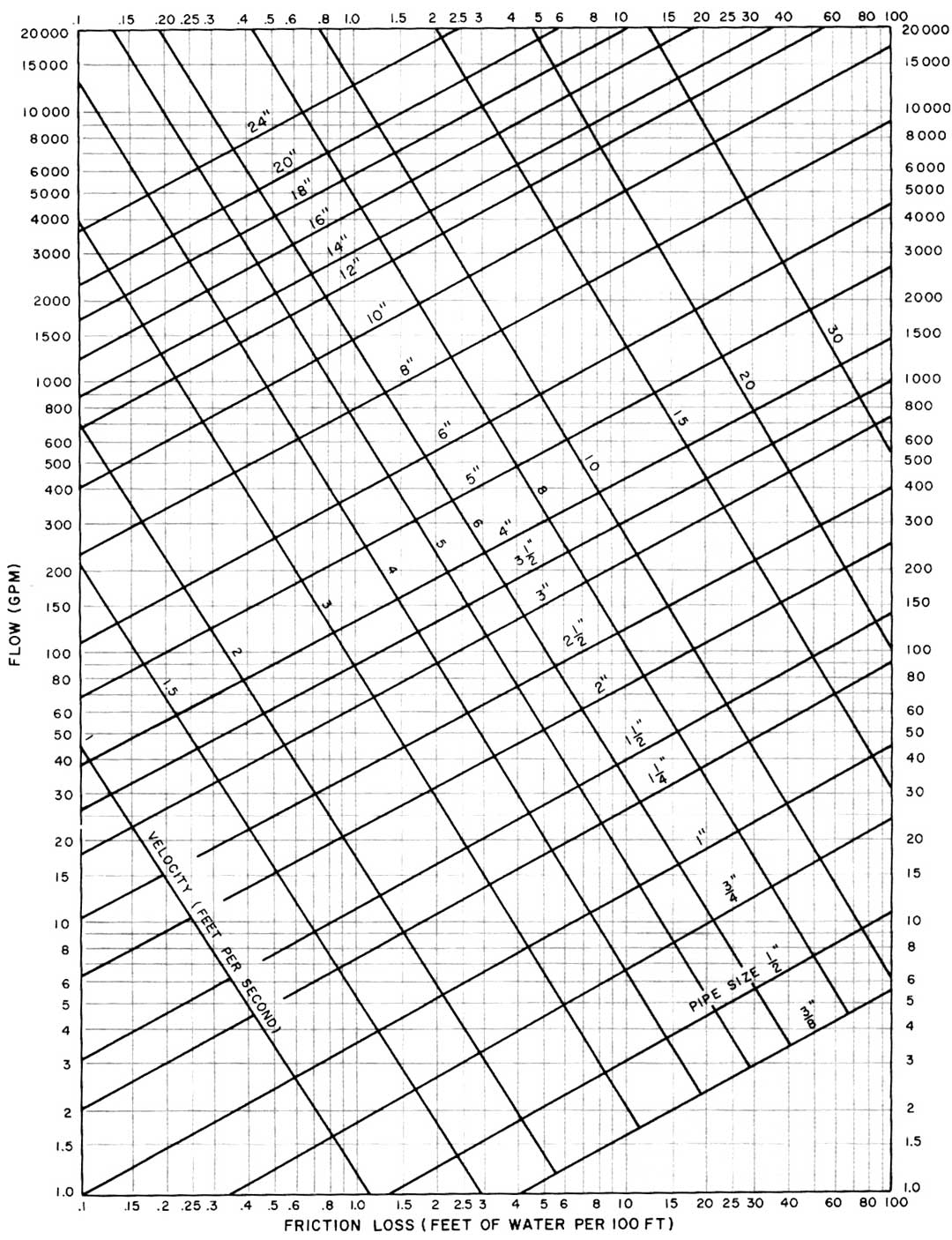
Friction Loss Table - Pipe Schedule 40
In design, water velocity in pipes should be between 1.2-2.4 meters/second or 4-8 feet/second, and should not exceed 3 meters/second to prevent noise and reduce pipe and valve erosion.The table below provides data to help design branch pipes
Table showing number of 15 mm (1/2 inch) branch pipes that can be connected to plumbing pipes
|
Plumbing Pipe Size mm. (inches) |
Number of pipes that can be connected under normal use |
Number of pipes that can be connected |
|---|---|---|
|
15 (1/2) |
1 | 1 |
|
20 (3/4) |
4 | 3 |
|
25 (1) |
10 | 6 |
|
30 (1-1/4) |
20 | 12 |
|
40 (1-1/2) |
30 | 20 |
|
50 (2) |
50 | 35 |
|
65 (2-1/2) |
90 | 60 |
|
80 (3) |
125 | 85 |
|
100 (4) |
225 | 150 |
Table showing number of 25 mm (1 inch) flush valves that can be connected to plumbing pipes
|
Plumbing Pipe Size mm. (inches) |
Number of 25 mm flush valves that can be connected |
|---|---|
|
30 (1-1/4) |
|
|
40 (1-1/2) |
2 – 4 |
|
50 (2) |
5 – 12 |
|
65 (2-1/2) |
13 – 25 |
|
80 (3) |
26 – 40 |
|
100 (4) |
41 – 100 |
*Count two 20 mm flush valves as equivalent to one 25 mm flush valve, and use 25 mm supply pipe
Pressure Drop in Pipes
In water pipe systems, water flows through straight pipes, fittings, and various valves. In design, we use equivalent length, meaning the length of straight pipe of the same size as the fitting or valve that would give the same pressure drop as the device. The table below shows equivalent lengths of fittings and devices in meters.
Table showing equivalent lengths of fittings and devices (unit: meters)
|
Pipe Size |
90° Elbow |
45° Elbow |
Tee |
Tee |
Gate Valve |
Globe Valve |
Angle Valve |
|---|---|---|---|---|---|---|---|
|
10 (3/8″) |
0.8 |
0.2 |
0.5 |
0.1 |
0.06 |
2.4 |
1.2 |
|
15 (1/2″) |
0.6 |
0.4 |
0.9 |
0.2 |
0.12 |
4.5 |
2.4 |
|
20 (3/4″) |
0.8 |
0.5 |
1.2 |
0.25 |
0.15 |
6 |
3.6 |
|
25 (1″) |
0.9 |
0.6 |
1.5 |
0.3 |
0.18 |
7.6 |
4.5 |
|
30 (1-1/4″) |
1.2 |
0.7 |
1.8 |
0.4 |
0.25 |
11 |
5.5 |
|
40 (1-1/2″) |
1.5 |
0.9 |
2.1 |
0.5 |
0.3 |
14 |
6.7 |
|
50 (2″) |
2.1 |
1.2 |
3 |
0.6 |
0.4 |
17 |
8.5 |
|
65 (2-1/2″) |
2.4 |
1.5 |
3.6 |
0.8 |
0.5 |
20 |
10 |
|
80 (3″) |
3 |
1.8 |
4.5 |
0.9 |
0.6 |
24 |
12 |
|
100 (4″) |
4.2 |
2.4 |
6.4 |
1.2 |
0.8 |
38 |
17 |
|
125 (5″) |
5.1 |
3 |
7.6 |
1.5 |
1 |
42 |
21 |
|
150 (6″) |
6 |
3.6 |
9 |
1.8 |
1.2 |
50 |
24 |
Example Calculation 1
A two-story building has the following fixtures. What size main water pipe is needed for adequate supply?
- 2 Water closets with flush tanks
- 3 Lavatories
- 1 Kitchen sink
- 1 15mm faucet
We can find fixture quantities from the FU table:
- 2 Water closets = 2 x 3 = 6 FU
- 3 Lavatories = 3 x 1 = 3 FU
- 1 Kitchen sink = 1 x 2 = 2 FU
Total = 11 FU
From Hunter’s Curve table, 11 FU equals 8.5 gpm
From water factor table, we get 1.0
If the faucet is used simultaneously with other fixtures, and faucet flow rate is 5 gpm
Water flow rate in pipe = 8.5 + 5 = 13.5 gpm or (13.5 x 3.785)/60 = 0.85 lps (liters/second)
From the pipe sizing graph, we find:
Should use 20 mm pipe with water velocity 2.8 meters/second and pressure drop about 80-100 meters, but since pressure drop is too high, we’ll change to 25 mm pipe (larger) with water velocity about 1.7 meters/second and pressure drop 25 meters


