MicroFiber Glass Wool Roof Thermal Insulation Model FLS

Price 630.00 บาท – 4,800.00 บาทPrice range: 630.00 บาท through 4,800.00 บาท
Product Details
MicroFiber Glass Wool Roof Thermal Insulation Model FLS with 1-sided aluminum foil heat reflective surface, 1.22 meter width, available in long rolls that can be rolled along or across rafters.
Available in densities from 12K – 48K and insulation thickness from 25 mm – 75 mm. Yellow insulation material that does not absorb water. When water drops on the insulation, it forms beads without penetrating the material. Water droplets can evaporate naturally when air flows through.
MicroRoof
Micro Roof glass wool insulation is designed for roofing applications to prevent heat from the roof entering factory buildings. Factory metal sheet roofs reach maximum temperatures of 70°C during midday, which transfers heat down to the building, resulting in extremely hot working conditions.
Installing roof insulation reduces the temperature transferred from the roof, minimizing excessive heat exposure for workers inside the building. In air-conditioned warehouses, thermal insulation installation helps reduce air conditioning workload due to decreased heat transfer and enables longer retention of cool air inside.
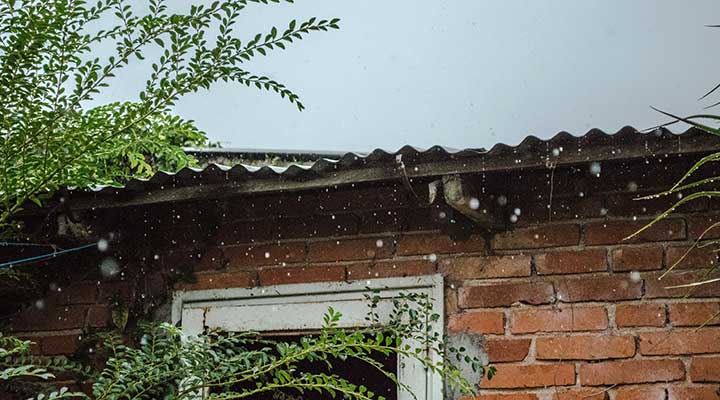
The roof is the area most exposed to water and moisture.
Thermal Conductivity
For thermal insulation applications, the most important consideration is the thermal conductivity value (K-value) of the insulation. Thermal conductivity indicates how well insulation can transfer heat. Higher thermal conductivity allows more heat to pass through. Therefore, high thermal conductivity means poor insulation, as we want to prevent heat transfer. The closer the thermal conductivity value is to 0, the better the thermal insulation performance.
MicroFiber glass wool insulation has been tested for thermal conductivity at ASTM (American Society for Testing and Materials) according to ASTM C518 testing standards to determine the material’s thermal conductivity value.
Moisture Absorption
Moisture absorption of roof insulation is extremely important because roofing applications may develop holes over time due to material wear or roof leaks, causing rainwater to drip onto the insulation. If the insulation material absorbs water, it becomes heavier and water evaporation becomes more difficult.
However, MicroFiber glass wool insulation has been tested for water absorption according to ASTM C411 standards. Test results show water absorption of < 1%, which is very low. When we test by dropping water onto MicroFiber glass wool insulation, water droplets do not penetrate the insulation material but form beads on the surface and evaporate naturally.
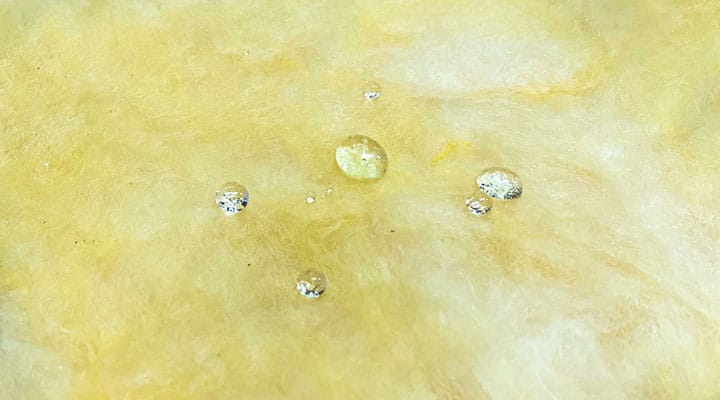
Water droplets on glass wool form beads without penetrating the glass wool.
Mold Resistance
Roof thermal insulation is installed under the roof where inspection is quite difficult. If mold or damage occurs, insulation should not promote growth of microorganisms like mold or fungi that could affect indoor air quality. MicroFiber glass wool insulation is a non-mold-promoting product and does not serve as a food source for microorganisms, eliminating concerns about damage from mold or fungi. It can be used safely with buildings.

When temperature and humidity are suitable, mold problems often occur.
Surface Burning Characteristic
According to the 2006 International Building Code (IBC), wall and ceiling surface materials inside buildings must be classified for surface burning characteristics according to ASTM E84 standards, with additions by NFPA (National Fire Protection Agency) under NFPA 101 Life Safety Code requiring classification of interior wall and ceiling surface materials as Class A, Class B, Class C tested according to NFPA 255, ASTM E84, or UL 723.
Testing provides two values: Flame-Spread Index (FSI) and Smoke Development Index (SDI), and materials are classified based on these values.
Material Classification Table for Surface Fire Spread According to ASTM E84
|
Flame-Spread Index (FSI) |
Smoke Development Index (SDI) |
|
|
Class 1 or Class A |
0 – 25 |
450 Maximum |
|
Class 2 or Class B |
26 – 75 |
450 Maximum |
|
Class 3 or Class C |
76 – 200 |
450 Maximum |
According to the ASTM E84 surface fire spread classification table, MicroFiber glass wool insulation is classified as Class 1 or Class A with Flame-Spread Index < 25 and Smoke Development Index < 50.
Installation Methods
1.) Installing insulation in rafter spaces (with wire mesh attached between rafters)
Install insulation along rafter spaces with Wire Mesh or Chicken Wire installed between or under rafters to support the insulation. Can be installed on roofs under new construction.
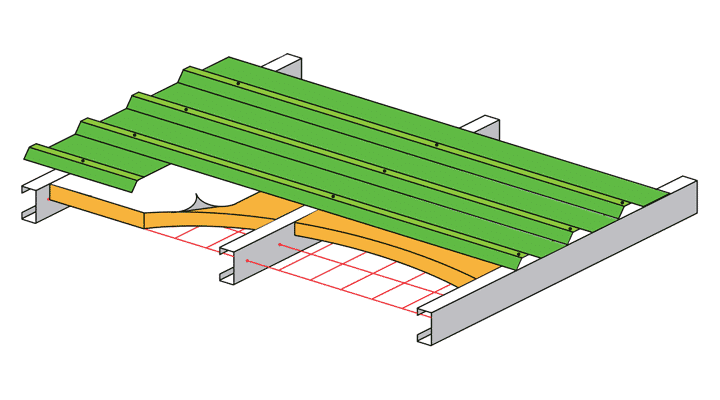
Installing insulation in rafter spaces with wire mesh attached between rafters
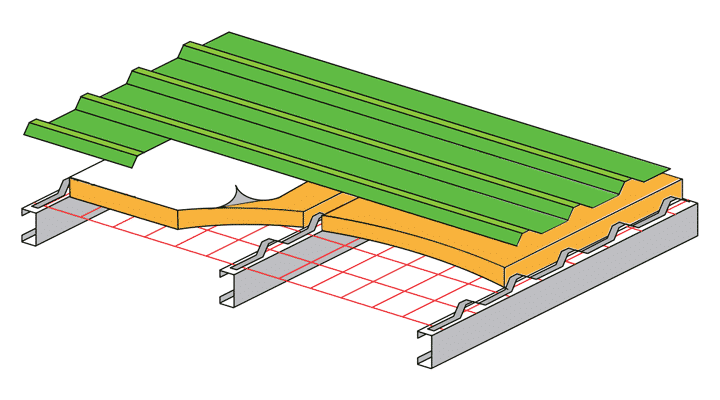
2.) Installing insulation in rafter spaces (with wire mesh attached on rafters)
Install insulation along rafter spaces with Wire Mesh or Chicken Wire installed on rafters to support the insulation. Can be installed on roofs under new construction.
Installing insulation in rafter spaces with wire mesh attached on rafters
3.) Installing insulation in rafter spaces (wire tie method)
Install insulation along rafter spaces with wires tied to rafters at approximately 30 cm intervals to support the insulation. Can be installed on both new construction and completed roofs.
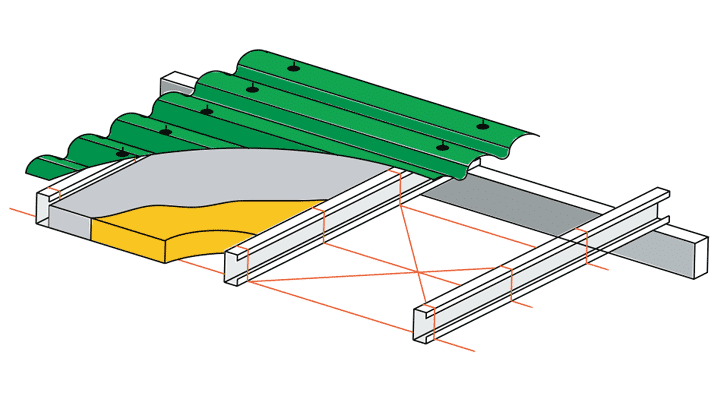
Installing insulation in rafter spaces with wire tie method
4.) Installing insulation across rafters (with wire mesh attached on rafters)
Install insulation across rafter spaces with Wire Mesh or Chicken Wire installed on rafters to support the insulation. Can be installed conveniently and quickly on roofs under new construction.
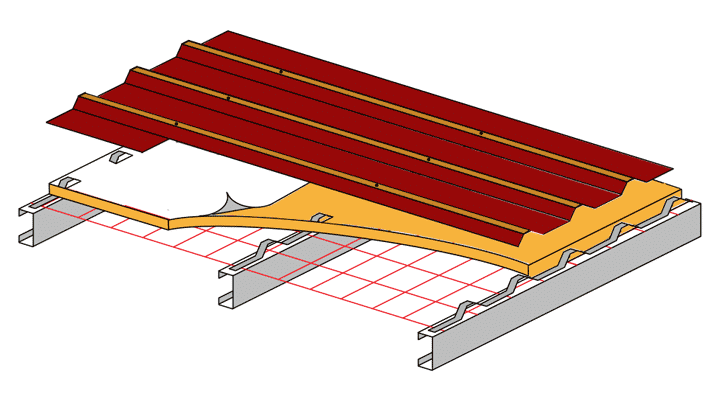
Installing insulation across rafters with wire mesh attached on rafters
5.) Installing insulation across rafters (without wire mesh support)
Install insulation across rafters without using Wire Mesh or Chicken Wire for support. Suitable for roofing with rafter spacing not exceeding 1.5 meters. Can be installed conveniently and quickly on new construction roofs.
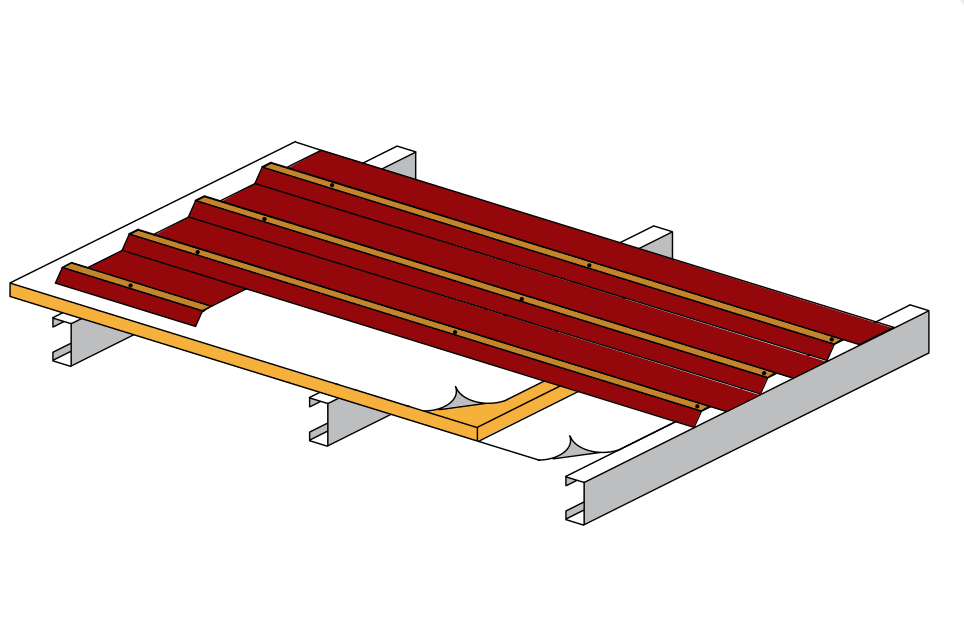
Installing insulation across rafters without wire mesh support
6.) Installing insulation by attachment under floor (Concrete Slab)
Attach insulation to concrete slab using spindle pins or anchors spaced approximately 20-30 cm apart, and use wire wrapped around anchor heads extending from the insulation in a diagonal pattern. Anchor drilling must not impact the building structure. Can be installed on both new construction and completed buildings.
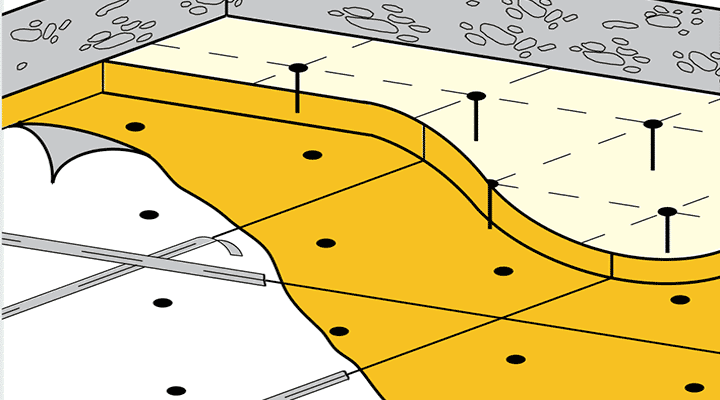
Installing insulation by attachment under floor (Concrete Slab)
Product Size Table
MicroRoof Roll Type Size Table
|
Density (Kg/m3) |
Thickness (mm) |
Size (W x L) |
|
12 |
50 |
1.22 x 16.50 |
|
75 |
1.22 x 11.50 |
|
|
16 |
25 |
1.22 x 30.50 |
|
50 |
1.22 x 15.25 |
|
|
75 |
1.22 x 15.25 |
|
|
24 |
25 |
1.22 x 30.50 |
|
50 |
1.22 x 15.25 |
|
|
75 |
1.22 x 15.25 |
|
|
32 |
25 |
1.22 x 15.25 |
|
50 |
1.22 x 15.25 |
|
|
75 |
1.22 x 7.50 |
|
|
48 |
25 |
1.22 x 7.50 |
|
50 |
1.22 x 7.50 |
|
|
75 |
1.22 x 7.50 |
MicroRoof Sheet Type Size Table
|
Density (Kg/m3) |
Thickness (mm) |
Size (W x L) |
|
32 |
25 |
1.22 x 2.44 |
|
50 |
1.22 x 2.44 |
|
|
75 |
1.22 x 2.44 |
|
|
48 |
25 |
1.22 x 2.44 |
|
50 |
1.22 x 2.44 |
|
|
75 |
1.22 x 2.44 |
Technical Data Table
|
Features |
MicroRoof Products |
Test Standard |
||||
|
Density |
12 Kg/m3 |
16 Kg/m3 | 24 Kg/m3 | 32 Kg/m3 |
48 Kg/m3 |
|
|
Thermal Conductivity (W/m.K) |
0.042 |
0.038 | 0.035 | 0.033 |
0.032 |
ASTM C518 |
|
Operating Temperature |
Max Service Temp 233°C |
ASTM C411 |
||||
|
Moisture Absorption |
< 1% at 49°C (95% RH) |
ASTM C1104 |
||||
|
Corrosion |
Does not accelerate |
ASTM C665 |
||||
|
Mold Resistance |
No Growth |
ASTM C665 |
||||
|
Surface Burning |
Flame Spread |
ASTM E84 |
||||
|
Smoke Developed |
||||||
|
Fire Testing |
Class 0 |
BS 476 Part 6 BS 476 Part 7 ASTM 1530-3 |
||||
|
Ignitability Index 0 |
||||||
|
Spread of Flame Index 0 |
||||||
|
Heat Evolved Index 0 |
||||||
|
Smoke Developed Index 1 |
||||||


