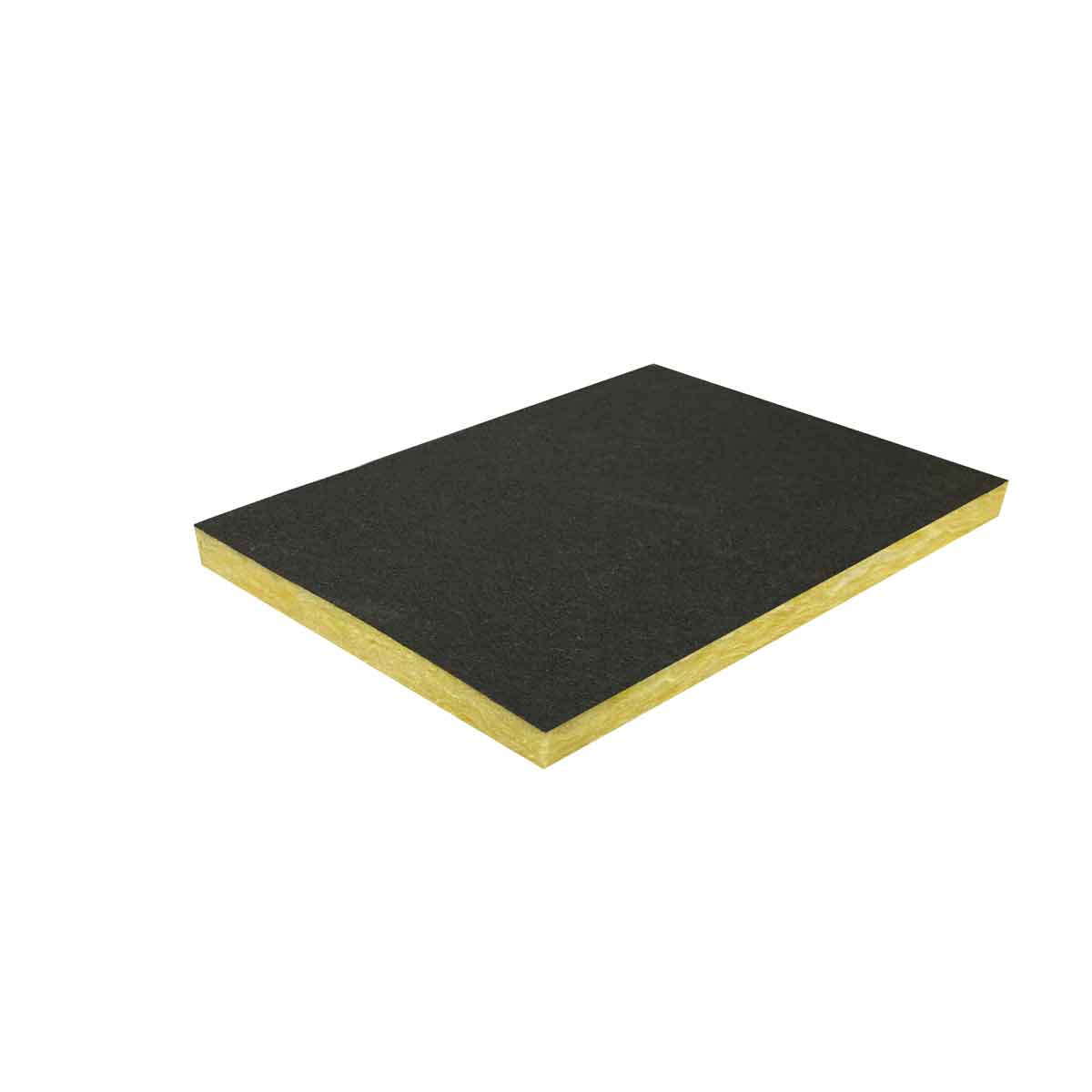
MicroFiber glass wool insulation for GTS air duct lining with black Glass Tissue surface
Price 640.00 บาท – 1,280.00 บาทPrice range: 640.00 บาท through 1,280.00 บาท
Product Details
Microfiber glass wool insulation for air duct sound absorption with black Glass Tissue surface, density 32K – 48K, thickness 25 mm – 50 mm Helps save energy and control condensation while absorbing sound transmitted through air ducts to prevent disturbance to building occupants
Size 1.22 x 2.44 meters
Micro Duct Liner
Micro Duct Liner glass wool insulation is a MicroFiber glass wool insulation designed for installation inside air ducts. It functions to reduce air noise within ducts and can operate at temperatures not exceeding 120°C at air velocities of 5,000 fpm (25.4 m/s) without erosion from airflow, tested according to UL 181 Erosion Test standard.
Maintaining cooling inside air ducts
Air temperature inside ducts will be low at 13-15°C while temperature outside ducts will be higher, possibly 25-30°C, causing heat exchange at the duct surface. Therefore, we need thermal insulation covering the inside and outside of ducts to reduce this heat exchange, so air inside ducts remains cool until reaching air outlets.
Preventing condensation
Water droplet formation in air conditioning systems occurs frequently because air inside ducts has low temperature while air outside ducts has higher temperature. When high-temperature air outside ducts contacts the duct surface with lower temperature, water droplets form on the duct surface.
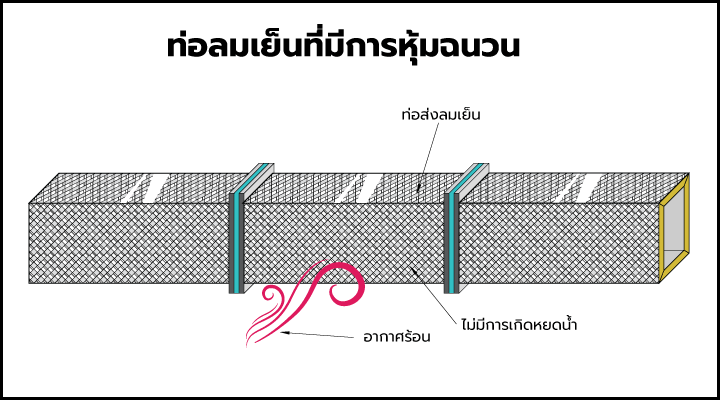
Cold air ducts with insulation covering will not form water droplets on duct surfaces.
Like a glass with ice inside – when left standing, water droplets form on the glass sides. Or in cases where ducts have insulation covering but water droplets still form, this may indicate insufficient insulation thickness due to very cold air inside ducts or very hot ambient air temperature.
Sound properties
The main purpose of Micro Duct Liner insulation is to absorb sound generated inside ducts, which may occur from high air velocity inside ducts causing loud noise outside ducts. We can solve this problem by using Micro Duct Liner glass wool insulation to absorb sound inside ducts through the porous properties of glass wool insulation. When sound travels and contacts the insulation surface, it is absorbed until it disappears.
Sound Absorption Coefficients (SAC) indicate when sound contacts material, what percentage the material will absorb and what percentage will reflect. For example, PFL 3225 at 2000 Hz frequency has SAC = 0.93, meaning it absorbs 93% of sound and reflects 7%.
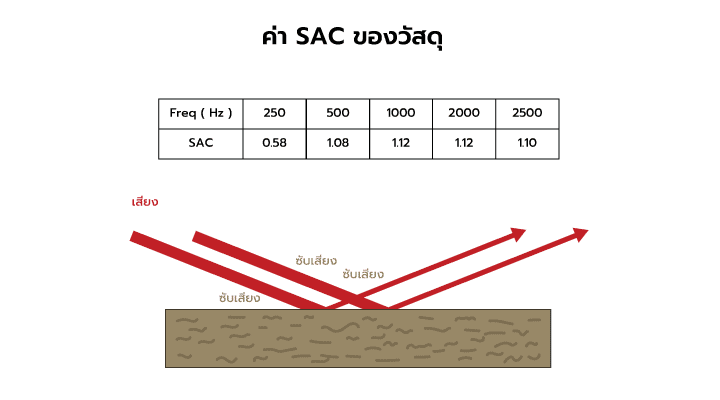
SAC values depend on sound frequency
Noise Reduction Coefficient (NRC) is the average of SAC values at frequencies 250Hz, 500Hz, 1000Hz, 2000Hz that can be used as an overall sound absorption value. If this material type has NRC = 0.9, it means this material type has average sound absorption of approximately 90%.
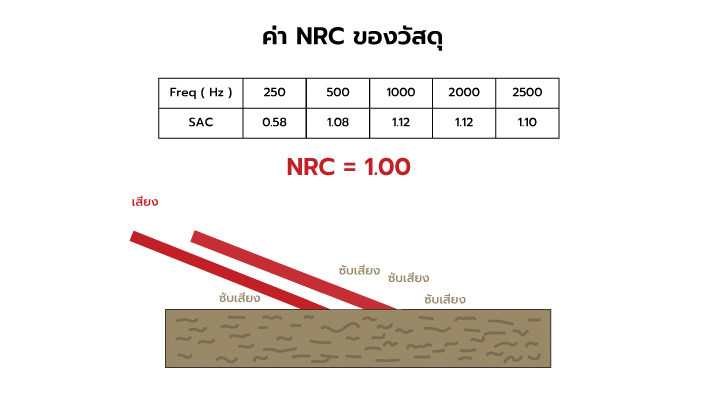
Material NRC value is the overall average value of the material
Sound Absorption Coefficients (Type “A” Mounting)
|
Product Type |
Thickness (mm.) |
Sound Absorption Coefficients, ASTM C423 (Type A Mounting) Octave Band Center Frequencies (Hz) |
||||||
|
125 |
250 | 500 | 1000 | 2000 | 4000 |
NRC |
||
|
PFL 3225 |
25 |
0.00 |
0.25 | 0.74 | 0.92 | 0.93 | 1.00 |
0.70 |
|
PFL 3250 |
50 |
0.12 |
0.44 | 1.02 | 1.07 | 0.84 | 0.78 |
0.85 |
|
PFL 4825 |
25 |
0.02 |
0.27 | 0.73 | 1.04 | 1.05 | 0.88 |
0.80 |
|
GTS 4850 |
50 |
0.20 |
0.86 | 1.12 | 1.07 | 1.01 | 0.99 |
1.00 |
|
GLC 4825 |
25 |
0.06 |
0.33 | 0.66 | 1.08 | 0.94 | 0.85 |
0.75 |
|
GLC 4850 |
50 |
0.24 |
0.90 | 1.11 | 1.11 | 1.03 | 1.01 | 1.05 |
Micro Duct Liner glass wool insulation surface materials
- Perforated Foil (PFL) surface covered with perforated foil
- Glass Tissue (GTS) surface covered with Glass Tissue
- Glass Cloth (GLC) surface covered with glass cloth
Product Size Table
Micro Duct Liner size table
|
Density (Kg/m3) |
Thickness (mm) |
Size (W x L) |
|
32 |
25 |
1.22 x 2.44 |
|
50 |
1.22 x 2.44 |
|
|
40 |
25 |
1.22 x 2.44 |
|
50 |
1.22 x 2.44 |
Technical Data Table
|
Features |
MicroCover |
Test Standard |
|
Operating Temperature |
121°C |
ASTM C 411 |
|
Density |
32 kg/m3, 40 kg/m3 |
|
|
Water Vapor Absorption |
< 1.0% at 49°C, 95% RH |
ASTM C1104 |
|
Mold and Fungus Growth |
Does not promote mold and fungus growth |
ASTM C665 |


