MicroFiber Glass Wool Insulation for Air Conditioning Systems, FSF Model

Price 3,930.00 บาท – 6,500.00 บาทPrice range: 3,930.00 บาท through 6,500.00 บาท
Product Details
MicroFiber glass wool insulation for air conditioning systems, FSF model, with density 16K – 48K, yellow glass wool material, thickness 25 mm – 50 mm, covered with aluminum foil on both sides
The glass wool insulation is water-repellent. When water drops on the insulation, it forms beads that roll on the surface of the insulation. When air passes over it, the water evaporates on its own. It can be used at temperatures between 4 – 120 degrees Celsius.
FSF aluminum foil, 7-layer fire-retardant type, double-sided foil, tested according to UL723, ASTM E84 and BS 476 Class O standards
Micro Duct Wrap
MicroFiber’s Micro Duct Wrap glass wool insulation is widely used for insulating air conditioning ducts, both in duct manufacturing plants, air grilles, or on-site in buildings using chillers and air handlers for duct insulation.
Air Conditioning System Insulation
Air conditioning systems using galvanized air ducts require insulation for two main reasons:
-
- To maintain the temperature of cool air inside the duct until it reaches the air outlets

Cool air outlets in air conditioning systems
- To prevent condensation on the duct surface, as the low-temperature galvanized ducts come into contact with warmer outside air, causing water droplets to form
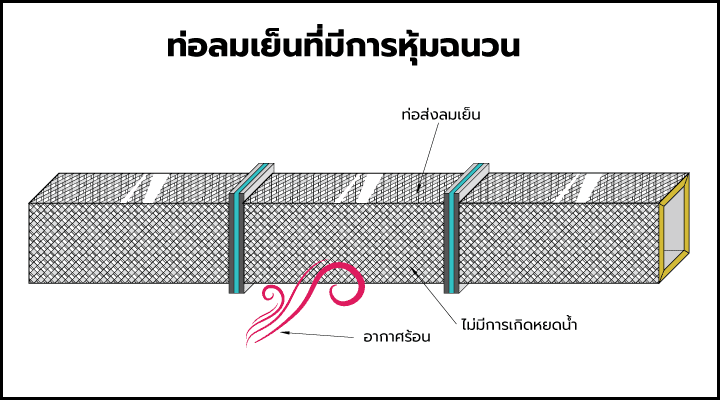
Insulated ducts prevent condensation on the duct surface
- To maintain the temperature of cool air inside the duct until it reaches the air outlets
Thermal Conductivity
Thermal Conductivity is a value that indicates how much heat can pass through a material. The higher the thermal conductivity, the more heat it can transmit.
For insulation, the thermal conductivity should be close to 0 to be considered good heat insulation. In air conditioning systems, using glass wool insulation is appropriate because it has a low thermal conductivity of only 0.034 W/m.K and is inexpensive, making it widely popular in the HVAC industry.
Water Absorption
As mentioned earlier, duct insulation in air conditioning systems prevents water droplets. Glass wool insulation can prevent water droplets due to its inherent properties. MicroFiber has further innovated by adding substances during the production process to prevent water absorption by the glass wool insulation.
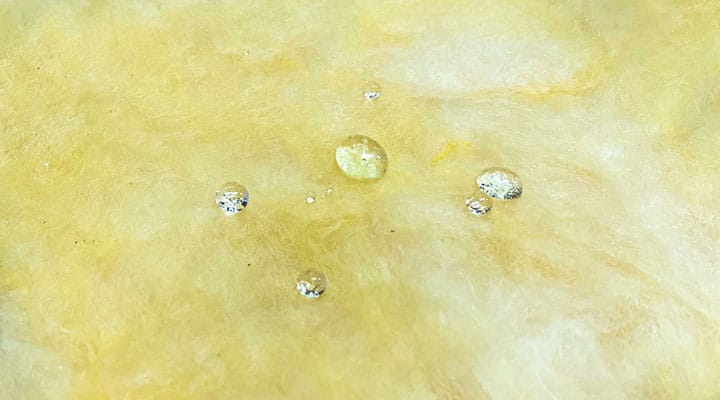
Water droplets on glass wool form beads without penetrating the glass wool.
Therefore, when water droplets form on the insulation, they will not be absorbed into the insulation material but will remain as droplets on the surface. If we splash water on the glass wool insulation, it will behave like a water-repellent coating on a car windshield.
Resistance to Mold and Fungi
The material used in glass wool insulation production is recycled glass or silica sand, melted and spun into fibers. Therefore, glass wool insulation is not a food source for living organisms. Mold, fungi, or rodents cannot eat glass wool insulation.
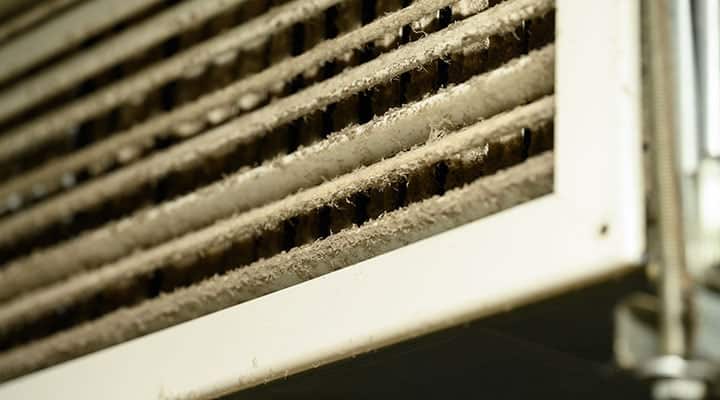
Mold can grow in areas with high humidity
Surface Flame Spread
In air conditioning systems, fire safety is very serious because ducts branch throughout the entire floor of a building. In case of a fire, we should contain the fire to one area and prevent it from spreading to other areas. If materials attached to the ducts are flammable, it can cause rapid flame spread, which is highly detrimental.
Therefore, materials attached to ducts are tested for fire ignition and flame spread. Micro Duct Wrap glass wool insulation has been tested according to ASTM E84 standards to classify materials based on flame spread and smoke development characteristics.
Material Classification Table for Surface Fire Spread According to ASTM E84
|
Flame-Spread Index (FSI) |
Smoke Development Index (SDI) |
|
|
Class 1 or Class A |
0 – 25 |
450 Maximum |
|
Class 2 or Class B |
26 – 75 |
450 Maximum |
|
Class 3 or Class C |
76 – 200 |
450 Maximum |
MicroFiber glass wool insulation has a Flame Spread < 25 and Smoke Developed < 50, classifying it as Class A
Micro Duct Wrap Glass Wool Insulation
FL
Duct insulation with aluminum foil facing, non-combustible 5-layer type, tested according to ASTM E84 and BS 476 Class O standards
FR
Glass wool insulation for air conditioning ducts, faced with non-combustible 5-layer aluminum foil, tested according to UL723, ASTM E84, ULC-S102M, and FM-Approved standards
FSF
Glass wool duct insulation faced with double-sided aluminum foil, non-combustible 7-layer type, tested according to UL723, ASTM E84, and BS476 Class O standards
FRD 524
Glass wool insulation for air conditioning ducts, faced with double-sided aluminum foil using Albar interlayer bonding technology for enhanced water and moisture resistance, non-combustible 6-layer type, tested according to UL723, ASTM E84, BS476 Class O, and Australian Standards
Product Size Table
Micro Duct Wrap Roll Sizes Table
|
Density (Kg/m3) |
Thickness (mm) |
Size (W x L) |
|
16 |
25 |
1.22 x 30.50 |
|
50 |
1.22 x 15.25 |
|
|
24 |
25 |
1.22 x 30.50 |
|
38 |
1.22 x 15.25 |
|
|
50 |
1.22 x 15.25 |
|
|
32 |
25 |
1.22 x 15.25 |
|
38 |
1.22 x 15.25 |
|
|
50 |
1.22 x 15.25 |
|
|
48 |
25 |
1.22 x 7.50 |
|
38 |
1.22 x 7.50 |
|
|
50 |
1.22 x 7.50 |
Technical Data Table
|
Features |
MicroRoof Products |
Test Standard |
|||
| Density |
16 Kg/m3 |
24 Kg/m3 | 32 Kg/m3 |
48 Kg/m3 |
|
| Thermal Conductivity
(W/m.K) |
0.038 |
0.035 | 0.033 |
0.032 |
ASTM C518 |
| Operating Temperature |
Max Service Temp 233°C |
ASTM C411 |
|||
| Moisture Absorption |
< 1% at 49 C (95% RH) |
ASTM C1104 |
|||
| Corrosion |
Does not accelerate |
ASTM C665 |
|||
| Fungal Resistance |
No Growth |
ASTM C665 |
|||
| Surface Burning Characteristics |
Flame Spread < 25 |
ASTM E84 |
|||
|
Smoke Developed < 50 |
|||||
| Fire Test |
Class 0 |
BS 476 Part 6 BS 476 Part 7 ASTM 1530-3 |
|||
|
Ignitability Index 0 |
|||||
|
Spread of Flame Index 0 |
|||||
|
Heat Evolved Index 0 |
|||||
|
Smoke Developed Index 1 |
|||||


