
How does heat transfer occur?
Heat Transfer
Everyone knows that a cold water bottle will warm up if we leave it in a hot environment, and if we put the cold water bottle in a refrigerator, the water will become colder. We also know that heat will transfer from areas with high temperature to areas with low temperature. This phenomenon is scientifically called “Heat Transfer”.
The First Law of Thermodynamics
The first law of thermodynamics is known by the principle of “Conservation of energy,” which states that “energy cannot be created or destroyed, but only transformed into other forms of energy.”
From this statement, we can write the equation as:
(Ein) – (Eout) = (ΔEsystem)
- Ein = Energy input to the system
- Eout = Energy output from the system
- ΔEsystem = Energy change in the system
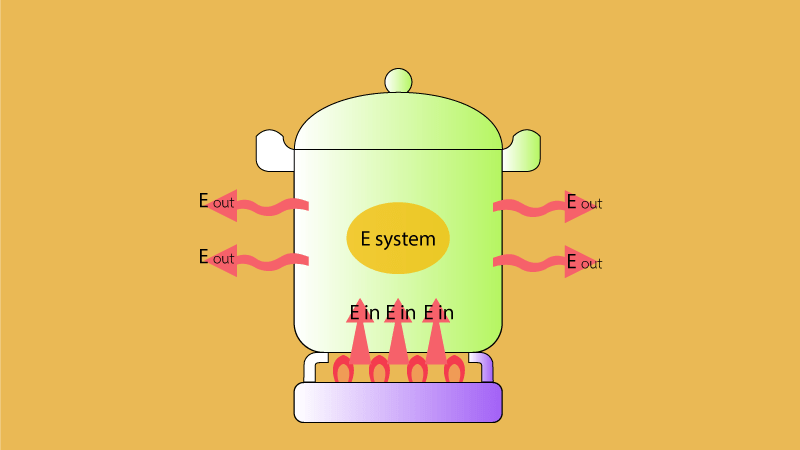
Figure 1: Diagram explaining the conservation of energy law with energy input, energy output, and changes
Energy Balance for Closed Systems
Closed Systems refers to systems where mass does not change such as a soda can at 12°C placed at room temperature of 25°C. Over time, the soda can temperature increases to 20°C
From the example, the soda can has the same mass of water as initially set, but receives heat from the outside environment which has a higher temperature (25°C), causing the soda can temperature to rise to 20°C (the water becomes warmer).
We can write the equation as:
(Ein) – (Eout) = (ΔEsystem)
ΔU = mcvΔT
or
Q = mcvΔT
- ΔU = Energy change in the system, or ΔEsystem
- Q = Heat energy (kJ)
- m = Mass of the system (kg)
- cv = Specific heat capacity (kJ/kg.K)
- ΔT = Temperature change (K)
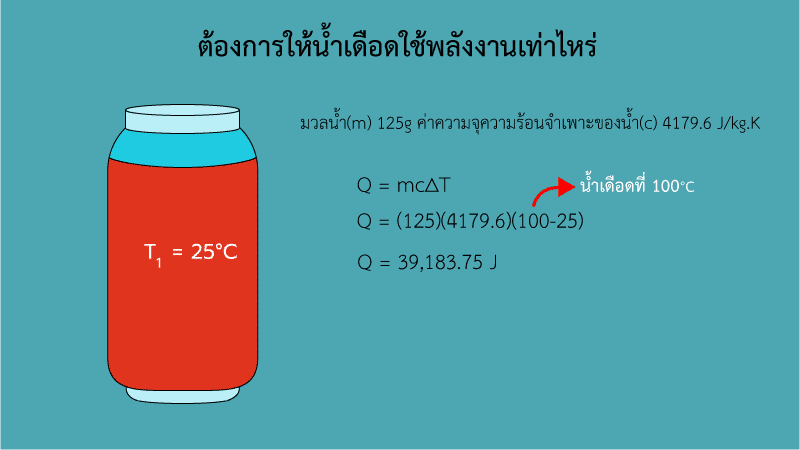
Figure 2: Example image of a can and calculations
Energy Balance for Open Systems (Steady-Flow System)
Steady-Flow System is a system with constant flow where the mass flowing in equals the mass flowing out, such as a water pipe with water flowing inside, where the water flowing in at the beginning of the pipe equals the water flowing out at the end of the pipe. This system is called a Steady-Flow System.
We can write the equation as:
Q̇ = ṁcvΔT
- ΔU = Energy change in the system, or ΔEsystem
- Q̇ = Heat transfer rate (kJ/s)
- ṁ = Mass flow rate (kg/s)
- cv = Specific heat capacity (kJ/kg.K)
- ΔT = Temperature change (K)
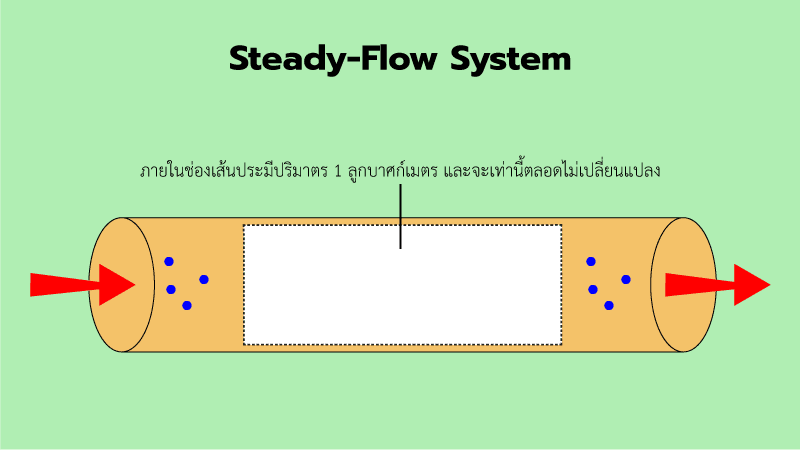
Figure 3: Example image of flow inside a pipe
Heat Transfer Mechanisms
Heat transfer from one area to another can be accomplished in 3 ways:
- Conduction
- Convection
- Radiation
- Conduction
Heat transfer that requires a medium including solids, liquids, and gases, where the medium is stationary with a fixed shape.
For example:
- Using metal chopsticks to pick up pork from a pan and feeling heat in your hand, because the metal chopsticks receive heat and transfer the heat to our hand.
- Static air between building glass is also considered conduction.
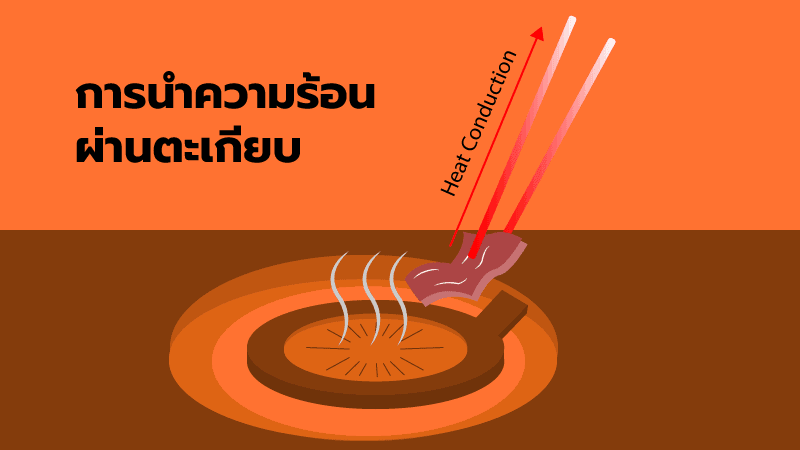
Figure 4: Example image explaining heat conduction with chopsticks and fire
Thermal Conductivity or K-Value
As we know, when eating hot pot, we should use wooden chopsticks instead of metal chopsticks because wooden chopsticks won’t get hot, while metal chopsticks will get hot. Do we know why?
What makes these two types of chopsticks different is the thermal conductivity (K-Value), which indicates how much heat can be transferred to the other side, depending on the type of material.
- If the thermal conductivity coefficient is high, it means it can transfer a lot of heat.
- If the thermal conductivity coefficient is low, it means it can transfer little heat.
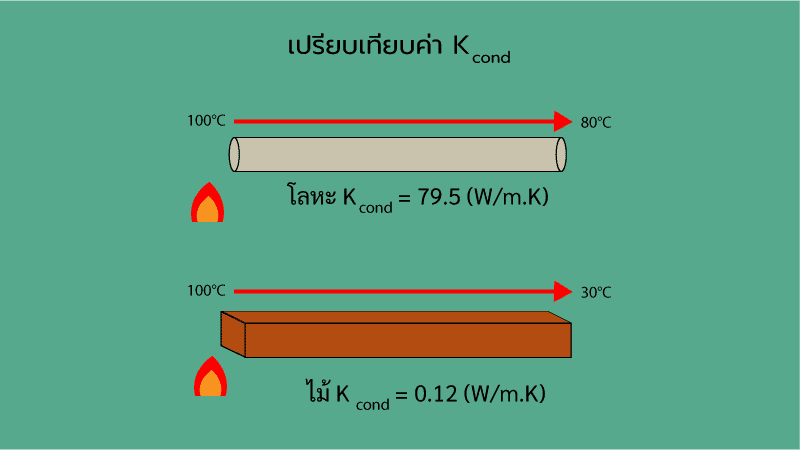
Figure 5: Image showing the difference between materials with high and low thermal conductivity
From the example, we can say that “metal” chopsticks have high thermal conductivity, while “wooden” chopsticks have low thermal conductivity.
We can calculate the conduction heat transfer rate from:
Q̇cond = kcond x A x (T1 -T2) /Δx
- Q̇cond = Conduction heat transfer rate (kJ/s)
- kcond = Thermal conductivity coefficient
- A = Heat transfer area (m2)
- T1 = Temperature at point 1 (K)
- T2 = Temperature at point 2 (K)
- Δx = Thickness of the medium (m)
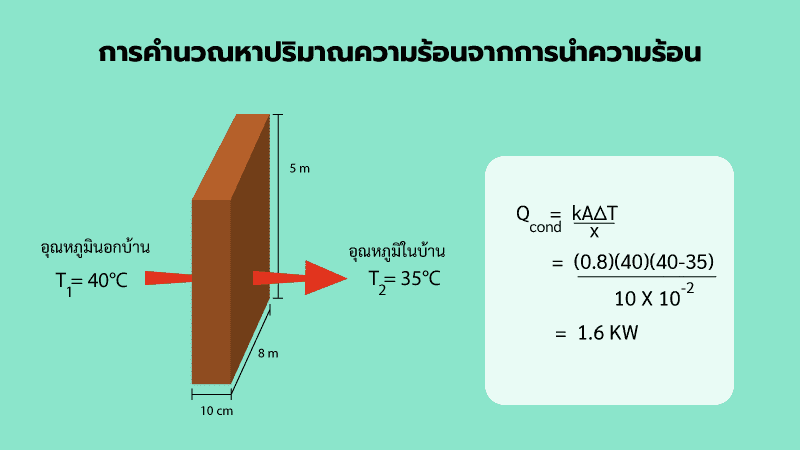
Figure 6: Calculation example with accompanying illustration
From this example, we can see that the lower the thermal conductivity coefficient, the lower the temperature on the other side. Therefore, we have another variable called “Thermal Resistance (R-Value)”.
Thermal Resistance or R-Value
A variable that is opposite to the thermal conductivity coefficient (K-Value).
- If thermal resistance is high, it means the medium allows little heat to pass through.
- If thermal resistance is low, it means the medium allows a lot of heat to pass through.
- Convection
The convection process is a process that relies on moving mediums, including liquids and gases, where the high-temperature part rises to the top and the low-temperature part sinks to the bottom, as we often hear “hot air rises, cold air sinks”.
For example:
- Tea boiling in a glass, where we can see tea leaves swirling vertically.
- Air from an air compressor, which is quite hot.
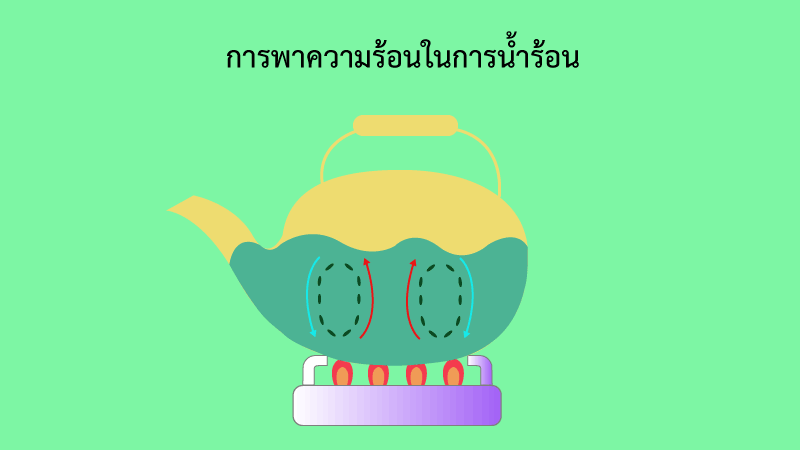
Image of heat convection in a tea cup
Convection depends on the characteristics of heat convection. For cold air, we can classify it as:
- Free Convection (Natural Convection)
- Forced Convection
For example, on a very hot day after exercising, if we stay still, we call it “Free Convection,” but if we say it’s too hot and need to turn on a fan, we call it “Forced Convection”.
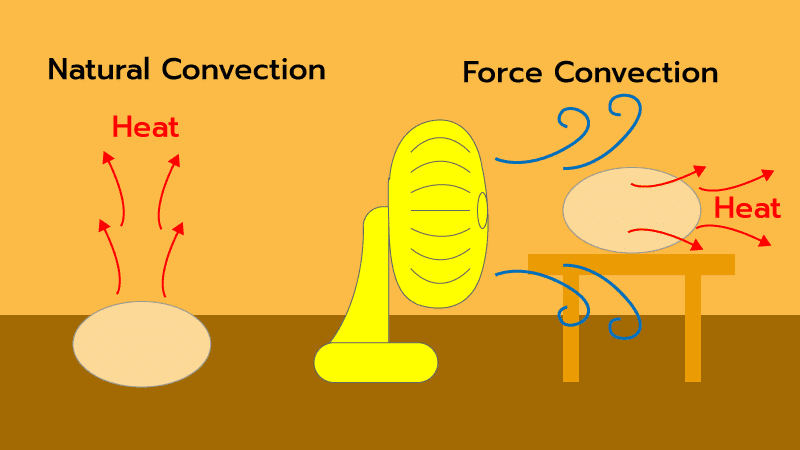
Figure 7: Image of Free Convection and Forced Convection
Convection Coefficient
This variable tells us how much heat the environment at that moment can convect away.
- If the convection coefficient is high, it means the fluid can carry away a lot of heat.
- If the convection coefficient is low, it means the fluid can carry away little heat.
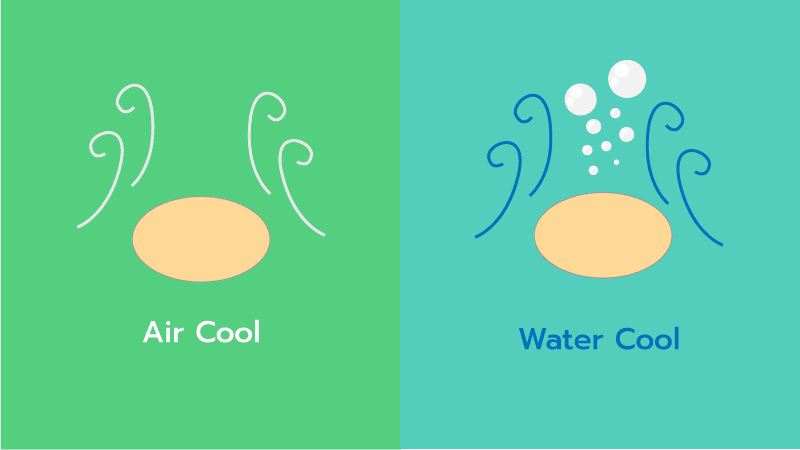
Figure 8: Image of fluids that can carry away different amounts of heat
We can calculate the heat transfer rate from convection using Newton’s law of cooling:
Q̇conv = hconv As (Ts -T∞)
- Q̇conv = Convection heat transfer rate (kJ/s)
- hconv = Convection coefficient
- As = Surface area where convection occurs (m2)
- Ts = Object surface temperature (K)
- T∞ = Fluid temperature (K)
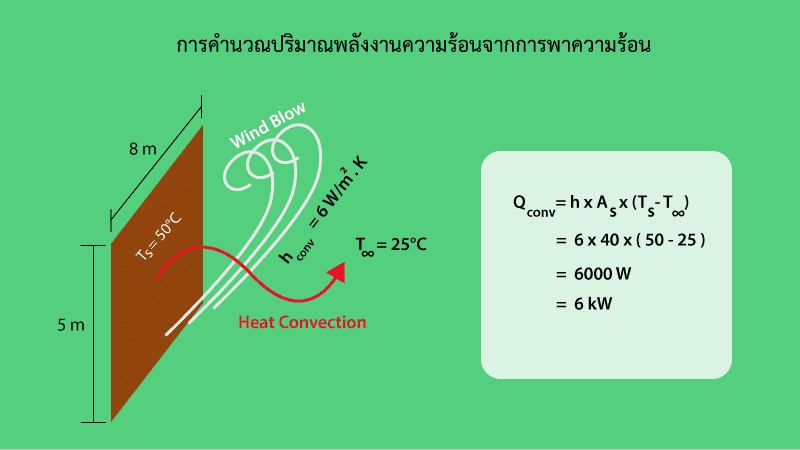
Figure 9: Image of heat convection calculation
From this example, we can say that the amount of heat through convection depends on the values of:
- hconv Convection coefficient
- As Surface area
- T∞ Fluid temperature
- Radiation
Radiation is the emission of energy in the form of electromagnetic waves, which does not require a medium and can travel through a vacuum.
For example:
- Solar radiation reaching Earth through space, which is a vacuum.
All objects with temperatures above 0 Kelvin (K) emit and absorb thermal radiation. We can calculate thermal radiation using the Stefan-Boltzmann law.
Q̇rad = εσAs T4s
- Q̇rad = Radiation heat transfer rate
- ε = Emissivity coefficient
- σ = Surface area where convection occurs (m2)
- As = Radiation surface area
- Ts = Object surface temperature (K)
Typically, the emissivity coefficient is less than 1. Objects with an emissivity coefficient equal to 1 are called “blackbodies” and have the highest emissivity coefficient.
Radiation is the emission of energy in the form of electromagnetic waves, which does not require a medium and can travel through a vacuum.
For example:
- Solar radiation reaching Earth through space, which is a vacuum.
All objects with temperatures above 0 Kelvin (K) emit and absorb thermal radiation. We can calculate thermal radiation using the Stefan-Boltzmann law.
Q̇rad = εσAs T4s
- Q̇rad = Radiation heat transfer rate
- ε = Emissivity coefficient
- σ = Surface area where convection occurs (m2)
- As = Radiation surface area
- Ts = Object surface temperature (K)
Typically, the emissivity coefficient is less than 1. Objects with an emissivity coefficient equal to 1 are called “blackbodies” and have the highest emissivity coefficient.
Summary
Heat Transfer is the transfer of heat from areas with higher temperatures to areas with lower temperatures, accomplished through 3 methods:
- Conduction
- Convection
- Radiation
Conduction and convection require a medium to transfer heat, while radiation does not require a medium.
Calculations for thermal data analysis cannot use just one method alone, because in reality, heat transfer occurs in all 3 forms simultaneously and in 3-dimensional form (all directions), which is very challenging.
However, having correct fundamental knowledge can be used for analysis and logical prediction, which is very beneficial.
Source: Heat and Mass Transfer Fundamentals & Application Fifth Edition Book
Follow our news
- Facebook: https://www.facebook.com/3tinsulation/
- Website: https://3t-insulation.com/


