In hot or cold process industries, piping constitutes a major component. Piping systems play a crucial role in facilitating the transfer of raw materials from one point to another. Whether in power plants, sugar mills, or ice factories, all involve piping systems.
The pipes contain various source materials for further utilization, from steam pipes in power plants and sugar mills to refrigerant pipes in ice factories. While these two types of pipes operate at opposite temperature extremes, they share one common requirement: the need to minimize heat loss from within the pipes.
What is Pipe System Insulation?
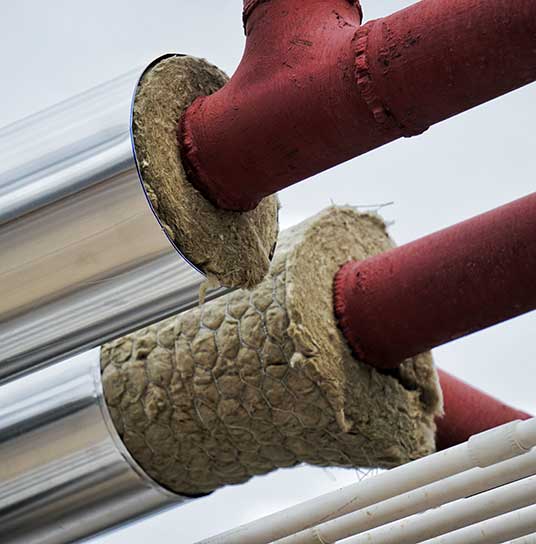
Piping systems are divided into two categories: hot pipes and cold pipes. Hot pipes contain hot water or steam at temperatures ranging from 50 to 650 degrees, while cold pipes contain either chilled water at 7-8 degrees Celsius for chiller systems or refrigerants at temperatures below 0 degrees Celsius.
We need to maintain stable temperatures within these pipes to preserve energy value. This is where thermal insulation becomes essential. Selecting appropriate thermal insulation for piping systems is therefore crucial.
How Do Hot and Cold Water Pipe Insulations Differ?
For hot piping systems, we use open-cell insulation materials such as glass wool or rock wool. Glass wool can withstand temperatures up to 450 degrees Celsius, making it suitable for temperatures between -18 to 450 degrees Celsius. Rock wool can withstand temperatures up to 650 degrees Celsius, making it suitable for temperatures between 0 to 650 degrees Celsius. For applications with higher temperatures, ceramic fiber or calcium silicate insulation would be more appropriate.
| Material | Glass Wool | Rock Wool |
|---|---|---|
| Thermal Conductivity Thermal Conductivity |
0.043 – 0.058 W/m.K | 0.037 – 0.083 W/m.K |
| Operating Temperature | -18 – 450 degrees Celsius | -18 – 650 degrees Celsius |
| Price | 100 Baht/meter | 145 Baht/meter |
* Price for 1-inch pipe insulation with 25mm thickness
For cold piping systems, we use closed-cell insulation such as black rubber or PE insulation. Black rubber insulation operates at temperatures between -50 to 105 degrees Celsius, while PE insulation operates between -80 to 100 degrees Celsius.
Therefore, they are not suitable for hot applications.
PE insulation has a wider temperature range, making it suitable for applications with significant temperature variations. However, if temperatures don’t drop to -80 degrees Celsius, black rubber insulation is more cost-effective with similar specifications.
| Material | PE Insulation | Black Rubber Insulation |
|---|---|---|
| Thermal Conductivity Thermal Conductivity |
0.032 W/m.K | 0.033 – 0.035 W/m.K |
| Operating Temperature | -80 – 100 degrees Celsius | -50 – 105 degrees Celsius |
| Price | 150 Baht/meter | 143 Baht/meter |
Whether for hot or cold applications, the insulation must be covered with a jacket made of aluminum, zinc, or galvanized material to extend the insulation’s service life.
Preventing Rust Under Pipe Insulation
In piping systems, one of the main issues is rust or corrosion. We need to first understand how “rust” occurs.
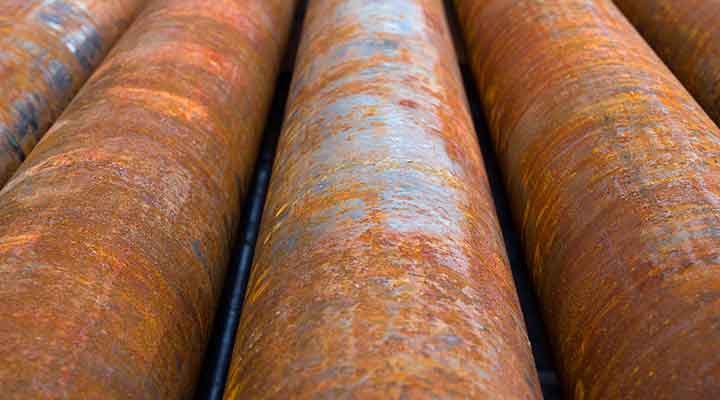
Rust forms through an oxidation reaction between iron and oxygen or other chemicals (chlorine, bromine, etc.). For example, in water supply systems, chlorine is added to kill bacteria. Inside iron pipes, this chlorine reacts with the metal, creating rust that can clog the pipes. The exterior of iron pipes is exposed to rain and moisture, causing surface rust.
For water pipes without insulation, rust can be easily observed on the surface. However, for insulated pipes with jacket covering, how can we detect rust? This phenomenon is called “Corrosion Under Insulation” or CUI.
We can prevent pipe corrosion by:
- Thoroughly cleaning the pipe surface
- Applying anti-rust paint to the pipe surface
- Ensuring insulation fits tightly against the pipe surface
- Using wire to secure the insulation firmly to the pipe
- Covering with aluminum sheets to protect against rain and sunlight damage
* Rust requires three factors: moisture, chloride compounds, and iron. Eliminating any one factor prevents rust formation. Therefore, we must try to eliminate moisture or chloride compounds.
* We reduce moisture by using open-cell insulation like glass wool or rock wool to allow water droplets and vapor to evaporate quickly. We also add water-resistant agents to prevent water from penetrating the insulation to reach the iron pipe, and cover the insulation with aluminum sheets to protect against water and moisture infiltration.
* We reduce chloride content in insulation production to less than 10 ppm (10 parts per million) to minimize rust formation from thermal insulation.


