
Fire Plume and Ceiling Jet
Plume
A plume is a column of hot smoke and gases produced by combustion that rises vertically due to buoyancy force.
Buoyancy force is the force created by the density difference between smoke and air. Because smoke has high temperature and lower density than cool air, it rises vertically.
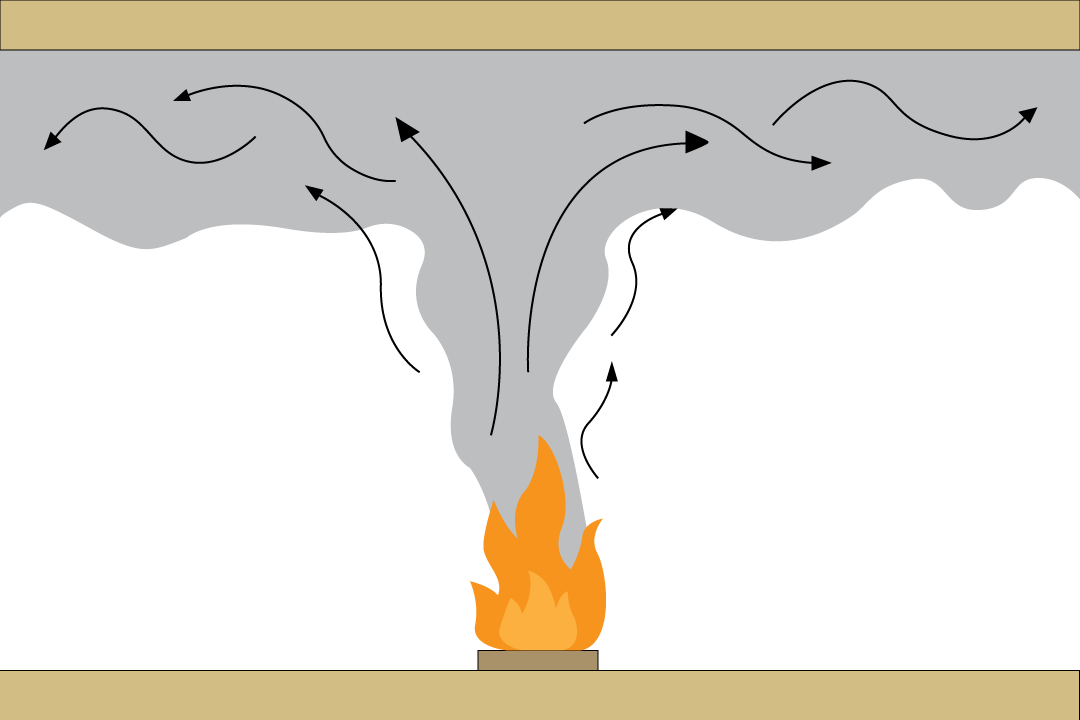
Image - Enclosure Plume
Axisymmetric Plume
The plume is divided into 3 zones:
Continuous Flame zone with continuous flame
Intermittent Flame zone where fuel combustion is nearly complete, with flame appearing partially and intermittently
Buoyant Plume zone where combustion is complete, containing only hot gases
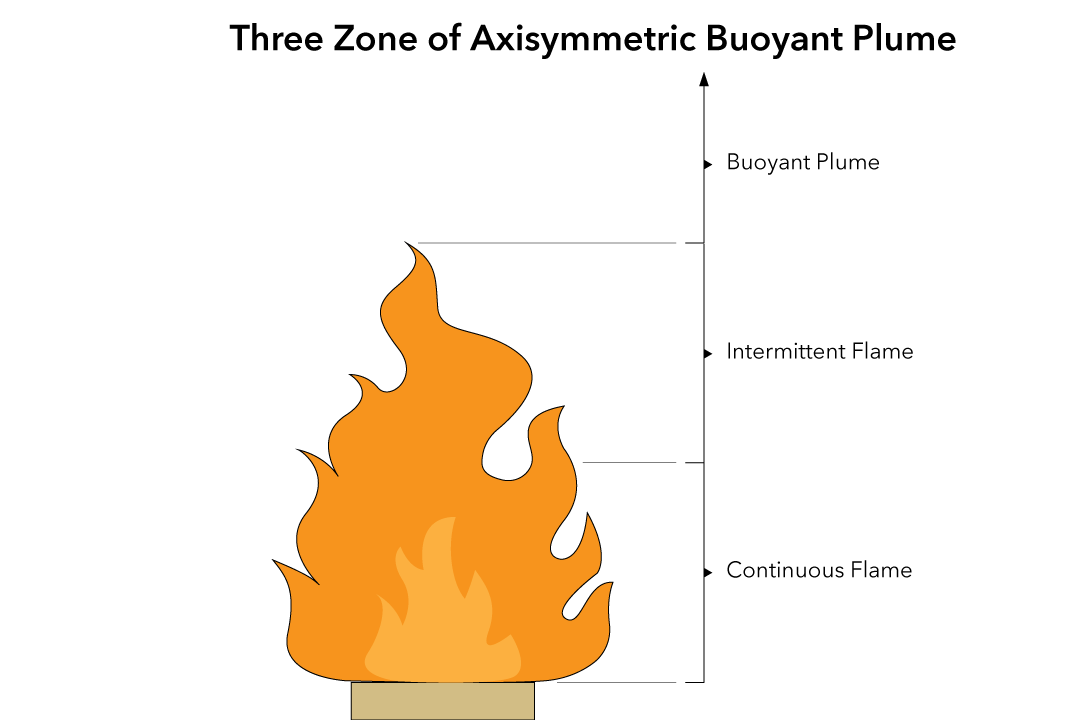
Image - Axisymmetric Plume
Plume Velocity
We can measure smoke velocity at different heights along the centerline of the plume. The velocity in each zone can be calculated as follows:
Flame:
z/Q̇2/5 < 0.08 u0 = 6.8z1/2
Intermittent:
0.08 < z/Q̇2/5 < 0.2 u0 = 1.9Q̇1/5
Plume:
z/Q̇2/5 > 0.2 u0 = 1.1z-1/3Q̇1/3
Plume Temperature
The temperature of smoke along the centerline changes with increasing height. We can divide these changes into 3 zones:
Flame:
z/Q̇2/5 < 0.08 ∆T0 = 2.91T∞
Intermittent:
0.08 < z/Q̇2/5 < 0.2 ∆T0 = 0.227(Q̇2/5/z) T∞
Plume:
z/Q̇2/5 > 0.2 ∆T0 = 0.076T∞ (Q̇2/5/z)5/3
Ceiling Jet
When smoke hits the ceiling, it flows radially outward. This flow under the ceiling is called a Ceiling Jet. The temperature and velocity of the ceiling jet directly affect the response time of fire detection devices (such as Sprinklers, Heat Detectors, Smoke Detectors).
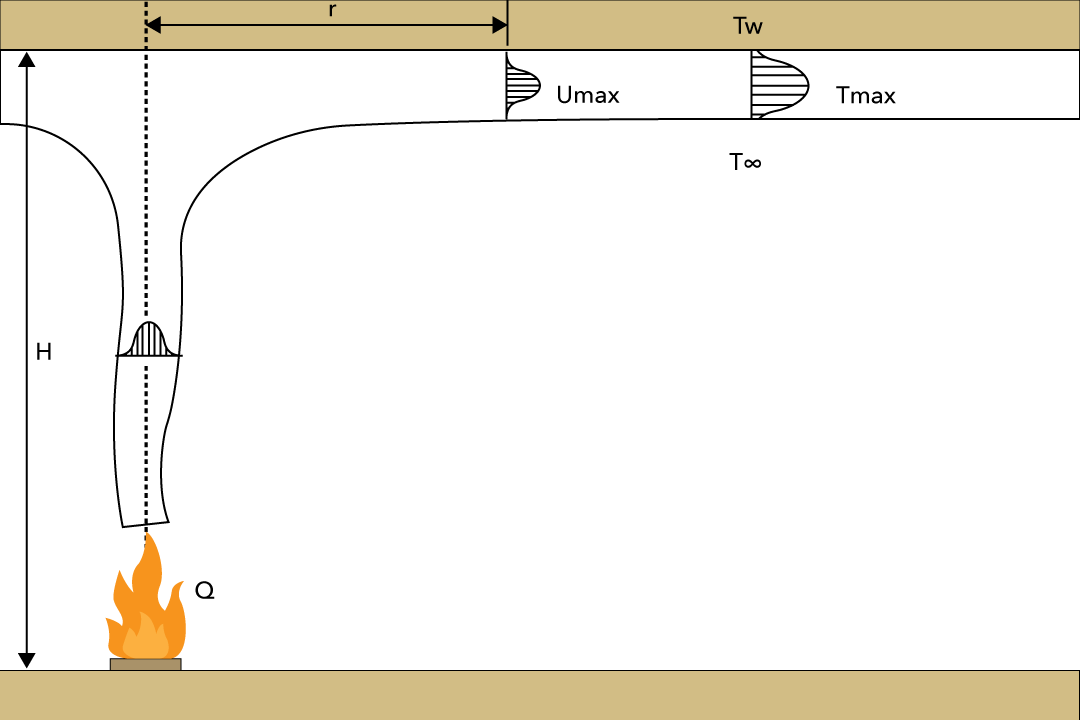
Image - Ceiling Jet Flow
The ceiling jet flow can be classified into 2 types, depending on the ratio of beam depth (hb) and beam spacing (W) to the height from fuel surface to ceiling (H):
Unconfined Ceiling jet: hb/H < 0.126(H/W)1/3 and W/H > 1.2
Confined Ceiling jet: hb/H > 0.126(H/W)1/3 and 0.4 < W/H > 1.2
Unconfined Ceiling
Temperature of ceiling jet at distance R
R/H < 0.18 ∆TCJ = 16.9 Q̇2/3 /H5/3
R/H > 0.18 ∆TCJ = 5.38 (Q̇/R)2/3 /H
∆TCJ is the temperature difference of the Ceiling Jet
Velocity of ceiling jet at distance R
R/H < 0.18 uCJ = 0.96(Q̇/H)1/3
R/H > 0.18 uCJ = 0.195Q̇1/3H1/2 / R5/6
uCJ is the velocity of the Ceiling Jet
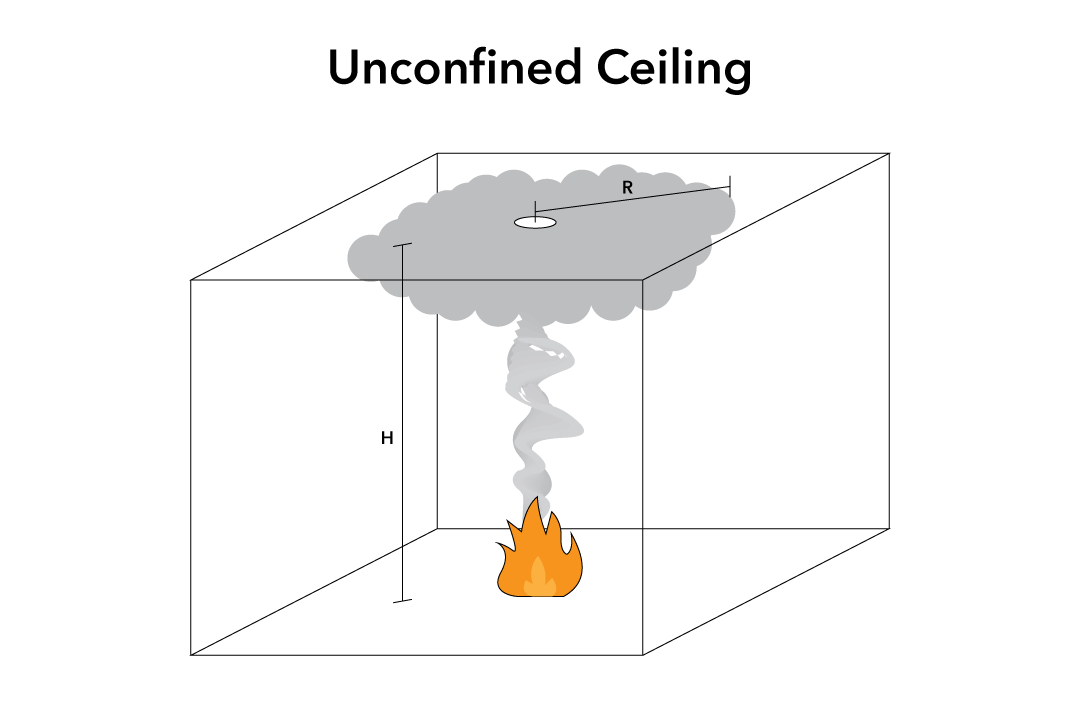
Unconfined Ceiling
Confined Ceiling
Temperature of ceiling jet at distance L (L>W/2)
∆TCJ/∆T0 = 0.37(H/W)1/3 exp[ -0.16(L/H)(W/H)1/3 ] Velocity of ceiling jet at distance L (L>W/2)
uCJ/u0 = 0.27/(W/H)1/3
When L < W/2, the velocity and temperature of the smoke can be calculated using unconfined ceiling jet equations
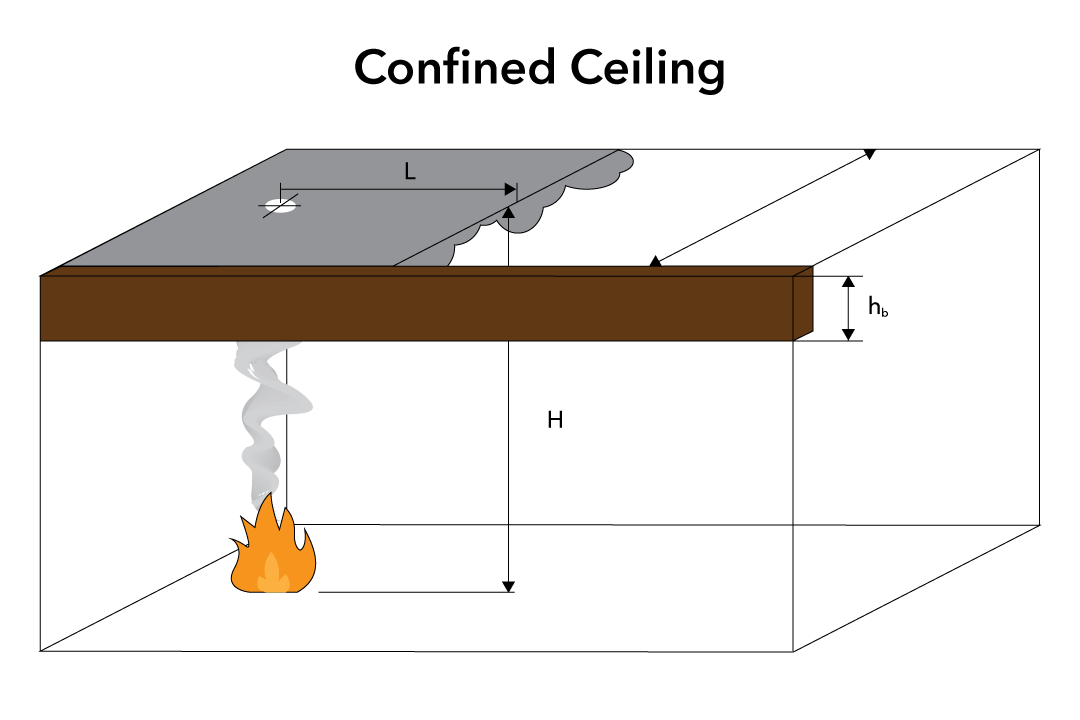
Confined Ceiling
Example 2
A fire occurs in a room with a height of 3 meters from the fuel surface to the ceiling. If the fire releases a constant energy of 1,000 kW and the air temperature is 25ºC, answer the following questions:
- At 3 meters above the fire, which zone of the Fire Plume is it in?
- Calculate the temperature and vertical velocity at 3 meters above the fire.
- Calculate the temperature and velocity of the Ceiling Jet at a radial distance of 2 meters if the smoke flow is:
-
- Unconfined Ceiling
- Confined Ceiling (W = 1.5 m)
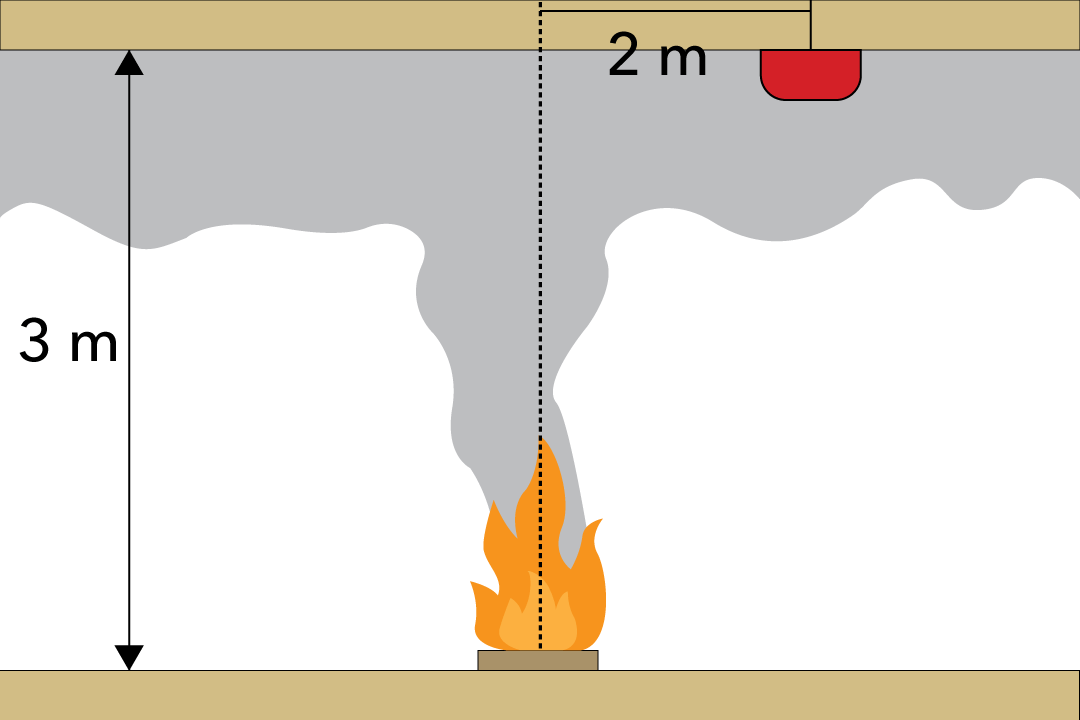
Image - Illustration for Example 2
Given:
Q̇ = 1,000 kW, z = 3 m, T∞ = 25ºC = 25 + 273 = 298K
Calculate z/Q 2/5 to determine which zone the plume is in at 3 m height
z/Q2/5 = 3/(1000)2/5 = 0.19
Since 0.08 < z/Q 2/5 = 0.19 < 0.20, therefore at 3 m height, the plume is in the Intermittent Flame zone. We can calculate the temperature and velocity of the plume at 3 m using the equation:
0.08 < z/Q2/5 < 0.20
u0 = 1.9Q̇1/5 = 1.9(1,000)1/5 = 7.56 m/s
∆T0 = 0.227(Q̇2/5/z) T∞ = 0.227(1/0.19)298 = 357 K
Therefore, the plume temperature will be T0 – T∞ = T0 – 298 = 357 or T0 = 655K = 382 ºC
The calculations show that at 3 meters height, the plume is in the Intermittent Flame zone, with a vertical velocity of 7.56 m/s and a temperature of 382 ºC
Smoke can flow freely under the ceiling. We can calculate the temperature and velocity of the ceiling jet. From the problem, we know R = 2 m and H (room height) = 3 m, therefore R/H = 2/3 = 0.67 > 0.18. Thus, the ceiling jet temperature will be:
∆TCJ = 5.38 (1000/2)2/3/3 = 112.97
∆TCJ = 112.97 K or TCJ = 410.97 K = 137.97ºC
Ceiling jet velocity at R/H = 0.67 > 0.18
uCJ = 0.195Q̇1/3H1/2 / R5/6 = 0.195(1000)1/3(3)1/2 /(3)5/6 = 1.89
The ceiling jet velocity at 2 m is 1.89 m/s
For the unconfined ceiling jet at a radius of 2 m from the plume centerline, the temperature is 137.45ºC and the velocity is 1.89 m/s
For smoke flowing under the ceiling between beams with W = 1.5 m at distance L = 2 m, we can calculate the smoke temperature using:
∆TCJ/∆T0 = 0.37(H/W)1/3 exp[ -0.16(L/H)(W/H)1/3 ]
= 0.37(3/1.5)1/3 exp[ -0.16(2/3)(1.5/3)1/3 ]
= 0.428
u CJ / u 0 = 7.56 Therefore: uCJ = 0.34(7.56) = 2.57 m/s
In part 2, for smoke flowing between beams with W = 1.5 m at L = 2 m, the temperature is 178 ºC and velocity is 2.57 m/s
This example demonstrates that the temperature and velocity of ceiling jet flow in confined spaces are higher than in unconfined spaces. This is because the energy from combustion in confined spaces is channeled in one direction, resulting in higher temperature and velocity compared to smoke that can spread freely under the ceiling.


